

The 2025 Typed Python Survey, conducted by contributors from JetBrains, Meta, and the broader Python typing community, provides an in-depth look at the current state of Python’s type system and developer tooling. With 1,241 responses (a 15% increase from last year), the survey captures the evolving sentiment, challenges, and opportunities around Python typing in the open-source ecosystem. This blog covers a summary of the key findings and trends from this year’s results.
Who Responded?
The survey was initially distributed on official social media accounts by the survey creators and later shared organically across various platforms including Reddit, email newsletters, Mastodon, LinkedIn, Discord, and Twitter. When respondents were asked where they heard about the survey, Reddit emerged as the most effective channel, although significant engagement also came from email newsletters and Mastodon, reflecting the diverse spaces where Python developers connect and share knowledge.
The respondent pool was predominantly composed of developers experienced with Python and typing. Nearly half reported over a decade of Python experience, and another third had between five and 10 years. While there was representation from newcomers, the majority of participants brought substantial expertise to their responses. Experience with type hints was similarly robust, with most respondents having used them for several years and only a small minority indicating no experience with typing.
Typing Adoption and Attitudes
The survey results reveal that Python’s type hinting system has become a core part of development for most engineers. An impressive 86% of respondents report that they “always” or “often” use type hints in their Python code, consistent with last year’s Typed Python survey.
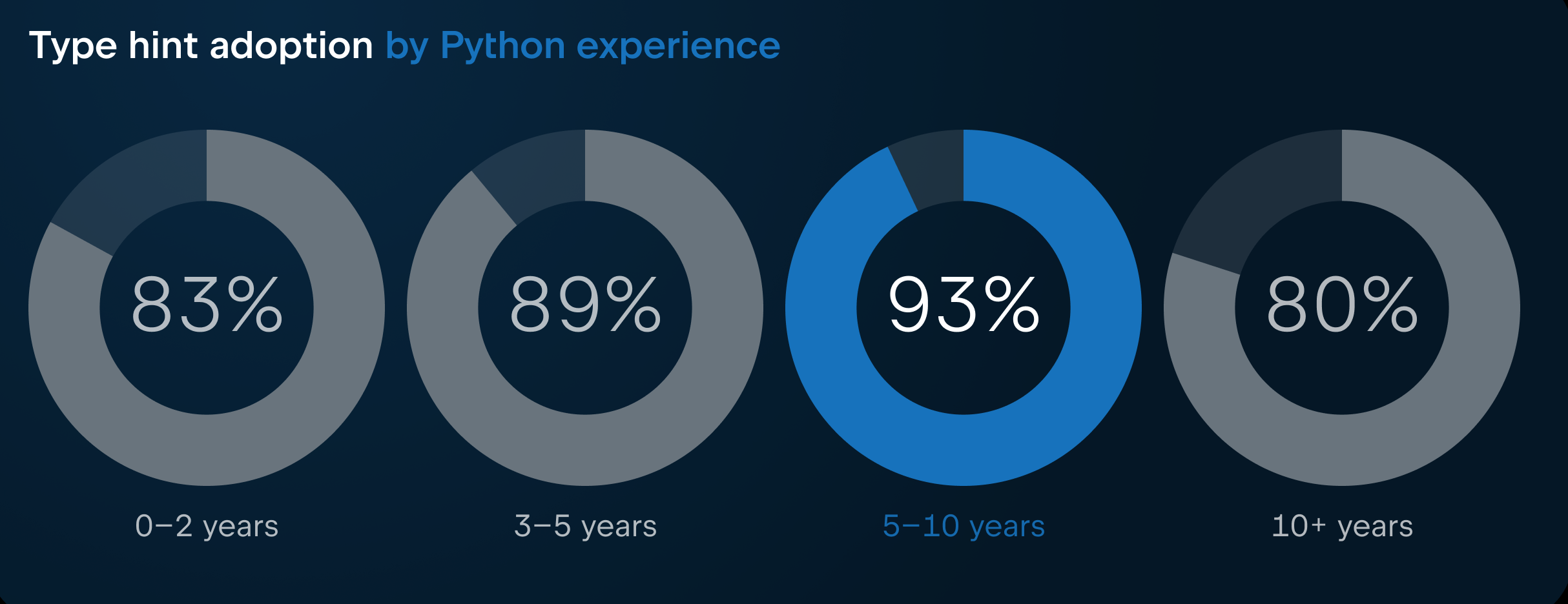
For the first time this year the survey also asked participants to indicate their years of experience with Python and Python typing. We found that adoption of typing is similar across all experience levels, but there are some interesting nuances:
- Developers with 5–10 years of Python experience are the most enthusiastic adopters, with 93% reporting regularly using type hints.
- Among the most junior developers (0–2 years of experience), adoption is slightly lower at 83%. Possible reasons could be the learning curve for newcomers (repeatedly mentioned in later survey questions).
- For senior developers (10+ years of experience), adoption was the lowest of all cohorts, with only 80% reporting using them always or often. Reasons for this drop are unclear; it could reflect more experienced Python developers having gotten used to writing Python without type hints before they were supported, or possibly they are more likely to work on larger or legacy codebases that are challenging to migrate.