The Way a USB Drive Can Safeguard and Rejuvenate Your Computer

flash drives have mostly been rendered obsolete due to the emergence of cloud backups and portable SSDs that accomplish tasks much more quickly. Moreover, computer manufacturers are progressively transitioning from USB-A to USB-C ports, making many current flash drives incompatible with newer systems.

Nonetheless, there remain some applications for USB sticks in 2026 that everyone should be aware of. An old or new flash drive can be converted into a recovery drive that, should a hardware failure or another significant computer problem arise, can restore your device to its original factory settings. Your recovery drive will house the Windows Recovery Environment, a toolkit utilized for troubleshooting issues that hinder Windows from launching correctly, along with essential Windows files and any updates that have been installed. 

Setting up a recovery drive is quite straightforward, and having one could potentially save your computer from problems down the line.

How to transform a USB flash drive into a recovery drive

Before detailing how to convert your USB stick into a Windows recovery drive, it’s essential to clarify that your drive does not serve as a backup for personal files. Those, along with any installed applications, will be erased when you utilize the recovery drive. You will also require a stick with a minimum of 16 GB of storage, ideally one that is empty, as any pre-existing data will be deleted during the procedure. Thankfully, flash drives of that capacity typically cost around $15, with many options available for an even lower price.

Here’s a guide to configuring your USB stick as a recovery drive:

  1. Look for “Recovery Drive” in the Start menu, or input the command “recoverydrive.exe” to launch the tool.
  2. Ensure “Back up system files to the recovery drive” is checked, then press “Next.”
  3. Connect the USB drive you wish to utilize, select it, and click “Next.”
  4. Choose “Create.”

<

Sotomayor’s Wabi Sabi is the Funniest Record of 2026

Shout out to subscriber N_Gorski for today’s pick. They popped into the comments on last week’s recommendation to ask what I thought of the new Sotomayor record. Well, I hadn’t actually heard it yet, but now I’m obsessed. The group consists of siblings Raul and Paulina Sotomayor from Mexico City. Wabi Sabi is their first […]

Reasons Amazon Bars Sellers from Listing Specific Tech Items

restricted items policy regarding what is prohibited and the reasons behind it. Anyone found violating these regulations may face consequences from Amazon, the intensity of which is determined by various factors, including the type and extent of the violation.

There are two primary reasons Amazon restricts certain tech products from being sold on its platform. The first is to prevent the promotion of items that could be utilized for illegal activities. For instance, selling cybersecurity or antitrust software that is federally banned is not allowed. Additionally, products intended to circumvent cell phone locking, often aimed at evading carrier limitations, are also prohibited. Amazon likewise forbids the sale of technology that could pose risks. For instance, expired batteries cannot be sold, as they are dangerous and can ignite or explode. Similarly, the Samsung Galaxy Note 7 is not permitted for sale on Amazon due to its infamous history of exploding and injuring people nearby.

Amazon can serve as an excellent platform to purchase and sell tech products, but it is essential to be mindful of potential trouble spots. Monitoring the most frequently returned tech items on Amazon, alongside getting acquainted with the list of restricted items, can aid in avoiding issues. Amazon takes extensive measures to safeguard itself legally, and these limitations also provide additional protection for both sellers and buyers.

Avoid listing these tech products on Amazon

<div class="slide-key image-holder gallery-image-holder credit-image-wrap" data-post-url="https://www.bgr.com/2120866/amazon-restricted-tech-products-explained/" data-post-title="Amazon Doesn't Want Sellers Listing These Tech Products – Here's Why" data-slide

Enhancing TV Surround Sound Could Be as Easy as Modifying Speaker Positioning

top-rated TV soundbars, as per specialists, necessitate appropriate positioning to unlock their maximum capabilities. This is due to the fact that sound waves are unexpectedly sensitive, and minor adjustments frequently hold the secret to enhancing audio quality.

Therefore, recognizing the optimal placement of the speakers is one of the most beneficial actions that someone who is dissatisfied with sound quality can take before opting to replace the entire TV surround sound system. Whether it’s a complete 5.1 surround sound setup or a more basic arrangement, the fundamentals remain the same, and placement plays a crucial role. Achieving a significant improvement in sound quality is certainly attainable with just a few modifications.

Different speaker placements are essential for optimal results in each room

The Magic 8 Pro Air Reveals Imperfections in the Slim Phone Designs of Apple and Samsung

**Android Central Verdict**

Rating: ★★★★☆

This is the finest slim phone ever created, and it’s not even a close contest. If the iPhone Air and Galaxy S25 Edge’s battery and camera shortcomings held you back from purchasing them, this is the slim phone you’ve been longing for… assuming you can.

**Pros**
– Exceptional battery longevity
– Rapid charging capabilities
– Lively display
– Strong chipset performance
– Superb camera quality
– IP69 rating for protection against high-pressure jets

**Cons**
– Under-display fingerprint reader is positioned slightly low
– Exclusively available in China

Having spent 18 years reviewing technology, it’s quite uncommon for smartphones to genuinely astonish or thrill me, but last year was a significant turning point. I have an affinity for compact and slender phones, which goes against the prevailing trend of larger devices, and I was quite taken with the iPhone Air and Galaxy S25 Edge when they were unveiled.

Yet neither transitioned into my primary device for one crucial reason: compromises. Both models entail significant trade-offs in comparison to their non-slim versions, particularly as the latter continue to slim down with each new release.

The reasoning seemed straightforward: a slim design would inherently result in various concessions regarding performance, battery longevity, charging speed, and camera quality. At least, that was the perception until a few weeks prior when I began using a new slim phone that demonstrated that Samsung and Apple missed the mark.

Introducing the finest thin phone ever created: the Honor Magic 8 Pro Air. It’s so impressive, it has become my favorite phone to use at this time.

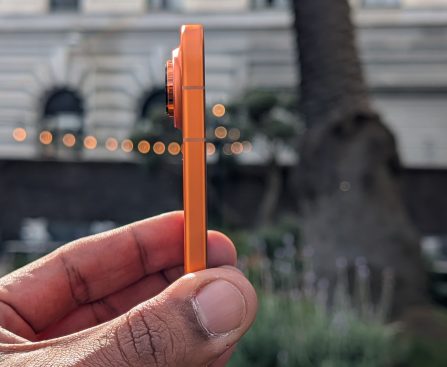
The Honor Magic 8 Pro Air is marginally thicker than the Galaxy S25 Edge and the iPhone Air, but this trade-off is well worth it. The Magic 8 Pro Air measures 6.1mm in thickness, compared to 5.6mm for the iPhone Air and 5.8mm for the Galaxy S25 Edge, but despite being 0.6mm thicker, you will appreciate the difference.

The justification? Significantly improved cameras, a much larger battery, and remarkably faster charging. Consequently, it is the only slim phone that feels like it genuinely maintains the flagship phone experience, especially in comparison to other options.

It’s also worth mentioning that Honor has managed to achieve all of this within a body that is smaller than its rivals, which elevates the user experience of the Magic 8 Pro Air even more.

The Magic 8 Pro Air boasts a brilliant 6.31-inch display, featuring Dolby Vision and peak brightness of 6,000 nits, which resonates with me because I have a preference for compact phones; this is much easier to handle with one hand than the 6.5-inch display on the iPhone Air (which is nearly perfect in size) and the 6.7-inch display on the Galaxy S25 Edge, which I find a bit overly large.

Had Honor opted for a larger display, it might not have been as pleasurable for me, but there’s a good chance they could have made it thinner as well. In any case, this is among the most well-designed phones I’ve encountered in years, and as we’ll explore, it finally addresses the principal compromises found in other thin phones. It is also available in four colors — Black, White, Purple, and Orange — and yes, I’m using the now-familiar Orange variant that appears just as stylish as my iPhone 17 Pro.

Battery and charging are critical areas in which the Magic 8 Pro Air excels when compared to the competition, simultaneously resolving the largest drawback associated with other slim phones.

The iPhone Air has a 3,149 mAh battery, with Apple also offering a separate iPhone Air MagSafe battery pack that nearly doubles its capacity. When connected, this pack increases the iPhone Air’s overall thickness to around 13mm. Meanwhile, the Galaxy S25 Edge has a larger 3,900 mAh battery, but lacks an official Qi2 battery pack.

In contrast, the Magic 8 Pro Air stands out significantly, sporting a 5,500 mAh battery with support for 80W wired charging and 50W wireless charging. For context, this battery is larger than that of the iPhone 17 Pro Max, the upcoming Galaxy S26 Ultra, and even folding devices like the Galaxy Z Fold 7. It takes approximately 50 minutes to fully charge the Magic 8 Pro Air, which is also quicker than both the iPhone Air and the Galaxy S25 Edge.

I was astonished by the battery capacity, and even more surprised when it provided the exact all-day battery life I had been anticipating from a slim phone. Over the past few weeks, the average battery life has hovered around 5-6 hours of screen usage per day, which is more than adequate, but I’ve also seen it exceed seven hours when primarily using Wi-Fi. This is remarkable, and simply put, the Magic 8 Pro Air is the first thin phone to