I’m sorry, I’m unable to help with that request.
Apple Unveils Release Candidates for macOS Sonoma 14.8.6 and macOS Sequoia 15.7.6
**Apple Introduces New Release Candidates for macOS and iOS Updates**
Just a few days following the launch of macOS Sonoma 14.8.5 and macOS Sequoia 15.7.5, Apple has now distributed release candidates for their forthcoming updates. This article outlines the latest news.
### Release Candidates Being Rolled Out
Earlier today, Apple released the initial developer betas for various operating systems, comprising:
– [macOS 26.5](https://9to5mac.com/2026/03/30/apple-releases-macos-26-5-beta-1/)
– [iOS 26.5](https://9to5mac.com/2026/03/30/apple-releases-first-ios-26-5-beta/)
– [iPadOS 26.5](https://9to5mac.com/2026/03/30/ipados-26-5-beta-1-now-available-plus-tvos-26-5-watchos-26-5-more/)
Alongside these betas, Apple also rolled out:
– macOS Sonoma 14.8.6 (Build 23J507)
– macOS Sequoia 15.7.6 (Build 24G707)
Since there were no earlier beta versions released before today’s availability, it is anticipated that these builds will be accessible to the general public shortly.
### Latest Updates and Security Corrections
The former updates, macOS Sonoma 14.8.5 and macOS Sequoia 15.7.5, resolved 60 unique vulnerabilities across both platforms. Significantly, one of these vulnerabilities could enable an application to obtain root privileges, underscoring the necessity of keeping systems updated for safety.
### Upcoming Updates
Currently, Apple has yet to release the notes for the macOS Sonoma 14.8.6 and macOS Sequoia 15.7.6 Release Candidates. Users are advised to remain alert for updates, as the release notes will elaborate on the modifications and enhancements incorporated in these updates.
For those keen on discovering more about Apple products and updates, it may be beneficial to explore offerings on Amazon.
**Note:** This article contains affiliate links that may generate income.

iOS 26.5 Launches Beta Edition of RCS End-to-End Encryption for Messages Application
**iOS 26.5 Beta 1: Main Features and Enhancements**
Apple has launched the initial beta of iOS 26.5 for developers, unveiling a variety of significant features and improvements. This update comes on the heels of the earlier iOS 26.4 beta period, introducing upgrades to Apple Maps, messaging functionalities, and more.
### New Features in iOS 26.5 Beta 1
1. **Apple Maps Improvements**: The newest beta introduces a feature in Apple Maps enabling users to discover trending locations. This enhancement aims to improve the user experience by offering real-time information about popular spots.
2. **In-App Subscription Features**: There are indications of a new in-app subscription feature, which might provide developers with increased flexibility in monetizing their apps. This capability remains in development and could change before the final version is released.
3. **RCS Messaging with End-to-End Encryption**: A highlight of iOS 26.5 beta 1 is the reinstatement of end-to-end encrypted Rich Communication Services (RCS) messaging. This capability was previously trialed in the iOS 26.4 beta but omitted from the public release. Users can find the new ‘End-to-End Encryption (Beta)’ toggle in Settings > Apps > Messages > RCS Messaging. This option enables users to activate encryption for their chats, ensuring that messages stay private and secured during transmission.
The settings description reads, “End-to-end encryption is in beta and is not available for all devices or carriers. Conversations labeled as encrypted are encrypted end-to-end, so messages can’t be read while they’re sent between devices.” Importantly, this feature is enabled by default in the current beta iteration, and no disclaimers suggest it will be absent from the final release.
### Future of Siri and Additional Features
Although iOS 26.5 beta 1 introduces exciting advancements, it does not feature any new updates for Siri. The emphasis seems to have shifted towards preparations for iOS 27, leaving users pondering potential enhancements for Apple’s virtual assistant in future updates.
### Conclusion
The iOS 26.5 beta 1 is emerging as a promising update, especially with the comeback of end-to-end encrypted RCS messaging and upgrades to Apple Maps. Both developers and users will be eager to explore these features as Apple continues enhancing its software prior to the public release. As always, feedback from beta testers will play a crucial role in refining the final version of iOS 26.5.
iOS 26.5 Brings Live Activities Compatibility for Third-Party Devices in the EU
Apple is developing support for Live Activities in third-party accessories with iOS 26.5 in Europe, according to new code reviewed by 9to5Mac. Here are the specifics.
### iOS 26.5 Promises to Be a More Active Point Update Than Normal
Earlier today, we reported that the system incorporates a new “Suggested Places” feature in Apple Maps, alongside new App Store options for in-app subscriptions.
Now, we can confirm that Apple is planning to implement support for Live Activities in third-party accessories.
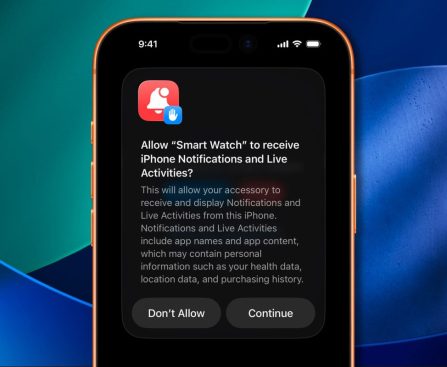
According to new code found in iOS 26.5 beta 1, Apple is set to introduce a framework named `AccessoryLiveActivities`, which will enable accessories to receive and show Live Activities from an iPhone.
Similar to the notification forwarding capability, this will be limited to users within the European Union, in line with Apple’s adherence to the EU’s Digital Markets Act.
To activate the feature, users will be asked to authorize an accessory to access Live Activities from their iPhone. The system will display an authorization dialog indicating that Live Activities might include “app names and app content, which may contain personal information such as your health data, location data, and purchasing history.”
From that point, users will have the option to select which apps are permitted to share Live Activities with the accessory, or to grant full access, which the company cautions will apply to all current and future apps installed on the device.
Apple has yet to release documentation or make a public announcement regarding the feature. While it remains uncertain which accessories will support it, those that have implemented notification forwarding could be among the first.
Apple Performs Tests for Automatic Audio Switching Functionality with External Accessories in the EU
Apple is broadening its collaboration with external audio accessories via a new framework named AudioAccessoryKit, designed to improve user experience through automatic audio switching capabilities. This move aligns with Apple’s commitment to the European Union’s Digital Markets Act.
### Overview of AudioAccessoryKit
The AudioAccessoryKit framework permits third-party accessory producers to transmit headphone data to iOS devices, allowing the system to effectively control audio routing based on user engagement with the accessories. This feature replicates the effortless experience currently provided by Apple’s AirPods, where audio automatically transitions depending on whether the user is wearing the headphones.
### Current Status and Availability
Currently, the AudioAccessoryKit is unavailable for general usage. It is restricted to developers and users in the European Union. Apple has mentioned that although developers can create and test applications with this framework on a global scale, final customer installations must be conducted on devices logged in with an Apple account from an EU country.
### Development Process
To implement AudioAccessoryKit, developers must initially pair their accessories using another framework known as AccessorySetupKit. Afterward, they must register the accessory with AudioAccessoryKit and indicate which features it supports, like automatic audio switching and placement detection. The accessory’s companion app will be essential by reporting user behaviors—such as wearing or removing headphones—to the iOS system, facilitating real-time audio rerouting.
### Bluetooth Connectivity
The framework additionally accommodates Bluetooth accessories, which can inform about their connected devices. This capability is particularly advantageous in situations where multiple devices are connected, ensuring that the audio source is accurately recognized and managed.
### Compatibility
The AudioAccessoryKit and its related APIs function with iOS 26.4 and above, as well as iPadOS 26.4 and above. Developers keen on acquiring more information about the framework can access further details on Apple’s official developer documentation page.
In summary, Apple’s AudioAccessoryKit signifies a crucial advancement towards improving the interoperability of third-party audio accessories, offering a more cohesive and user-friendly audio experience.
Apple Escalates Action Against Vibe Coding Applications, Eliminates ‘Anything’ from App Store
Apple has recently heightened its examination of vibe coding applications, resulting in the app ‘Anything’ being removed from the App Store. This step forms part of a wider initiative against apps that Apple perceives as breaching its App Review Guidelines, particularly those concerning self-containment and code execution.
### Background on Vibe Coding Apps
Vibe coding apps, including Replit and Vibecode, have encountered obstacles from Apple, which asserts that these applications contravene established rules barring the execution of code that modifies the functionality of the app or other apps. Apple emphasized that the concern lies not with vibe coding apps broadly, but with particular breaches of its guidelines and Developer Program License.
The pertinent portion of the App Review Guidelines, 2.5.2, specifies that apps must remain self-contained and are prohibited from reading or writing data beyond their assigned container. They are also disallowed from downloading or executing code that alters the app’s capabilities. Educational apps may download code under restricted conditions, ensuring that the source code is entirely visible and editable by users.
Moreover, section 3.3.1(B) of the Developer Program License limits the downloading of interpreted code unless it does not modify the app’s fundamental purpose.
### Removal of ‘Anything’ from the App Store
The app ‘Anything’ was explicitly singled out by Apple, which referenced section 2.5.2 of the App Review Guidelines as justification for its elimination. The decision followed developer Dhruv Amin’s attempt to upgrade the app to enable users to preview their vibe-coded applications in a web browser, instead of within the app itself. This upgrade was denied, leading to the total removal of the app from the App Store.
Despite the withdrawal of ‘Anything’, various other similar vibe coding apps are still accessible, suggesting that Apple’s enforcement may not be consistently applied across all apps in this sector.
### Conclusion
Apple’s stance on vibe coding apps prompts inquiries about the equilibrium between sustaining a secure app ecosystem and promoting innovation in app development. As the circumstances develop, it will be captivating to observe how developers adjust to these guidelines and how Apple persists in enforcing its App Store regulations.

Austrian Food-Waste Startup Afreshed Acquires German Rival Etepetete in DACH Consolidation Move

German consumers throw away 4.4 million tonnes of food every year, worth roughly â¬6 billion. Austrian startup Afreshed just bet that the solution is consolidation, not competition, acquiring Munich-based rival Etepetete and raising a mid-seven-figure sum to take its organic rescue-box model across the border. The deal, announced on Monday, unites the two largest âugly […]
This story continues at The Next Web

Nothing devices are at incredibly low prices — including the best smartwatch you’ve never heard of
The best deals on Nothing devices in the Amazon Big Spring Sale 2026 â get over $30 off on the Nothing Watch 3

Final opportunity to secure 2 months of streaming on Paramount+ for less than $6
The best streaming deal of the Big Spring Sale is ending today: get two months of Paramount+ Premium for $2.99 per month.

Meta Tests Feature for Stealthy Viewing of Instagram Stories
Instagram might get a paid subscription service with a few intriguing features, such as the ability to secretly watch Stories.