

NXP has announced the S32N79 “Super-Integration” automotive processor in the S32N7 series, featuring up to eight Arm Cortex-A78E application cores and twelve Arm Cortex-R52 cores for real-time processing.
This follows the 5 nm S32N55 16-core Cortex-R52 + 2x Lockstep Cortex-M7 automotive processor. The S32N79 is designed for software-defined vehicles (SDV) and adds Cortex-A78E application cores for ADAS sensor fusion, data AI services, and enhanced vehicle gateway/processing functions.
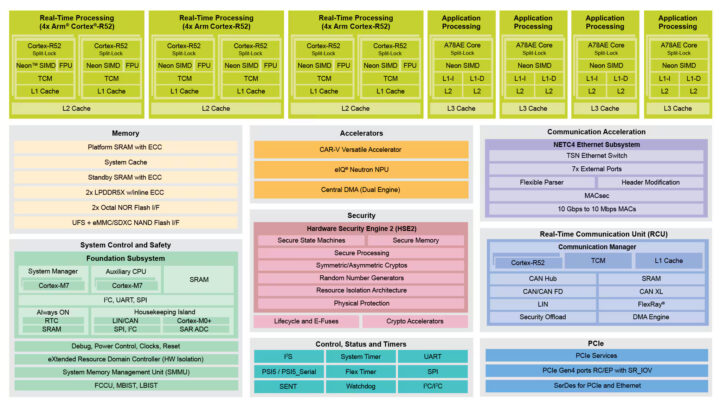
NXP S32N79 key features and specifications:
- CPU
- Up to 8x split-lock Arm Cortex-A78AE cores up to 1.8 GHz
Up to 12x split-lock Arm Cortex-R52 cores up to 1.4 GHz - RISC-V-based accelerator for networking, math, and data-intensive workloads
- Up to 8x split-lock Arm Cortex-A78AE cores up to 1.8 GHz
- AI accelerator – eIQ Neutron NPU for vehicle core NeuroNetwork offload
- Memory
- Up to 2x LPDDR4X/5/5X DRAM interfaces
- Up to 36 MB platform SRAM
- Storage
- 2x channel NVM interface for serial, quad, and octal NOR memory
- UFS 3.1 interface
- eMMC 5.1 NAND flash and SD Card/SDIO flash support
- Communication and Networking
- Independent communication subsystem for low-speed interfaces
- CAN Hub to virtualize CAN I/O, enabling shared CAN I/O pins and routing
- Multiple CAN FD, CAN XL, LIN, and FlexRay interfaces
- Integrated 10 Mbps to 10 Gbps TSN Ethernet switch
- Per-port In-line encryption with MACsec acceleration
- PCI Express Gen 4 (Root Complex)
- PCle engine for multiple services, including NTB
- Application Integration
- Full on-chip hardware isolation and virtualization for mixed-criticality applications
- Core-to-pin virtual hardware isolation for interference freedom
- Functional Safety
- Arm Cortex-M7-based independent system manager for SOC functional safety
- Hardware with freedom from interference and virtualized QoS mechanisms for shared resources
- Keeps fault impact