
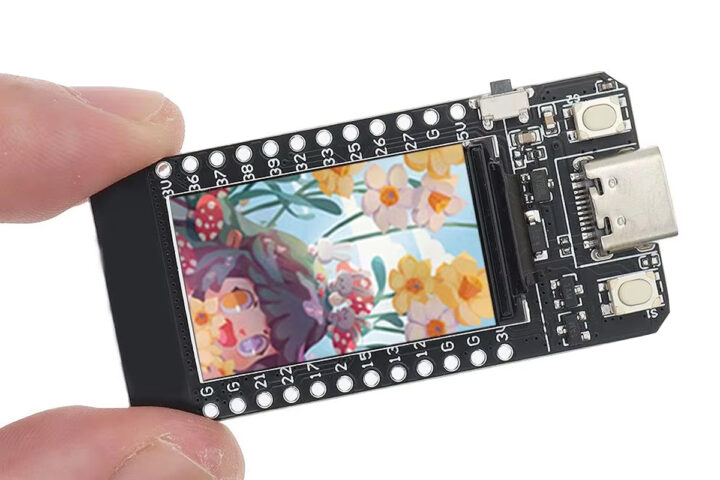

While browsing AliExpress for new products, I discovered the TENSTAR T-Display ESP32-D0WD, featuring a 1.14-inch IPS color LCD and 16MB of QSPI flash. Some use it as a tiny secondary mirrored monitor for their PC.
The board seems to be a budget-friendly alternative to the original LilyGo T-Display and includes a USB-to-TTL converter (CH9102F), a battery charging circuit, a toggle switch, and two programmable buttons, making it ideal for projects like the NerdMiner and small-scale dashboards for home automation. Despite the lack of standout hardware features, over 10,000 units have been sold. Upon investigation, the ESP32 Desktop Monitor project likely contributes to its popularity, allowing the board to function as a regular monitor with a tiny 1.14-inch LCD. More on this after the specifications.
TENSTAR T-Display Specifications:
– SoC: Espressif Systems ESP32-D0WDQ6-V3
– Dual-core Xtensa LX6 32-bit processor up to 240 MHz
– 520 KB SRAM (+ 448 KB ROM for booting/core functions)
– 2.4 GHz 802.11 b/g/n WiFi 4 and Bluetooth v4.2 + EDR
– Storage: 16 MB SPI flash
– Display: 1.14-inch 135×240 resolution color IPS LCD (ST7789V driver)
– USB: USB Type-C port for power and programming (via CH9102F)
– Expansion: 2x 12-pin headers with GPIO, SPI, I2C, UART, ADC, DAC, and Touch interfaces
– Miscellaneous:
– Reset and user buttons
– Slide switch for display/reset control
– PCB antenna
– Power:
– 5V via USB Type-C
– 3.7V Lithium battery support via 2-pin 1.25mm JST connector
– Integrated charging circuit (approx. 500mA charging current)
– Dimensions: ~51.5 x 25 x 8.5 mm
– Temperature Range: -40°C to +85°C
Built around an ESP32, the device can be easily programmed using the Arduino IDE or PlatformIO, and the 1.14-inch ST7789V SPI display is compatible with graphics libraries like TFT_eSPI and LovyanGFX. Further details can be found on the Manuals+ website.
Additionally, I encountered a Tom’s Hardware post that introduced me to the ESP32-Desktop-Monitor project on GitHub. This project enables the mirroring of your desktop screen onto a TENSTAR T-Display connected to an ESP32 over Wi-Fi. A Python script on the PC captures the screen in real time, compresses and diffs each frame to minimize bandwidth, and streams only the changed pixels to the ESP32 running Arduino firmware, which renders them on the small display. This converts the ESP32 T-Display into a low-latency desktop status/monitor viewer, likely fueling its high sales.
The T-Display series has several models, such as the LILYGO T-Display S3 Pro, T-Display S3 Pro LR1121, T-Display RP2040, and T-Display-S3-AMOLED-1.43. Competing ESP32-based display development boards include the M5Stack StickS3 and ESP32-C6-Touch-AMOLED-1.8. This variety might contribute to the initial perception that the TENSTAR T-Display ESP32 was unremarkable.
The TENSTAR T-Display ESP32-D0WD is available on AliExpress, with several listings. One listing is priced at $0.99 as part of a Valentine’s Day offer, though it might not apply to everyone. I found other listings starting at $1.82, and up to $5.99 from diverse stores. The package includes the development board, two male headers, and a JST 2-pin cable for battery connection. Similar boards are available on Amazon, though compatibility with the ESP32 Desktop Monitor project isn’t guaranteed.