
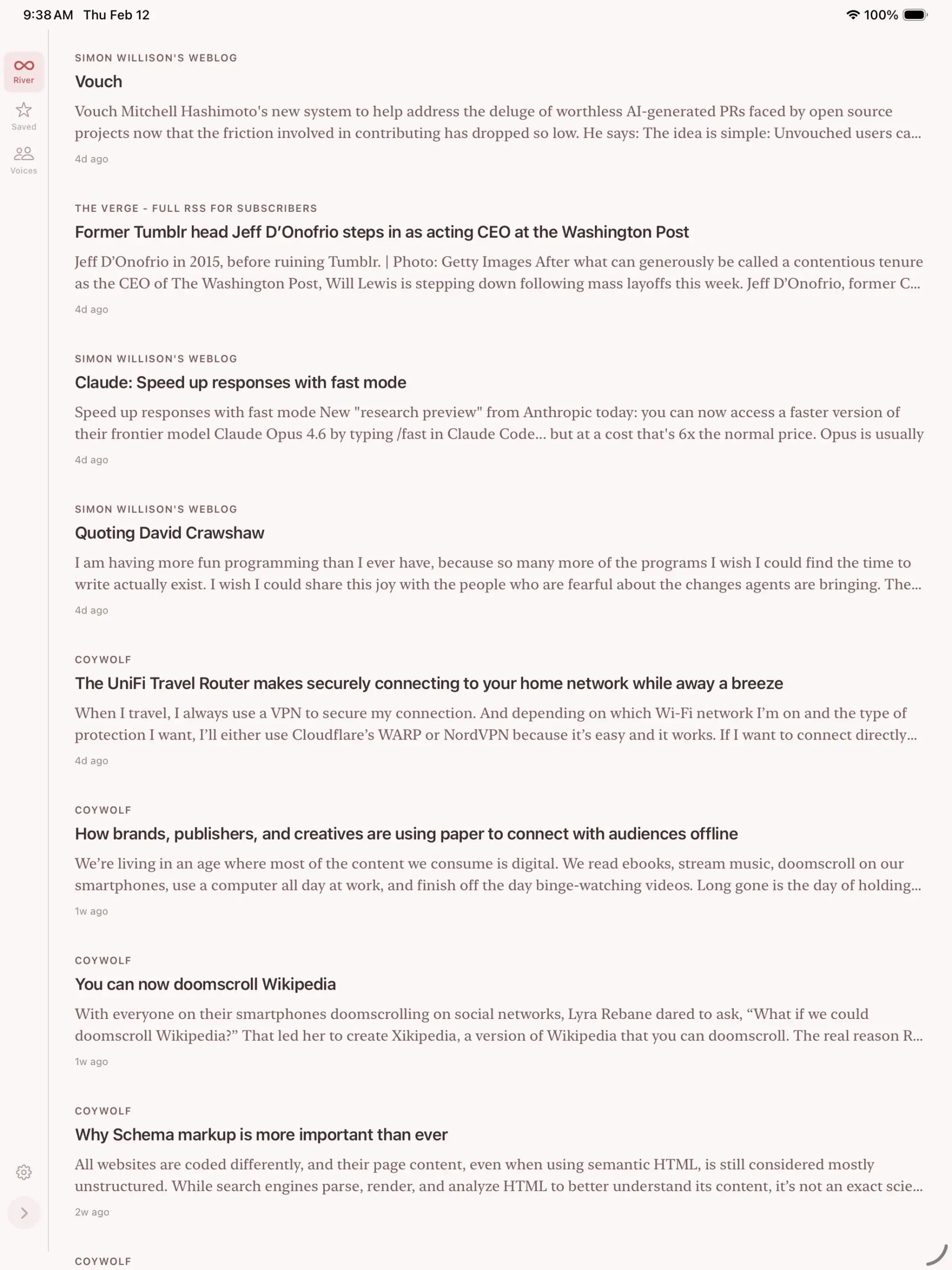

A new application named Current is transforming the concept of an RSS reader, aiming to deliver an experience akin to dipping into a stream of news rather than completing tasks. This approach seeks to make RSS feeds more welcoming for casual news consumers instead of those seeking information for work or classifying themselves as news enthusiasts.
Terry Godier, Current’s developer, observed the recurring guilt that accompanied returning to a feed reader after a brief hiatus. He believes this feeling stems from the design of many readers, which resemble email inboxes with unread counts and bolded new items.
“Email’s unread count signifies something particular: they are messages from actual individuals awaiting responses, representing a form of social obligation,” Godier expressed in a blog post about his inspiration behind developing Current during his spare time.
“But when applied to RSS, we adopted the anxiety without having the justification,” he added.
For those unfamiliar, RSS (Really Simple Syndication) is a format that structures updated website content for user access. Headlines and articles from preferred news platforms appear as unread entries in the chosen RSS reader.
RSS gained significant traction in the early 2000s but lost popularity with Twitter’s 2006 introduction, which offered an alternative for sharing real-time news and updates. With Twitter’s rise, many abandoned Google’s prominent RSS reader, Google Reader, leading to its eventual shutdown—an occurrence still lamented by users.
However, RSS remains alive, serving as the backbone for podcast distribution, and still supports web syndication via apps like Feedly, NetNewsWire, Inoreader, Reeder, among others.
Current, on the contrary, reimagines the RSS interface. It replaces list-oriented feeds with a more relaxed, river-like approach that isn’t focused on minimizing unread items.
“You aren’t merely observing content as if it’s a screensaver. Rather, the content behaves like a river: arriving, lingering briefly, and then vanishing,” writes Godier.
The speed with which content fades varies: breaking news remains bright for three hours, daily news stays around for 18 hours, essays linger for three days, and evergreen tutorials persist for a week. By scrolling through the river, users can stay updated without the pressure of marking content as read.
Current’s setup involves selecting one of five speeds per source: Breaking, News, Article, Essay, or Tutorial. There’s no requirement to mark them manually as read—just swipe left or tap the release button to return to the river. An undo button is also available.
Current includes numerous features designed for RSS aficionados. It can extract full articles from the web, even if sites truncate feeds to drive traffic. Users can label sources as webcomics for an image-centered reading experience, temporarily mute sources, and pin significant ones to the river’s top.
Additionally, Current refines the reading experience with intelligent features: it can limit or silence sites that flood feeds and suggest removing seldom-read content or pinning frequently read feeds.
Remarkably, Current permits the following of individual writers within a space called Voices, distinguishing personal blogs or newsletters from larger publication feeds. Tapping a Voice enables a customized feed focus.
It can also allow following individual writers within larger publications if they have personal RSS feeds.
Godier is enthused about identifying news voices, having created Byline, a specification enriching author context in RSS, Atom, and JSON feeds.
Besides Voices, there are two additional built-in categories, termed “currents”: the “River” for the main feed and “Read Later.” Users can create custom currents like “tech” or “design” or wait for app suggestions derived from reading habits.
Overall, the app’s nuanced design features like font choices, gestures, and themes cultivate a less stressful reading environment—appreciated even by news enthusiasts.
Current is available for a one-time purchase of $9.99 on Apple’s App Store for iOS, iPad, and Mac, supporting iCloud Sync and OPML import. There are no additional in-app purchases or subscriptions. A web version is planned for future release.