

For years, mobile gaming has been synonymous with app stores, where developers dedicate immense time to create games, only to give up a sizable portion—up to 30%—of their revenue to giants like Apple and Google. Now, a new player seeks to change this model.
Introducing Jest, a marketplace for messaging games, which has raised $7 million in seed funding as it emerges from stealth mode. Jest envisions the future of mobile gaming distribution not through app stores but within messaging apps.
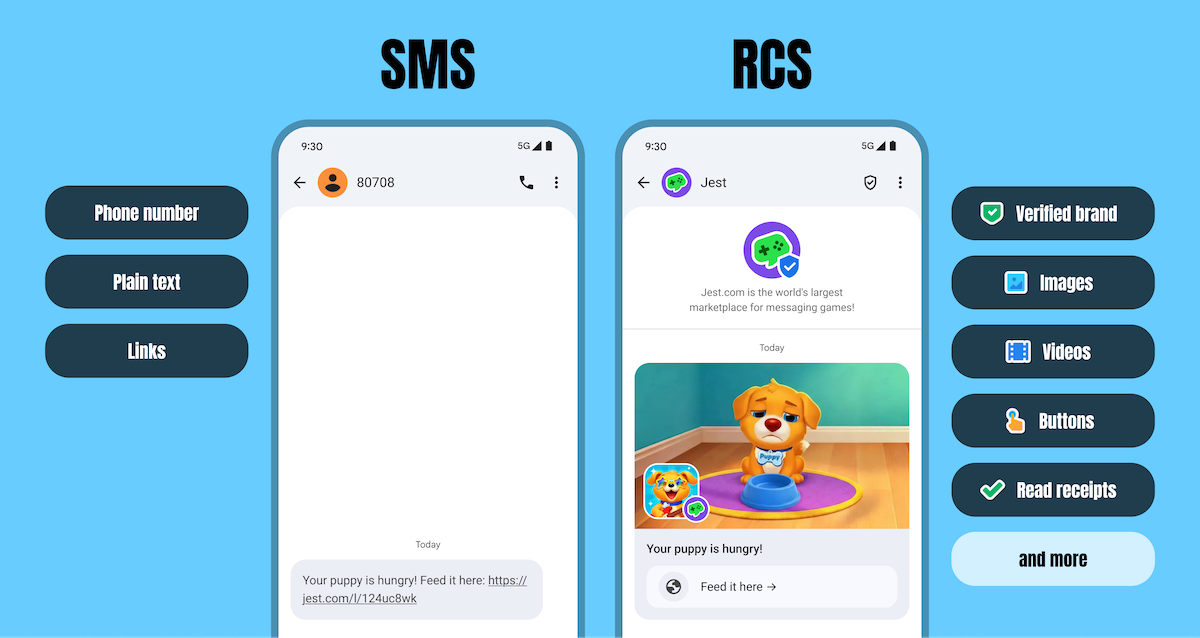
Jest’s launch aligns with the growth of Rich Communication Services (RCS), an upgraded version of SMS that offers engaging experiences with rich media, interactive features, and integrated payments.
With the rise of RCS, the landscape is evolving. In 2024, Apple embraced RCS with iOS 18, and by May 2025, RCS supported over a billion daily messages in the U.S., as per Google.
“Mobile game developers have been largely confined to app store distribution as the main method to reach players,” said Deyan Vitanov, CEO and co-founder, in a TechCrunch interview. “RCS games exist in the messaging inbox, a sticky mobile surface where users already spend significant time communicating with friends and family. We’re building on a daily interaction pattern.”
Jest allows users to send games directly in chat threads without accessing an app store. (Games open in the web browser and need Wi-Fi.)
This convenience matters as consumers are downloading fewer games. In 2025, mobile games were downloaded 39.4 billion times, marking an 8.6% year-over-year drop after a 6.6% decline from 2023 to 2024, as reported by Appfigures’ annual report.
Jest’s strategy is working effectively. Four months into its beta phase, by the end of January, the platform had already achieved two key milestones: over 1 million messaging games played and more than 300,000 messages exchanged.
“We are experiencing 3-4 times better retention than traditional mobile apps. It’s a fundamental shift in engagement. Concerning user acquisition, we’ve validated that people will sign up and play games via messaging. Our partners report 30-60% lower acquisition costs compared to mobile apps. It is remarkably simple. Just tap a link, and you’re in,” shared Vitanov.
Furthermore, Jest’s marketplace offers developers a compelling revenue model: a 90/10 split, with 90% of earnings going to them. This is a stark contrast to the standard 30% commission by conventional app stores, providing a promising path for gaming studios.
“There’s a clever network effect built in. If one studio acquires a user but another monetizes them, we split the revenue: 70% to the monetizing studio, 20% to the acquiring studio, and 10% to Jest. This creates strong incentives, allowing even viral games without good monetization to generate revenue streams when those users play other games on the platform,” Vitanov added.
Jest has drawn interest from several development partners, including teams behind “Episode,” “Puppy Mansion,” and “Kingdom Maker.”
The seed funding, led by Innovation Endeavors, will be used for platform scaling and onboarding the initial group of gaming studios.
To boost growth further, Jest has also initiated a dedicated Games Fund to support studios at every franchise development stage on the platform. This fund will distribute capital across three tiers: $1 million for flagship titles, $200,000 for mid-stage promising titles, and $40,000 for exploratory projects and experimental concepts.
Currently live in the U.S., Jest plans to expand to 14 additional countries by Q3 2026.