
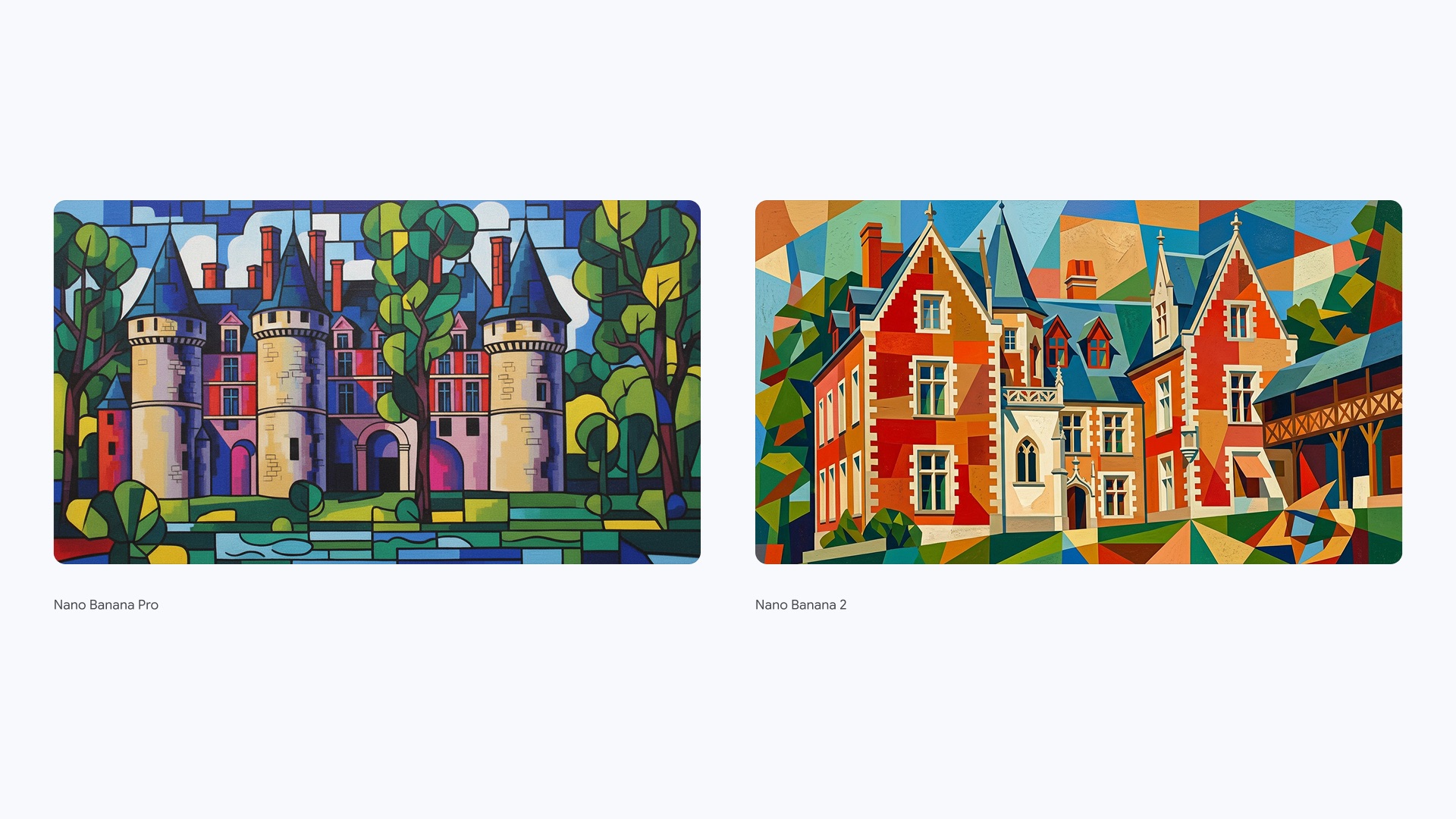

Google has unveiled the latest version of its widely used image generation model, Nano Banana 2. Officially named Gemini 3.1 Flash Image, this new model generates more life-like images compared to its predecessor and is now the default in the Gemini app for Fast, Thinking, and Pro modes.
Originally launched in August 2025, Nano Banana spurred the creation of millions of images, particularly in countries like India. Later, Nano Banana Pro was released in November, offering users the ability to produce more detailed and higher-quality images.
Nano Banana 2 combines some high-fidelity features of the Pro version while generating images at a faster rate. Users can produce images between a resolution of 512px to 4K, with various aspect ratios available.
Nano Banana 2 enhances character consistency up to five characters and maintains the fidelity of up to 14 objects in a single workflow, improving narrative capabilities. Google highlights its ability to process elaborate requests with nuanced details for image creation. Additionally, it allows the production of media with more vivid lighting, richer textures, and sharper detail.
Upon launch, Nano Banana 2 will be the standard model for image generation across all Gemini app applications. It’s also set as the default model for Google’s video editing tool, Flow.
For Google Search, Nano Banana 2 will be the default for search results through Google Lens and AI Mode across 141 countries on the Google app and on the web, available for both desktop and mobile platforms.
Subscribers of Google’s higher-tier plans, Google AI Pro and Ultra, can continue using Nano Banana Pro for specific tasks by regenerating images via the options menu.
Nano Banana 2 will be accessible to developers in preview form via the Gemini API, Gemini CLI, and the Vertex API. Additionally, it will be available in AI Studio and through Google’s development tool Antigravity, released last November.
Every image produced by the new model comes with a SynthID watermark, marking it as AI-generated by Google. These images are compatible with C2PA Content Credentials, a standard supported by companies like Adobe, Microsoft, Google, OpenAI, and Meta. Since the SynthID verification’s introduction in the Gemini app last November, it has been utilized over 20 million times.