

Starting this week, Perplexity subscribers will have a new agentic tool available.
Perplexity Computer, as described by the company, “unifies every current AI capability into a single system.” More specifically, Perplexity states its computer user agent can execute complex workflows independently using 19 different AI models, even creating subagents for specific issues.
The tool is now available but only on the company’s highest subscription tier, the $200/month Perplexity Max. It operates entirely in the cloud, potentially avoiding the security concerns of other agentic tools like OpenClaw.
TechCrunch hasn’t conducted a hands-on demo of the new tool, but in example workflows on Perplexity’s website, it is demonstrated handling tasks like collecting statistics, financial or legal data, creating analyses, and sharing its findings as finished websites or visualizations.
Perplexity executives invited the press to a briefing last week to discuss the product and future plans for the year. The event was meant to include a tool demonstration, but it was canceled due to flaws found in the product just hours before the event.
This tool signifies the evolution of Perplexity, which initially gained attention in the AI boom by integrating frontier models into familiar user interfaces, notably its search-engine-like answer service. It later launched its Comet web browser last summer. Competitors like Google have modified their products to reflect those created by Perplexity, one executive commented, although this poses both a challenge and a compliment.
The company is adapting to a changing ecosystem: Being one of the first AI companies to offer advertising, it discontinued that business late last year, indicating last week that it compromised users’ confidence in the accuracy of answers. Nonetheless, Perplexity’s total user base, numbering in the tens of millions, is small compared to OpenAI, which reports 800 million weekly users and has started testing ads in ChatGPT this year.
Now, Perplexity executives aim for a more boutique user base, with products serving individuals making “GDP-moving decisions.” During the briefing, executives, who requested anonymity, emphasized focusing on enterprise subscriptions, especially for deep research.
“You don’t hear us talk about MAUs ever, because we’re not actually on a mission to get as many users as possible,” one executive remarked.
Perplexity recently introduced a new benchmark for complex research tasks, called Draco, where its own deep research offering reportedly outperforms competitors like Gemini.
Perplexity claims it is no longer dependent on other companies’ APIs for its web index and now has its own AI-optimized search API. However, the company continues to focus on packaging frontier models into a user-friendly experience, arguing that combining multiple third-party LLMs delivers the most cost-effective and accurate answers to queries.
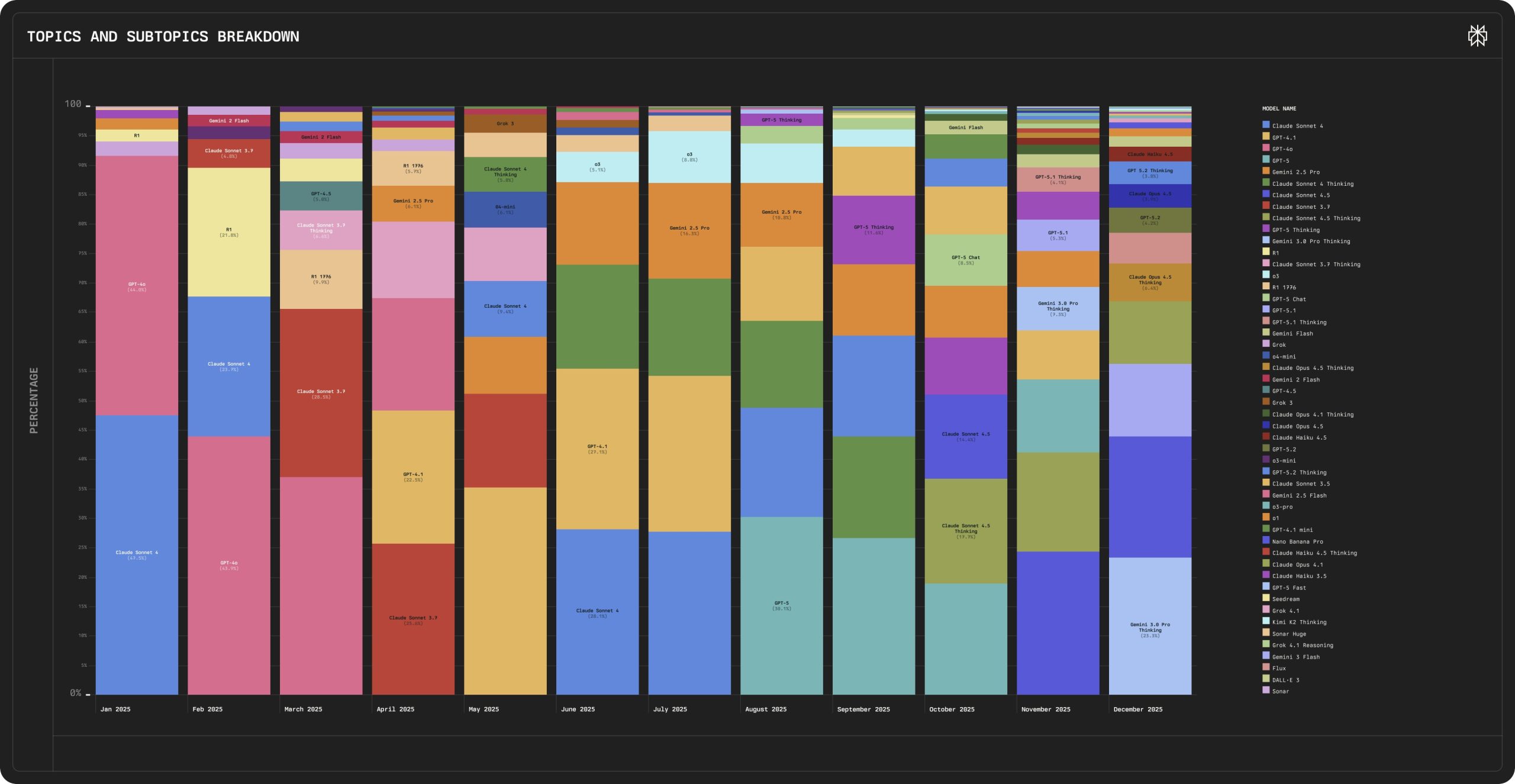
“Multi-model is the future,” one Perplexity exec asserted. They believe models are becoming more specialized, not commoditized. The company notes that users often switch between models to achieve desired results, with December 2025 queries mostly sent to Gemini Flash for visual outputs, software engineering done by Claude Sonnet 4.5, and medical research in GPT-5.1.
A visualization of model usage by Perplexity users over time.
If one LLM excels at coding tasks and another at drafting marketing copy, Perplexity’s software can automatically select the best-suited one. Executives noted that using Perplexity’s modified open-source Chinese-built LLMs to respond to queries more economically was criticized last year for lack of transparency. However, executed openly, this could be an efficient means to optimize LLM queries.
The company also allows users to query multiple models simultaneously through a feature called Model Council. But the unit economics of offering multiple queries at fixed subscription rates remain somewhat unclear.
Nevertheless, without costly infrastructure projects and with, according to executives, high user fee margins, Perplexity believes it will remain competitive by assigning tokens to the best model for each purpose.
More developments are on the horizon: the Perplexity Comet browser will arrive on iOS next month, and the company is organizing a developers’ conference, Ask, on March 11 in San Francisco to encourage third-party API use.
One executive noted a shift from focusing on daily query counts to the most recent revenue metrics. Some customers are noticing an increased emphasis on profitability, with discussions on the Perplexity subreddit about new rate limits on free and subscription tiers.
However, the executives at the briefing dismiss such complaints. “Any discussions on the free tier being made worse or rate-limited is completely false,” an executive stated.