
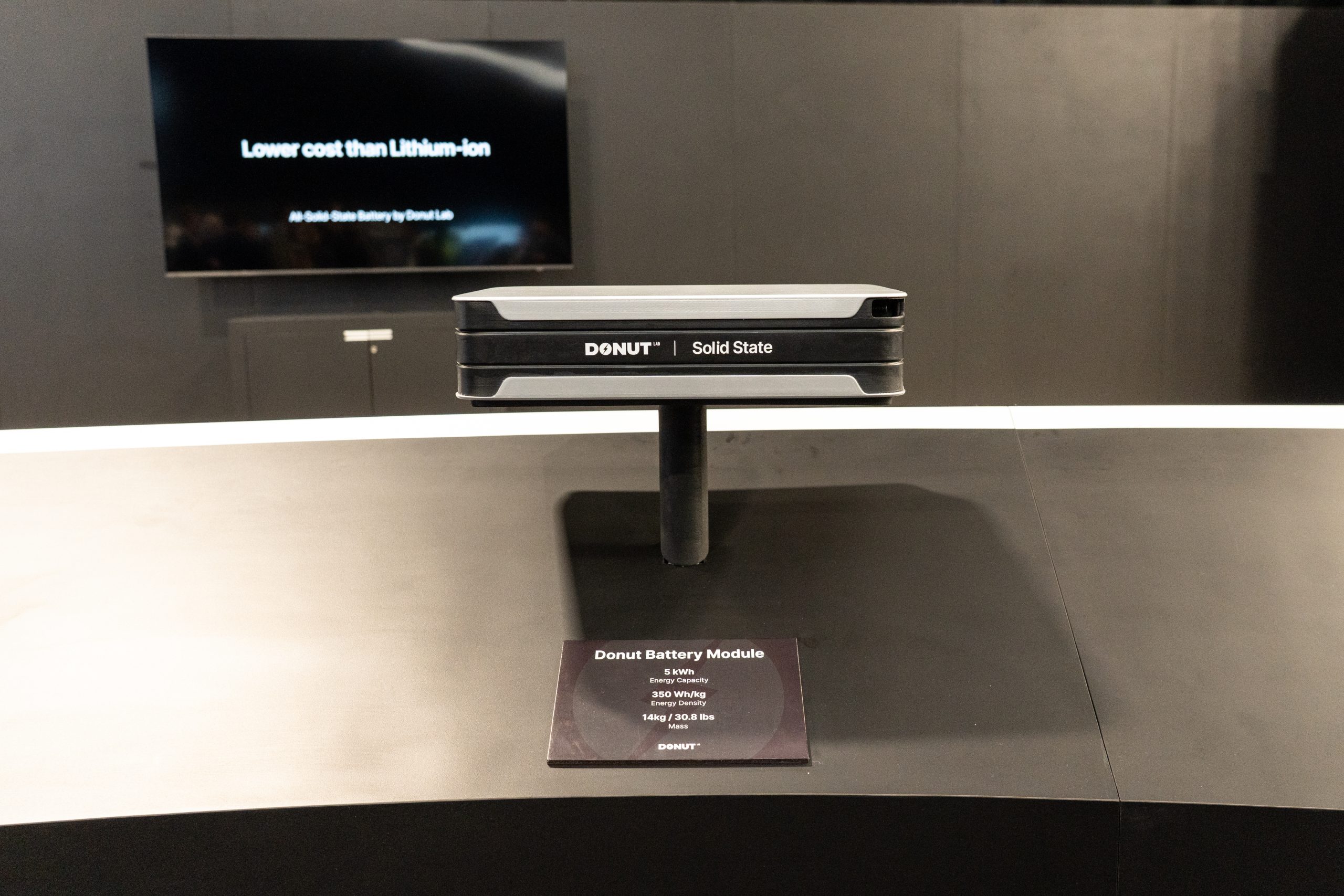

The Finnish startup’s battery demonstrated improved capacity under extreme heat conditions. Finnish startup Donut Lab is showing that their solid-state battery performs as advertised. Recently, they focused on testing the impact of extreme heat. This evaluation, like the previous fast-charging test, was performed by Finland’s VTT Technical Research Centre. The goal was to see how Donut Lab’s battery cells reacted to high heat, which typically degrades traditional lithium-ion batteries. Findings revealed the battery not only functioned well at temperatures up to 100 degrees Celsius but also gained capacity.
Tests involved a 3.6V/26 Amp-hour solid-state battery assessed at three temperatures: a baseline 20°C, 80°C, and 100°C. To ensure optimal performance, VTT applied physical pressure via a steel plate and used a heatsink in a temperature-controlled environment. At room temperature, the battery yielded 24.9Ah, serving as a benchmark. At 80°C, performance increased to 27.5Ah, while at 100°C, it provided 27.6Ah. Though the battery maintained functionality and rechargeable capability, its vacuum seal was compromised by the heat.
The solid-state cell became more efficient with increased temperatures, maintaining functionality even above 100°C, while still allowing recharging. Solid-state batteries are highly sought after due to their potential for longer range and improved safety over traditional lithium-ion batteries, which are prone to thermal runaway and inefficiencies in extreme temperatures. Donut Lab is working to enhance high-heat tolerance by using solid materials instead of flammable liquids, a change that appears to improve energy capacity under heat by reducing internal resistance.
However, some critical questions about Donut Lab’s battery remain unanswered. VTT did not verify the pack’s chemistry, and the “dendrite issue” involving potential shorts from anode to cathode is still unaddressed. Future independent test results, promised by Donut Lab as a part of their “I Donut Believe” initiative, might provide further insights.