

In 2024, Renesas released the RA0E1, an ultra-low-power Cortex-M23 MCU targeting cost-sensitive applications, followed by the RA0E2 with an extended temperature range (-40°C to +125°C). The company has now introduced the RA0E3, a simplified version of the RA0E1 with reduced memory, peripherals, and GPIOs, designed for small, budget-focused applications like sensing, motor assist, safety, and basic system control.
The MCU maintains the same 32 MHz Arm Cortex-M23 (Armv8-M) core but now has 16KB flash and 2KB SRAM. It includes an 8-channel 16-bit TAU timer, a 32-bit interval timer, a 10-bit ADC with a temperature sensor, a Data Transfer Controller, and serial interfaces including SPI, I²C, and UART (with LIN support). Additionally, it offers up to 17 GPIOs, pull-ups, open-drain support, and built-in clock sources. It operates at voltages from 1.6V to 5.5V and supports −40°C to +125°C operation in a 20-pin TSSOP package.
Renesas RA0E3 Series specifications include:
– MCU Core: Arm Cortex-M23 (Armv8-M architecture) up to 32 MHz
– Memory and Storage:
– 2KB SRAM
– 16KB code flash
– Flash read protection (FRP)
– Peripherals:
– Serial: 1x Serial Array Unit (SAU) with 4x Simplified SPI, Simplified I2C, or UART with LIN-bus support, 1x I2C bus interface (IICA)
– Up to 17x General Purpose I/O pins (5V tolerance, open drain, input pull-up)
– Analog: 10-bit A/D Converter (ADC10) with up to 6 channels, Integrated Temperature Sensor (TSN)
– Timers: 8x 16-bit Timer Array Unit (TAU) (7x PWM outputs), 1x 32-bit interval timer (TML32) configurable as 1x 32-bit, 2x 16-bit, or 4x 8-bit counters
– Clock Sources:
– 32 MHz high-speed on-chip oscillator (HOCO) with ±1% accuracy
– 32.768 kHz low-speed on-chip oscillator (LOCO)
– Clock trim support
– Clock output/buzzer output pin
– Safety and Security:
– Flash area protection, 128-bit unique ID
– ADC self-diagnosis function
– Cyclic Redundancy Check (CRC) calculator
– GPIO read-back level detection
– Register write protection
– Illegal memory access detection
– Debugging: CoreSight MTB-M23, SW-DP debug port
– Misc: Independent watchdog timer, Data Transfer Controller (DTC)
– Power:
– Voltage: 1.6V to 5.5V
– Consumption (Low power modes):
– Active mode: ~2.6 mA at 32 MHz
– Software Standby mode: ~0.2 µA (typ.)
– Power-on reset (POR) and Low Voltage Detection (LVD)
– Operating Temperature: -40 °C to +125 °C
– Package: 20-pin TSSOP (4.4 mm × 6.5 mm, 0.65 mm pitch)
The RA0E3 MCU is supported by the Renesas Flexible Software Package (FSP) and various development tools, including e² studio, CS+, and HAL driver code. The FSP provides a hardware abstraction layer (HAL), peripheral drivers, middleware, and example projects to simplify development. The MCU also supports standard CMSIS-based development, debugging through the CoreSight SWD interface, and programming with the Renesas Flash Programmer, allowing developers to integrate the RA0E3 into existing Arm Cortex-M development workflows.
Renesas states that the RA0E3 is intended to add low-cost functionality to existing designs without redesigning the main system architecture. For example, in food processors or kitchen mixers, the MCU can handle tasks like a safety lock mechanism. Instead of using a more capable and expensive main processor for these auxiliary functions, the RA0E3 can serve as a dedicated sub-microcontroller. The MCU can often be integrated without additional components, such as external oscillators or voltage-level shifters, helping keep the overall BoM cost low.
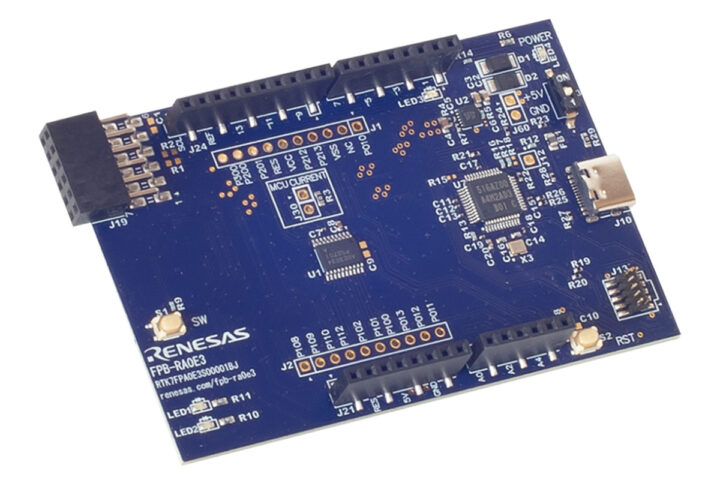
The company also developed the FPB-RA0E3 (RTK7FPA0E3S00001BJ) fast prototyping board for evaluation and early firmware development. It features an RA0E3 20-pin MCU with 16KB flash and