

<!–
Join us for The Pragmatic Summit on 11 February, 2026, in San Francisco. Discuss how AI reshapes software engineering with top engineers and leaders. Limited spaces available – get your tickets here.
–>
Hi, this is Gergely bringing you a free issue of the Pragmatic Engineer. This was the latest The Pulse issue, initially sent to paying subscribers. Due to the number of comments it inspired, I’m sharing it broadly, as it poses key questions about defensibility in open source.
If this email was forwarded to you, you can subscribe here for more issues like this.
Today’s edition of The Pulse centers on one major event with potential ripple effects. On Tuesday, Cloudflare stunned the developer community by announcing they had rewritten Next.js in a week with one developer and just $1,100 in tokens:
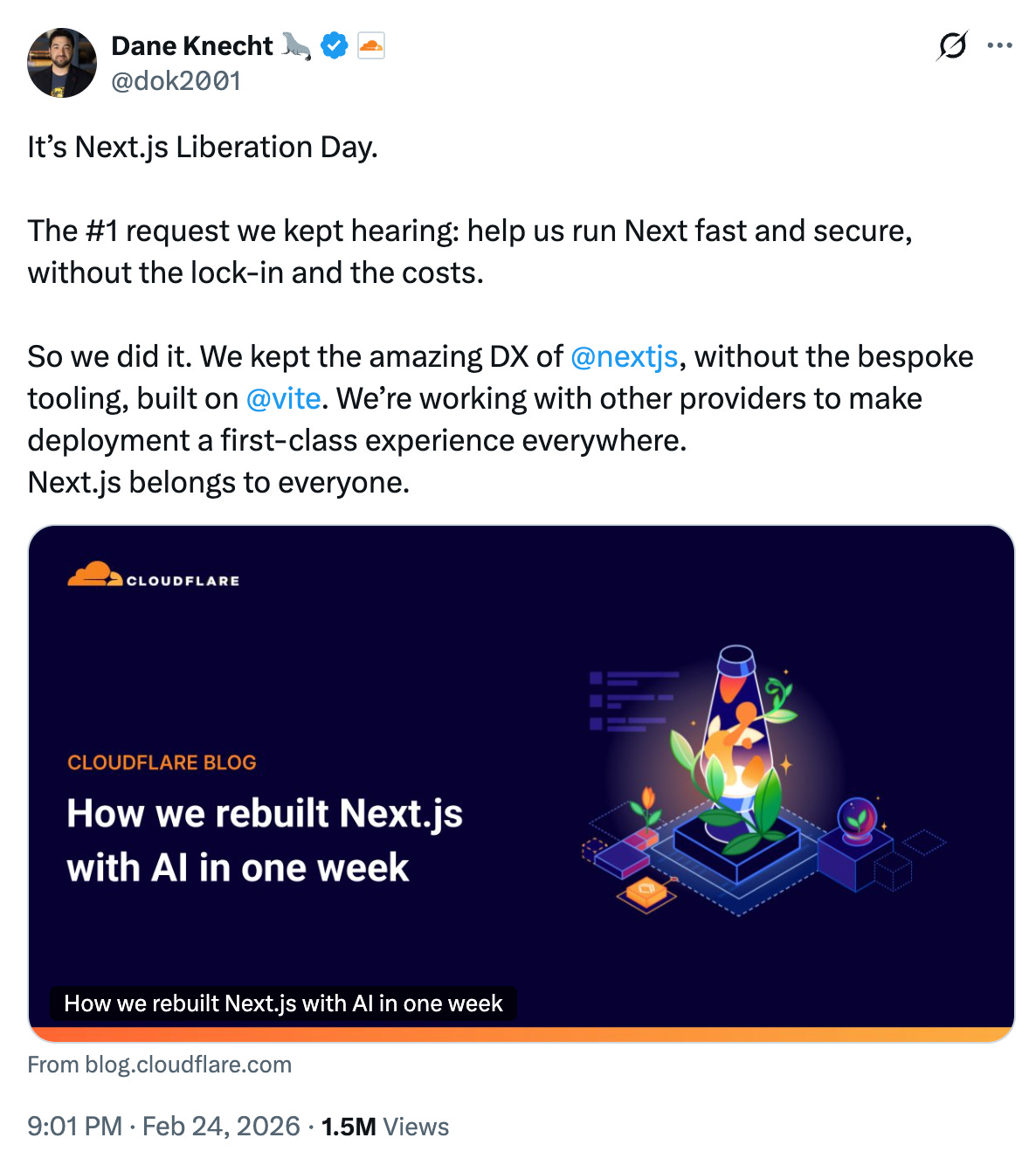
Let’s unpack this:
- Recapping the Next.js ecosystem. Nearly half of React developers use Next.js, primarily deploying to Vercel due to its proprietary build output.
- Cloudflare’s Next.js move. They replaced Next.js’s build engine with Vite, enabling easy deployment on Cloudflare.
- AI makes the extraordinary possible. Tasks that could take years were accomplished in a week using some tokens.
- “AI slop” issues remain. Despite Cloudflare’s claims, vinext is not production-ready and requires cleanup and auditing to match Next.js.
1. The Next.js ecosystem: a recap
Next.js is a leading fullstack React framework, used by around half of React developers, according to the 2025 Stack Overflow developer survey. It’s maintained by Vercel and ideally deployed there due to the optimized use of Vercel’s Turbopack build tool, producing a proprietary format. As Netlify engineer Eduardo Bouças notes:
“The output of a Next.js build has a proprietary and undocumented format that is used in Vercel deployments to provision the infrastructure needed to power the application.
This means that any hosting providers other than Vercel must build on top of undocumented APIs that can introduce unannounced breaking changes in minor or patch releases. (And they have)”.
</