
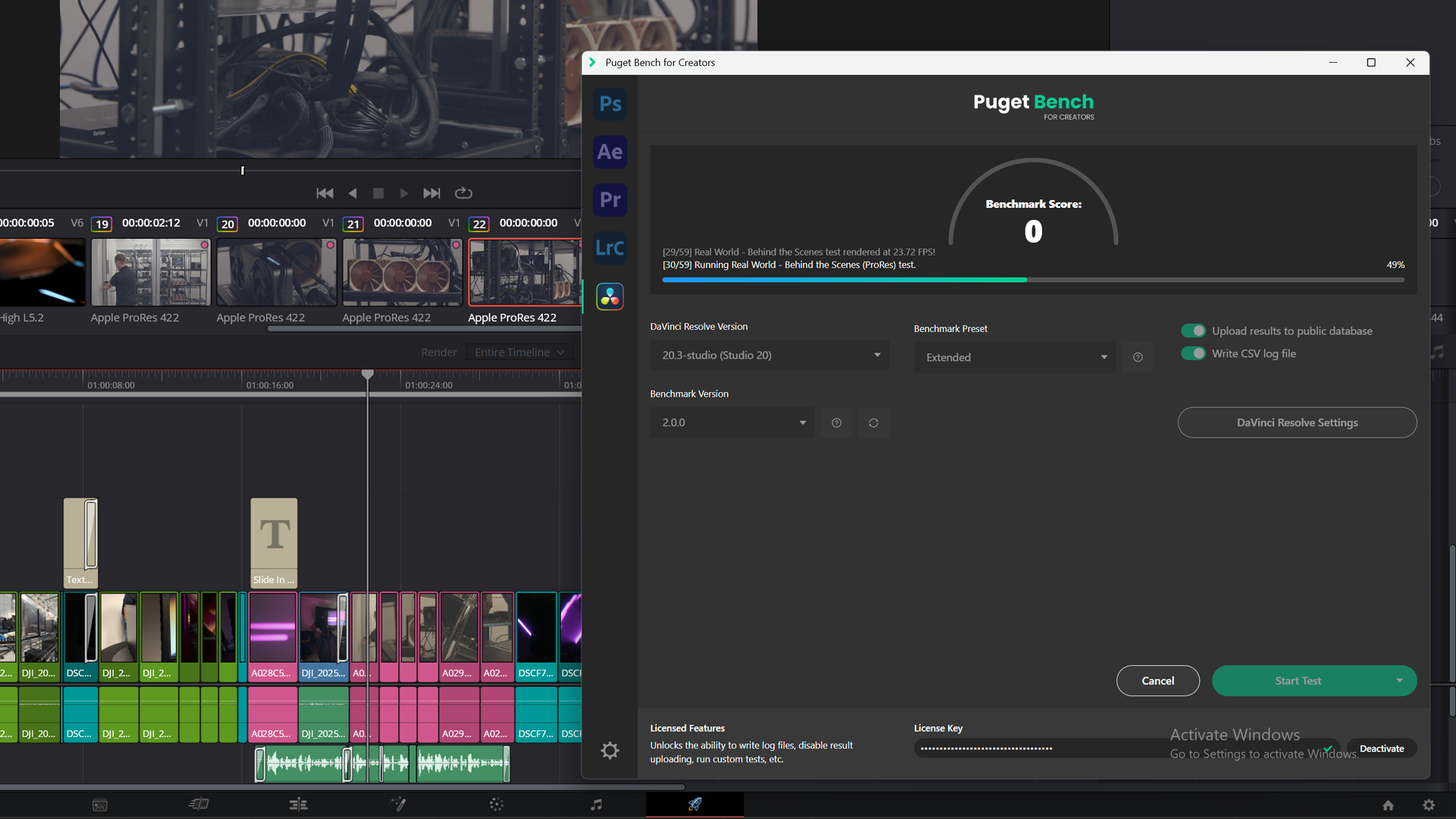

Introducing Puget Bench 2.0 for Premiere Pro & DaVinci Resolve
We are excited to announce the new 2.0 benchmark releases of both Puget Bench for Premiere Pro and Puget Bench for DaVinci Resolve. These benchmarks enhance the previous 1.x versions by utilizing new software features and workflows to better represent current everyday work for creators.
New features include:
- Updated codecs for Processing and Encoding tests.
- Addition of MultiStream Processing tests.
- Addition of “Real World” test projects featuring effects, transitions, and motion graphics, along with mixed codecs, frame rates, and media resolutions.
- Updated GPU Effects tests (Premiere Pro).
- Improved testing methodology for Processing and GPU Effects tests (Premiere Pro).
- Updated AI tests (DaVinci Resolve).
- Reorganization of tests (DaVinci Resolve).
- Scoring adjustments to better align with end-user priorities.
These features further enhance the numerous tests already included in the 1.x benchmark, aiding in evaluating performance when working with H.264, HEVC, ProRes, DNx, and various RAW media formats. The DaVinci Resolve benchmark also tests motion graphics and VFX workflows in the Fusion tab, as well as a suite of AI-based tasks.
For a comprehensive overview of the tests included in each benchmark, refer to the “Test Breakdown” and “Scoring” sections on the Puget Bench for Premiere Pro and Puget Bench for DaVinci Resolve pages. If you’d like to know more about Puget Bench in general or the version 2.0 updates summarized above, the rest of this post will dive into those details.
What is Puget Bench?
While gaming or synthetic benchmarks can offer general insights, they fall short in measuring performance in the actual workflows that matter to content creators. That’s where Puget Bench comes in. Puget Bench is a suite of performance benchmarks developed by Puget Systems, designed to evaluate hardware using the same real-world creative applications professionals rely on every day.
We built these benchmarks out of necessity. Prior to this, there simply wasn’t a reliable way to test hardware using real creative applications in realistic scenarios. To fill this need, we began turning our knowledge about computer hardware and creative workloads into a series of benchmarks. Our goal was to guide users across workflows like video editing, motion graphics, and photography – helping them make the most informed workstation purchasing decisions possible.
Puget Bench covers a range of applications, including Adobe Premiere Pro, Adobe After Effects, Adobe Photoshop, Adobe Lightroom Classic, and Blackmagic DaVinci Resolve. The tests run directly on top of the host application – in the case of this announcement, Premiere Pro and DaVinci Resolve. Instead of approximating workloads through synthetic methods, it uses real media and replicates realistic workflows, producing results that accurately reflect how a given system performs in practice. Because the benchmark operates within the application itself, it automatically accounts for software changes – whether that’s new hardware support, performance optimizations, or even regressions introduced by bugs.
Our benchmarks are a key ingredient in many of the <a href="https://www.pugetsystems.com/all-articles/" target="_blank" rel="noreferrer noop