
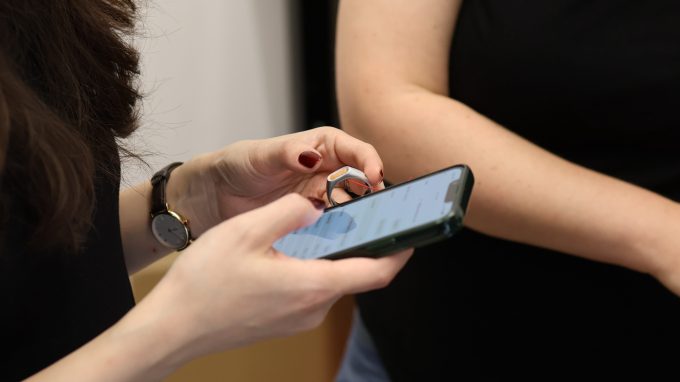

Sandbar, a startup founded by ex-Meta employees Mina Fahmi and Kirak Hong, gained significant attention last year with its note-taking wearable, the Stream ring. The company has now secured $23 million in Series A funding led by Adjacent and Kindred Ventures.
The company’s smart ring is designed for note-taking, unlike health-tracking products like Oura. It features a microphone that remains off by default and can be activated using a flat, touch-sensitive panel on top. Users can record notes, interact with an AI assistant via a phone app, and control media functions like play, pause, skip, and volume.
The ring’s microphone is optimized for proximity, requiring users to bring their hand to their face for note-taking.
Fahmi, with a background at startups such as CTRL-Labs and Magic Leap, stated that Sandbar has been developing the ring for over two years, having emerged from stealth last year following testing with friends and early adopters.
“The response [to the launch] was much warmer than anticipated, which is very encouraging and meaningful,” Fahmi expressed to TechCrunch. “Many people said they could see themselves wearing this.”
The startup reports positive feedback from early users, with the initial pre-order batch selling out last year, prompting a second batch to meet demand. Users reportedly use the ring over 50 times daily for tasks like planning presentations, trips, or meals.
Sandbar plans to ship the smart ring this summer. The company is concentrating on refining its app experience and enhancing what users can do with recorded notes. It is developing a web platform, improving the user interface, and reducing model response latency. In the long term, Sandbar aims to enable users to take action using their notes.
Fahmi highlighted the integration of conversational exchanges, as many users ask the AI assistant about incomplete notes.
“Conversational interaction is essential. Unlike experiences where a command is either transcribed or acted on by devices like smart speakers, Stream excels at iterative tasks that begin with conversation or note editing and hopefully expand into multi-turn dialogues,” Fahmi explained.
The Stream ring currently links exclusively to Sandbar’s phone app, but the company is considering broader access to non-ring users. The app can still take notes independently if the ring is charging or misplaced.
Sandbar, currently with 15 employees from companies like Amazon, Fitbit, Equinox, Google, and Apple, plans to double its software and machine learning teams and expand its marketing staff with the new funding.
The hardware device category for note-taking is expanding. Companies such as Plaud offer meeting note-taking devices, and Pebble plans to release an affordable $75 ring this year. Startups like Taya are designing jewelry-type products to attract a broader user base.
Adjacent’s Nico Wittenborn, experienced in investing in voice-focused startups, backed Blinkist at Insight Venture Partners. He believes Sandbar’s Stream ring offers a superior form factor compared to other note-taking devices, with its gesture of lifting the hand suggesting a private, intentional use case, unlike devices that might record surrounding conversations.
Wittenborn also believes some hardware targets “tech bros,” whereas Sandbar’s design is poised for wider adoption.
Previously, Sandbar raised $13 million from True Ventures in November. The company has accumulated $36 million in total funding.