

With the leading app stores brimming with AI applications, developers might assume that incorporating artificial intelligence into their products is the best route to profitability. However, a new study on the subscription app ecosystem across iOS, Android, and the web challenges this notion.
RevenueCat, providing subscription management tools to over 75,000 developers, reports in its 2026 State of Subscription Apps Report that AI integration does not ensure long-term retention. AI-powered apps have higher churn rates, with annual subscription cancellations 30% higher than non-AI apps at the median.
The report examines subscription app providers using RevenueCat’s tools, managing over 1 billion in-app transactions and generating more than $11 billion annually for developers, representing a valid sample for trend analysis.
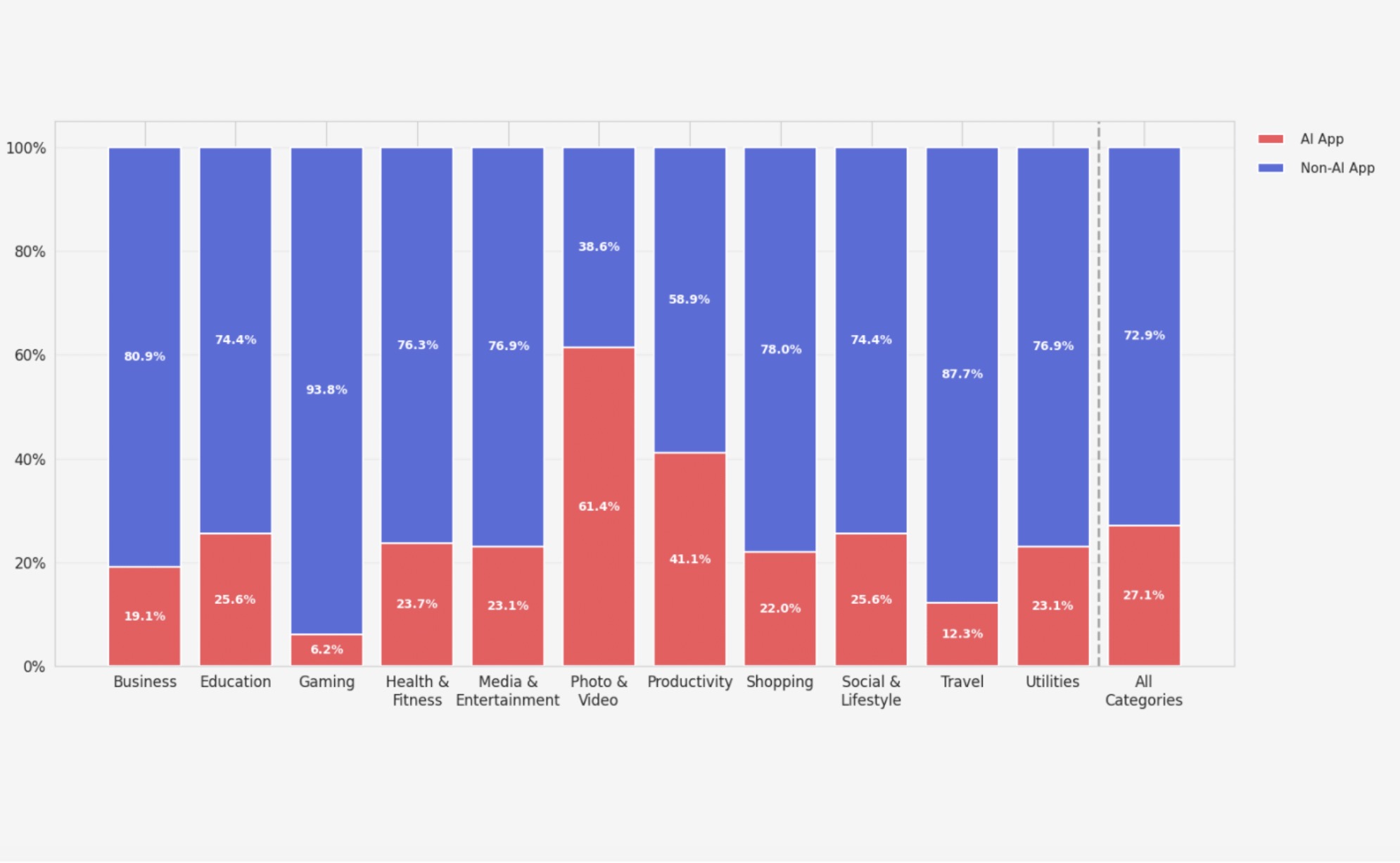
Findings show that most apps using RevenueCat’s platform aren’t AI-powered. AI apps make up 27.1% of categories, versus 72.9% for non-AI apps. Despite this, AI is a growing segment with about one in four apps now utilizing the technology.
The AI-powered apps category encompasses more than just popular chatbots like ChatGPT and Gemini; it includes any app marketed as AI-powered.
Photo & Video apps dominate with 61.4% AI-powered apps, while gaming is at a low 6.2%. Travel and Business categories are also low in AI with 12.3% and 19.1% respectively.
Interestingly, AI apps underperform in retention both monthly and annually. RevenueCat’s data indicates AI apps have a 21.1% annual retention rate compared to 30.7% for non-AI apps. Monthly, AI apps have a 6.1% rate versus 9.5% for non-AI apps, a 3.4 percentage point difference.
AI apps only lead in weekly retention with 2.5% compared to non-AI apps’ 1.7%, though weekly subscriptions are not popular among AI apps.
User metrics might be impacted by the fast-paced changes in AI technology, leading users to frequently switch apps seeking the latest technology.
As more AI apps are available, users may find some don’t satisfy their needs. AI apps see 20% higher refund rates (4.2% vs. 3.5% at the median) compared to non-AI apps.
The upper bounds for refund rates are also higher for AI apps (15.6% vs. 12.5%), indicating greater revenue volatility and issues in user value and experience.
There are benefits to being an AI-powered app. RevenueCat’s data shows AI apps convert users from trials to paid customers 52% better than non-AI apps (8.5% vs. 5.6% at the median) and monetize downloads around 20% better (2.4% vs. 2.0%).
AI apps also produce 39% higher monthly realized lifetime value (RLTV), at a median of $18.92 per month versus $13.59 for non-AI apps. On an annual basis, RLTV is 41% higher for AI apps, at $30.16 compared to $21.37, also at the median.
The report suggests that while AI can boost early monetization, these apps struggle to maintain customer value over time.