

The surge of AI apps in major app stores leads developers to believe integrating AI into their products could be profitable. However, a recent study on the subscription app ecosystem for iOS, Android, and web challenges this assumption. RevenueCat, which provides subscription management tools to over 75,000 developers, reveals in its 2026 State of Subscription Apps Report that AI integration doesn’t ensure long-term retention. AI-powered apps have a higher churn rate, with users canceling annual subscriptions 30% faster than non-AI apps, according to median figures.
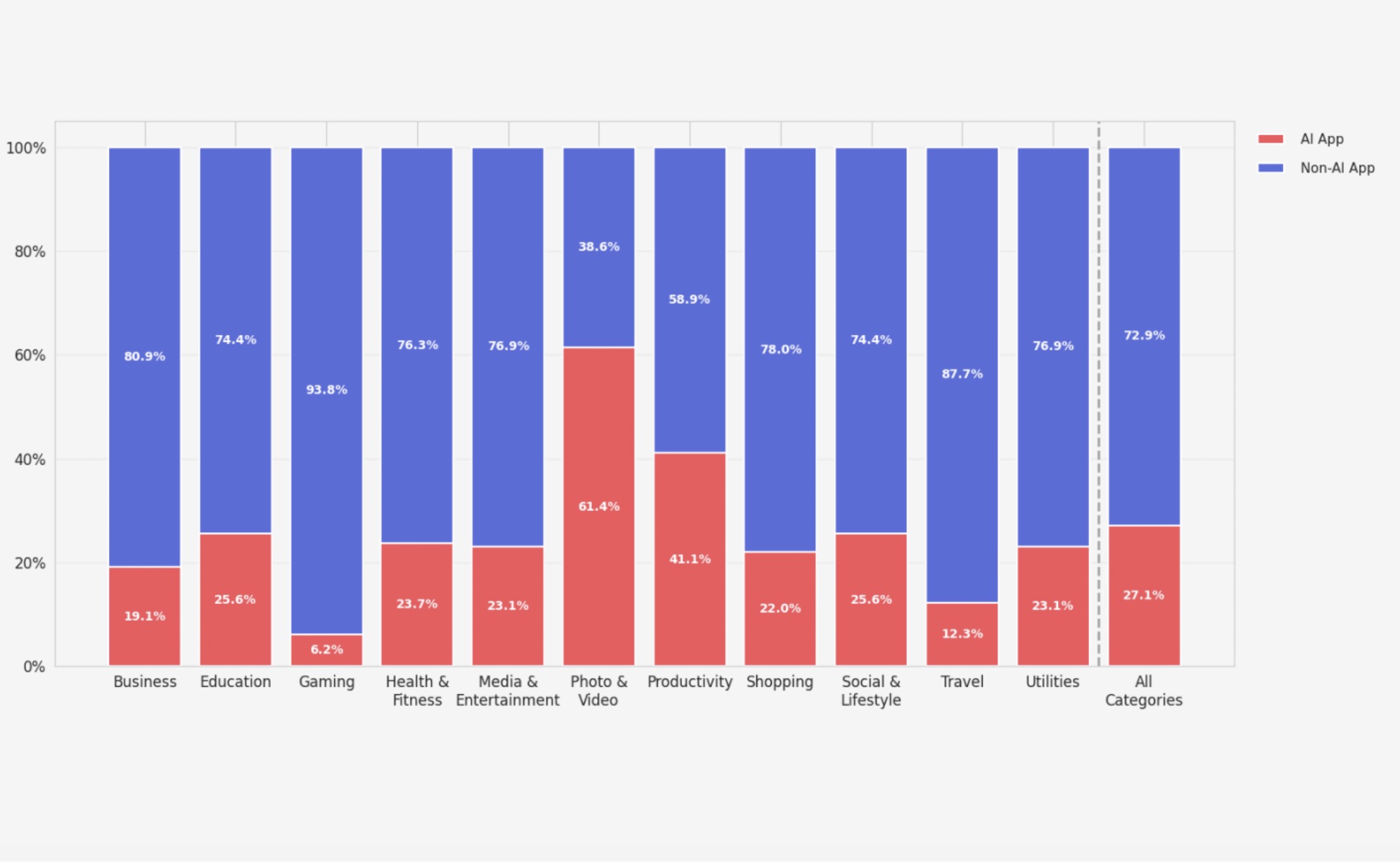
The report analyzed subscription app providers using RevenueCat’s tools, managing over 1 billion in-app transactions and generating $11 billion in annual revenue for developers. This data offers a robust sample for trend analysis. Interestingly, most apps on the platform aren’t AI-powered. AI-powered apps make up 27.1% of all categories, compared to 72.9% for non-AI apps. This category is expanding, with one in four apps now AI-powered. The AI-powered category includes popular AI chatbots like ChatGPT and Gemini, alongside other apps marketing as AI-driven.
RevenueCat’s data shows varying AI app performance across categories, with Photo & Video having the largest AI share at 61.4%, and Gaming the smallest at 6.2%. Travel (12.3%) and Business (19.1%) also show low AI adoption.
AI apps underperform in retention both monthly and yearly. Annual retention at 21.1% for AI apps falls below the 30.7% for non-AI apps. Monthly, AI apps see 6.1% retention versus 9.5% for non-AI apps, a 3.4% difference. AI apps only lead in weekly retention, with 2.5% compared to 1.7% for non-AI apps, though weekly subscriptions aren’t popular for AI apps.
These findings might reflect the fast-paced evolution of AI technology, prompting users to frequently switch between different AI apps to find the most advanced options.
Customers trying out AI apps more frequently realize some don’t fulfill their needs. The report notes higher refund rates for AI apps at 4.2% versus 3.5% for non-AI apps at the median. AI apps also have a higher refund rate upper bound of 15.6%, compared to 12.5% for non-AI apps, suggesting greater volatility in revenue and deeper issues in user satisfaction, experience, and quality.
However, AI-powered apps have advantages. RevenueCat found AI apps convert trial users to paid customers 52% better than non-AI apps (8.5% vs. 5.6% median), and monetize downloads 20% better (2.4% vs. 2% median). AI apps generate 39% or higher monthly realized lifetime value (RLTV) than non-AI apps, with an $18.92 median compared to $13.59. Annually, AI apps sustain a 41% higher RLTV of $30.16 versus $21.37, median values.
The overall conclusion is that while AI can drive strong early monetization, these apps struggle to maintain their value with customers over time.