
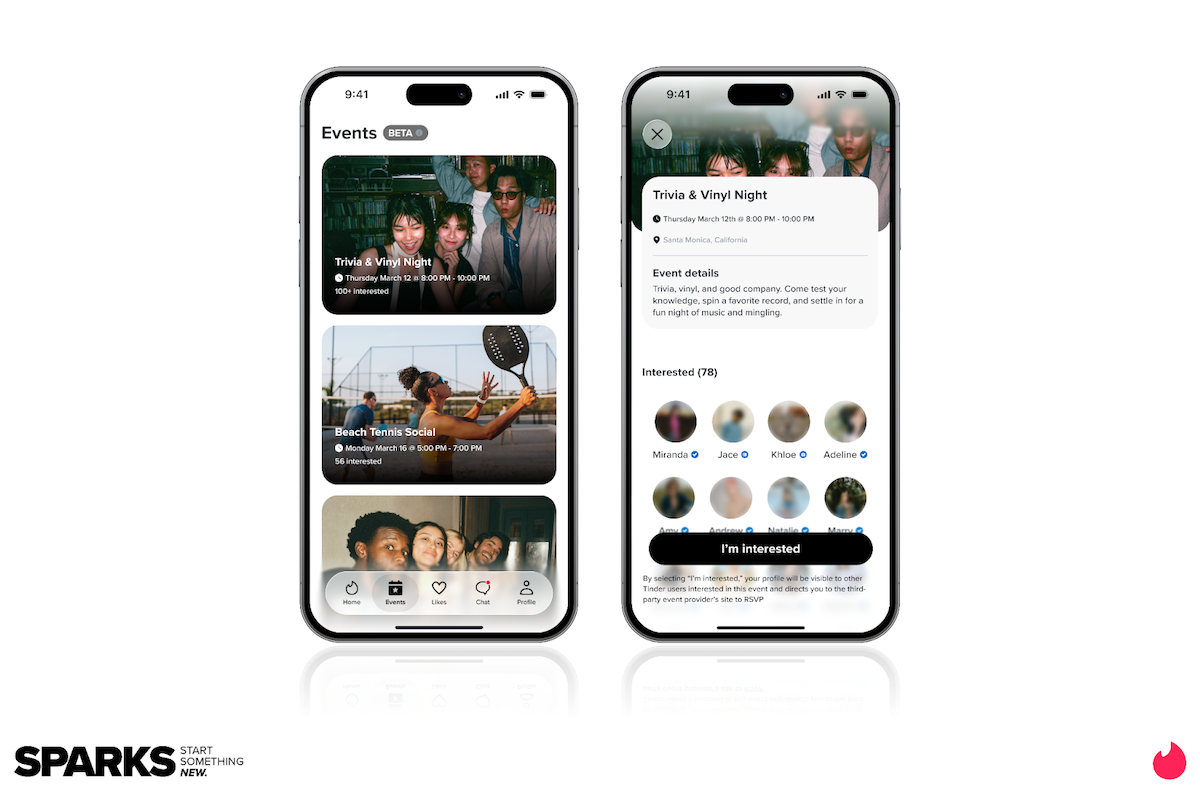

Tinder held its first product keynote on Thursday, revealing a series of updates aimed at revitalizing its app, improving safety, and utilizing AI. This follows Match Group’s $50 million investment in product development, announced last August, as the parent company seeks to re-engage with its audience and attract younger Gen Z users.
The updates include innovative ways to discover in-person events and meet people in real life, as well as a virtual speed dating experience being tested in Los Angeles. AI enhancements were also introduced to refine the matching algorithm and boost user safety.
A standout feature is the new Events tab, in beta for Los Angeles users starting in late May or early June. This allows users to find curated local events like speakeasies, bowling, raves, and pottery classes to connect in person with matches.
This shift caters to Gen Z’s desire for real-world experiences over endless swiping. As young people move away from traditional dating apps, there’s a preference for authentic offline and unconventional ways to meet partners. Apps like Breeze, 222, Timeleft, and Thursday have also embraced this IRL trend.
“We want to meet younger users where they already hang out,” said Hillary Payne, Tinder’s SVP of product, to TechCrunch. “You can attend an event with friends, enjoy it, or meet someone new. We aim to blend dating and social life, creating a more community-focused experience.”
Profiles from event attendees will be available on the app afterward, allowing users to swipe and like them, reminiscent of “Missed Connections” ads, offering another chance for those who missed or hesitated to connect.
Speed dating is making a comeback. In response, Tinder is piloting a video speed dating feature in L.A., allowing users to join scheduled three-minute video chats with matches. This serves as a vibe check, helping people break the ice and gauge chemistry before meeting in person.
The company stated that users could extend conversations beyond three minutes if promising. Participation requires a verified profile photo.
Although many daters are tired of video chats, this late-introduced experiment’s success remains to be seen. During the COVID-19 pandemic, Tinder launched a Face-to-Face feature, later discontinued due to declining interest.
AI was a significant topic at the keynote.
Tinder continues to invest in technology with its “Chemistry” feature, leveraging AI to learn about users via questions and, with consent, their camera rolls. This feature curates daily matches to reduce swipe fatigue and is being introduced in the U.S. and Canada following testing in Australia and New Zealand.
In the future, Chemistry will evolve from a single feature to something that shapes the entire Tinder experience, offering more personalization, the company announced.
Tinder also introduced “Learning Mode,” which presents more relevant matches early on. It aims to quickly identify user preferences, adapting matches to better suit them. Previously, Tinder required multiple swipes to personalize effectively.
With Learning Mode, Payne explained, it understands users from their first session: “We hope Tinder feels like it gets you from the start or if returning after a break, there’s no need for extensive input on preferences.”
Tinder is improving safety features like “Does This Bother You?” which now uses large language models to detect harmful messages and blur disrespectful content. “Are You Sure?” prompts are being refined to better identify potential harmful interactions.
Visually, Tinder is getting a sleek redesign: edge-to-edge profile photos, a subtle blur effect, and a Liquid Glass look for the Like and Nope bar. New modes include “Music Mode,” allowing up to 20 Spotify songs on profiles, and “Astrology Mode,” letting users add birth details for Sun, Moon, and Rising signs to check compatibility. This follows the recent debut of Double Date Mode and College Mode.
Overall, these announcements signal a pivotal shift in Tinder’s strategy. While Match reported positive Q4 2025 earnings with $878 million in revenue, the company faced continuous declines in paying subscribers. Thus, it must retain users and regain investor trust even amid changing preferences and increased competition.
Whether these changes will sustain interest in the app remains uncertain. Still, Tinder is noticeably committing to the future of dating, moving beyond swiping and adapting to what it assumes its young audience desires.