
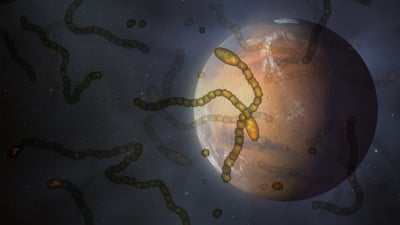

Not even an asteroid blast could destroy it. Scientists have discovered that a resilient microbe can survive pressures capable of pulverizing rock, lending weight to the idea that life might endure the impact of an asteroid hurling it off a planet.
Lily Zhao, a doctoral student in mechanical engineering at Johns Hopkins University, launched tiny samples of a microorganism using a gas gun the size of a room. This gun propelled a steel plate into a thin layer of bacteria at pressures up to 2.4 gigapascals, tens of thousands of times the Earth’s atmospheric pressure at sea level. The objective was to recreate the maximum pressure a microorganism might encounter during the start of its space journey.
Rather than annihilation, Zhao discovered a significant presence of life. After her trials, she compared a regular sample and the shocked sample to analyze them side by side.
“I really didn’t know what to expect,” she admitted to Mashable. “Was there a mix-up with the samples? The survival rate was astonishingly high — around 95 or 97 percent.”
The research, funded by NASA and published in the journal PNAS Nexus, investigates the long-debated lithopanspermia hypothesis — the concept that alien life could traverse between worlds within rocks dislodged by asteroids or comets. While no proof of such events exists, scientists have identified at least 400 meteorites on Earth originating from Mars.
Even at the peak pressure before the steel apparatus started deteriorating, survival remained approximately 60 percent.
K.T. Ramesh, Zhao’s faculty advisor, explained his interest originated from a National Academies study questioning whether microbes could travel from Mars to its nearby moons, Phobos and Deimos.
Hopkins microbiologist Jocelyne DiRuggiero selected the resilient microbe for the experiment. She chose Deinococcus radiodurans — or “D. rad” — known for its resistance to radiation, dehydration, cold, and more. Such adaptations are crucial for survival in space conditions. This extremophile even resides in Chile’s Atacama Desert, one of Earth’s driest, most radiated areas.
Experiments by other teams attempted to evaluate microbial survival in asteroid-like impacts, but the data were insufficient and hard to analyze. The Hopkins team aimed to control the pivotal variable: Zhao cultured cells in a liquid, then applied them uniformly to a thin membrane placed between two ultra-flat steel plates. A third plate was shot into the assembly to study the effects.
Zhao spent extensive time preparing the setup, and was skeptical beforehand. “Shooting a bullet at a microorganism? It’ll break apart,” she recalled thinking.
Ramesh noted, “Water — a major cell component — becomes significantly reactive around two gigapascals, altering its volume and forming ices.” Detailed modeling indicated that the worst damage occurred not when cells were compressed, but when the pressure was suddenly released.
Some surviving cells sustained damage to their outer lining, affecting their DNA and proteins. Initially ceasing their regular functions to repair, the cells resumed their normal form within hours. The surprise was how a single cell’s physical structure could endure such extreme conditions.
Lithopanspermia must exceed theoretical plausibility by weathering ejection from its origin planet, enduring space’s cold, dry void, radiation, and potentially millions of years of travel before surviving reentry heat on a new world. Ramesh, previously skeptical of such odds, now sees its possibility.
Planetary protection remains a concern, as inadvertent contamination by Earth life affects pristine worlds. Space agencies practice containment to mitigate transfer, yet resilient microbes may persist.
Intrigued by the results, Ramesh contemplates fresh crater sites for discovering extraterrestrial life. Craters, with potential water pathways, hold promise.
“Microorganisms are incredibly adaptable,” DiRuggiero said. “Found in the ocean depths, Antarctica ice, acidic pools — if life exists beyond Earth, microorganisms are likely.”
Though this study doesn’t confirm interplanetary biological exchange, it shifts perceptions on its feasibility.