
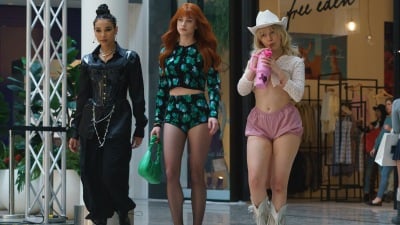

Lola Tung, Lili Reinhart, Victoria Pedretti, and Alexandra Shipp star in this girly, gross thriller.
A messy (but formative) part of girlhood is the reckless appropriation of various trends, traditions, and cultural elements in a haphazard attempt to build an identity. For some girls, this means trading one clique for another, or jumping from band geek to cheerleader. For others, it means dabbling in witchcraft.
30 years ago, The Craft became iconic for a generation of ’90s girls who dreamed of power, beauty, and boys. A coven of four teen girls could cast spells and hexes, and the only threat to their power was one another. Now arises Forbidden Fruits, a twisted teen comedy that feels like The Craft with a girly-pop aesthetic.
Forget the goth gear and smudged eyeliner. These witches are “mall royalty” who proudly work at a chic clothing store, and when they’re not eye-rolling over customers, they’re doing racy rituals and swallowing sequins as if they’re psychedelics. However, where The Craft became a coming-of-age story and cautionary tale about not being true to yourself, Forbidden Fruits is more interested in gnarly twists than any kind of PSA message.
Forbidden Fruits is a tale of rotten sisterhood.
Helmer Meredith Alloway makes her feature film directorial debut with this screen adaptation of playwright Lily Houghton’s Of the woman came the beginning of sin, and through her we all die. Together they scripted the adapted screenplay, which switches a Free People store for the less lawsuit-inducing “Free Eden.” There, a trio of intimidatingly cool girls — known as “the Fruits” — wear daring fashions and form a clique so tight, it’s suffocating.
The bubbly blonde who favors skimpy pink clothes and endlessly seeks external validation is Cherry (Victoria Pedretti). The chill astrophysics nerd, saving up for grad school and clad in dark purples and blacks, is Fig (Alexandra Shipp). And the Queen Bee of their coven is Apple (American Sweatshop’s Lili Reinhart), who has a cold stare but a heart that yearns for a “mini-me” to be her protégé.
As in Mean Girls or Clueless, the girls spot a diamond in the rough in the film’s protagonist, Pumpkin (Lola Tung). Sure, she’s dangling at the bottom of the social ladder, working as a free samples girl in the food court. But there’s something about her that intrigues the trio. Before you can recite the long title of Houghton’s play, Pumpkin is being initiated with a ritual that involves blood, dirty panties, a bitch slap, and some fresh tears.
However, much like the heroine of Mean Girls, Pumpkin isn’t just looking to be cool with killer clothes. She has a hidden agenda, which has her low-key stalking Fig and Cherry, seeking out dirt on Apple and gossip on the she-who-shall-not-be-named ex-bestie Pickle (Emma Chamberlain). Through all this, Forbidden Fruits veers from familiar teen comedy tropes into wobbly witchiness and then some outright horror movie violence to create a film that’s a wild ride, though not a satisfying one.
Forbidden Fruits is chaotic and superficial in its influences.
Let’s begin with the Bible. The title of Houghton’s play, Of the woman came the beginning of sin, and through her we all die, comes from a Bible verse, Ecclesiasticus 25:24, which essentially argues a woman’s role is to be a good wife, or else she is wicked and worth only scorn. In the film’s third act, Apple will wear this quote/title on a baby tee as she snarls at her coven mates. But the deeper meanings of this passage get lost amid a clash of pop culture references and shallow girl-boss talk.
Apple’s built her coven on a self-serving homespun feminism that demands they uplift other women, eliminate those who take pleasure in others’ pain, and never talk to boys outside of emojis. Apple’s preaching is constructed of buzzwords, while the coven’s icons range from off-brand Barbie dolls to Taylor Swift, Marilyn Monroe, and Miranda Priestly. Rather than a rich tapestry, Apple’s brand of witchcraft feels like a clumsy collage of ideas. Perhaps that’s intentional, meant to reflect how teen girls might try on new identities like so many jeans at the mall. But it also makes it hard to get a beat on who these girls are beneath their constant posturing.
Still, this dizzying barrage of allusions collides with an aggressively colorful world, and over-the-top performance styles push the horror comedy into a surreal space. In that setting, we, like Pumpkin, are encouraged to believe that Apple is more than an intimidating Head Bitch in Charge. She could well be a sorceress who can use magic to curse those