
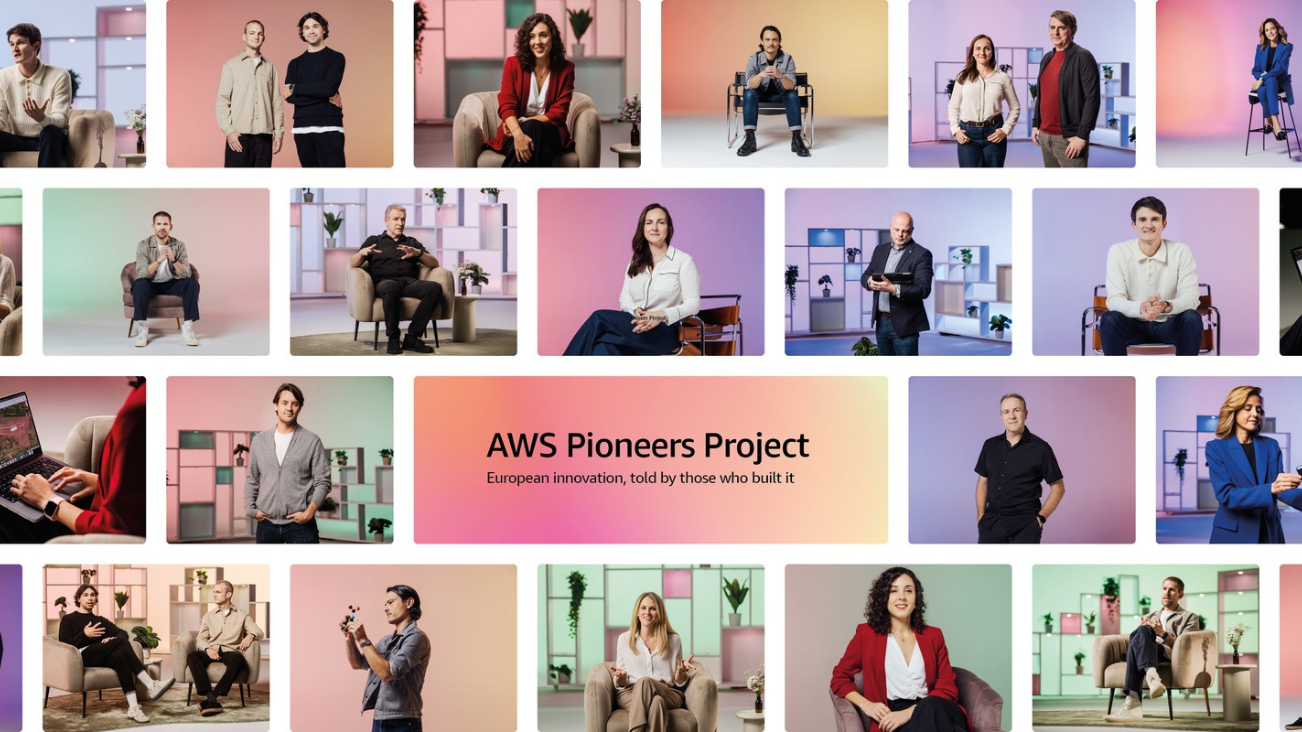

Amazon Web Services (AWS) has unveiled the second annual cohort of its Pioneers Project, which includes twelve European AI-driven companies using cloud technology to address issues from the molecular level to global concerns. These companies are involved in a range of projects, such as mapping uncharted ocean floors with zero-emission autonomous vessels, providing advance warnings of airstrikes to civilians in Syria, and diagnosing rare leukemia subtypes in a fraction of the usual time.
The announcement coincides with an AWS-commissioned study titled “Unlocking Europe’s AI Potential,” which revealed significant findings. Among them are that 91% of AI-first startups say AI has accelerated their innovation and 89% report productivity improvements. However, the study also highlights a critical challenge: 38% of European startups are considering relocating outside of Europe for growth, a figure that jumps to 51% among rapidly expanding companies. A more favorable regulatory environment is seen as a key factor in persuading them to remain, according to 65% of respondents.
The twelve companies named are based in countries such as France, Germany, Ireland, the Netherlands, Portugal, Sweden, and the UK. They were chosen for their emphasis on creating global impact rather than solely focusing on commercial scale. Notably, MLL Munich Leukaemia Laboratory, a German enterprise, utilizes cloud-scale genomics combined with hematological expertise to swiftly diagnose uncommon leukemia subtypes. XOCEAN, an Irish company, operates a fleet of small, autonomous vessels powered by batteries and solar energy for offshore wind surveys. Operating across 23 jurisdictions, XOCEAN’s vessels have worked with clients like SSE Renewables and BP, offering lower emissions compared to traditional survey ships.
Hala Systems, based in Lisbon, originated in Syria with its Sentry platform that warns civilians about incoming airstrikes and supports war crimes documentation. Dutch healthtech company myTomorrows connects patients with clinical trials through its AI-powered platform, having assisted thousands globally. Quandela, a French quantum computing company, builds photonic machines operable at room temperature and using existing fiber networks.
Other companies in the cohort include Callyope (France) using AI to detect mental health issues, CareMates (Germany) reducing hospital admission times, ETERNO (Germany) enhancing clinician consultations, Iktos (France) expediting drug design, Mindflow (France) providing enterprise automation, Paebbl (Sweden and Netherlands) reducing the carbon footprint of concrete, and Proximie (UK) enhancing access to surgical resources.
The report accompanying the announcement estimates that cloud-enabled AI could add €1.5 trillion to global GDP by 2030, emphasizing the potential loss if European AI startups relocate. The AWS announcement also reiterated their ongoing initiatives, including $1 billion in cloud credits for generative AI and $100 million for the Education Equity Initiative, aimed at addressing issues highlighted in the study.