
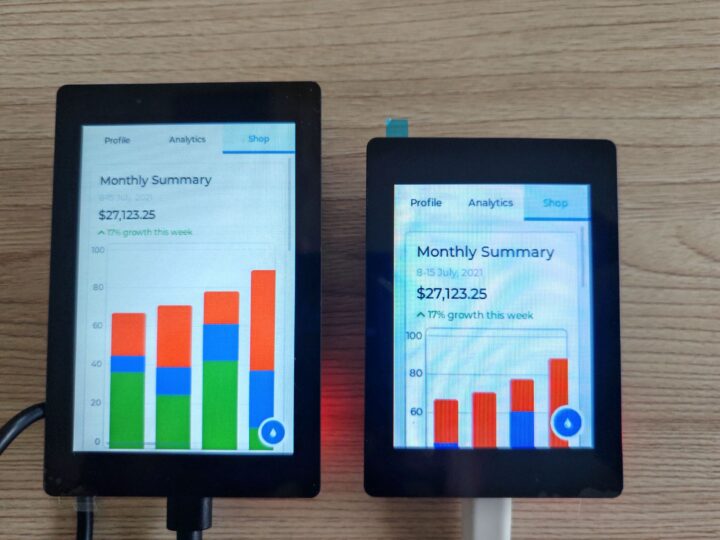

ITEAD provided samples of the Open Nextion ONX3248G035 and ONX2432G028 ESP32-S3 HMI displays for review. The Open Nextion line is distinct from the original Nextion HMI, integrating an ESP32-S3 wireless microcontroller for all processing, display, and connectivity functions.
The displays support both the ESP-IDF framework and Arduino IDE with LVGL graphics library compatibility. The ONX3248G035 has a 3.5-inch display, while the ONX2432G028 features a 2.8-inch screen. Accessories include a dual-microphone array, speaker, and I/O adapter.
Open Nextion is ideal for developers seeking integrated HMI and wireless capabilities, prototyping Smart HMI panels or IoT terminals, education with LVGL and ESP32-S3, and industrial applications requiring wireless displays and sensors.
### Open Nextion HMI Display Kits Unboxing
ITEAD provided the two displays and accessories. We examined the ONX3248G035 (3.5-inch) and ONX2432G028 (2.8-inch) packages.
Both models come with a USB-C cable and show minor differences.
The Nextion Dual MIC board includes two PDM microphones for voice input. The Nextion BOX speaker is for audio output.
The Nextion IO Adapter V2 connects to the HMI board via an FPC connector, exposing a 20-pin GPIO header.
### Open Nextion ONX2432G028 and ONX3248G035 Specifications
Both models share similar specifications, with differences in display size and resolution.
– **Display Size**: 2.8″ (ONX2432G028), 3.5″ (ONX3248G035)
– **Resolution**: 240×320 (ONX2432G028), 320×480 (ONX3248G035)
– **Number of Colors**: 262K (both)
– **Brightness**: 300 nits (both)
– **Touchscreen Type**: Capacitive (both)
– **Touch Driver**: CST826 (both)
– **Panel Driver**: ST7789 (ONX2432G028), ST7796 (ONX3248G035)
– **MCU**: ESP32-S3R8 (both)
– **CPU Speed**: Up to 240 MHz (both)
– **Flash**: 16 MB (both)
– **PSRAM**: 8 MB (both)
– **ROM/SRAM**: 384 KB / 512 KB (both)
– **MicroSD Slot**: Yes (both)
– **Wireless**: 2.4 GHz Wi-Fi + BT 5 (LE) (both)
– **USB Interface**: CH340K USB-to-UART (both, no USB OTG)
– **Power Input**: DC 5V 1A (USB-C) (both)
– **Battery**: Li-ion 3.7V + RTC 3V (both)
– **Temperature Range**: -20°C to 70°C (both)
### Board Design and Layout
The ONX2432G028 (2.8″) and ONX3248G035 (3.5″) boards have user-friendly designs. Notable features include a rare BLX8563-PARC RTC chip and an NS4168 Class D DAC + Amplifier chip.
Key features and ports:
– USB-C for power/programmer
– BOOT and RESET buttons
– ON/OFF switch
– UART0, I2C, UART1 connectors
– FPC connectors for microphone array and GPIO
– Camera and microSD card slots
– Speaker and battery connectors
– IPEX-1 antenna connector
### Comparison Between Nextion HMI and Open Nextion (Genius Series)
[Table comparing features of Nextion HMI and Open Nextion]
In conclusion, Nextion HMI suits users wanting simple UI design. Open Nextion fits projects needing built-in wireless and open-source capabilities.
### Testing Open Nextion with Arduino IDE and ESP-IDF Framework
Setup can be via Arduino for beginners or ESP-IDF for experienced developers. Example code demonstrates ESP32-S3 usage with ST7789 display.
### Using Open Nextion with the Arduino IDE
Example code for configuring the Open Nextion display is provided.
### Using Open Nextion HMI Displays with ESP-IDF Framework
ITEAD offers nine ESP-IDF sample programs. The displays show vibrant interfaces with good touch response. Color quality varies slightly between models.
### Wi-Fi Connectivity
The displays connect to Wi-Fi networks quickly. Touch panels respond well during demos, though ONX2432G028 has edge touch detection issues.
### Data and Media Handling
MicroSD card images load quickly and accurately. Music playback is clear via the speaker.
### Conclusion