
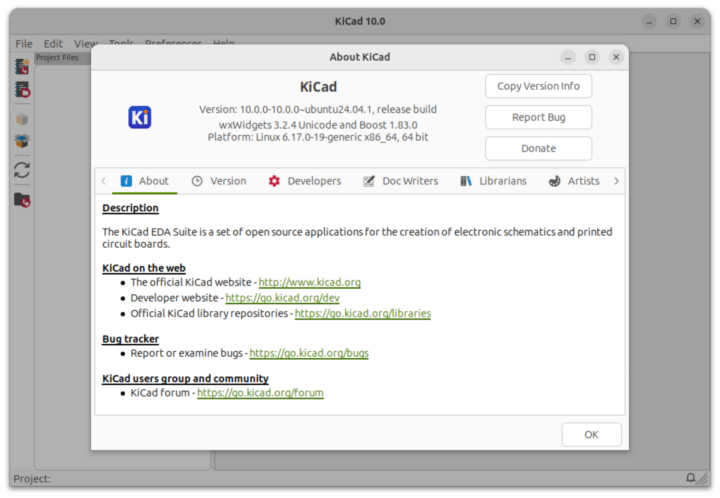

KiCad 10 open-source EDA software has been released, featuring dark mode support, importers for Allegro, PADS, and gEDA/Lepton PCB, and improvements to the Schematic Editor, including hop-over display, and the PCB Editor with a new graphical DRC rule editor.
The development of KiCad 10 involved hundreds of developers, translators, library contributors, and documentation submitters, who made 7,609 unique commits following the release of KiCad 9 in February 2025. The update introduces 952 new symbols, 1216 new footprints, and 386 new 3D models.
New UI and usability enhancements include dark mode support (Windows only), customizable toolbars, undo/redo functionality in dialogs, and lasso/freeform selection. Additionally, the release adds importers for Allegro, PADS, and gEDA/Lepton PCB.
Schematic editing now supports variants (e.g., single project with different BoM), hop-over display, jumper support, pin table CSV export/import, and grouping support.
PCB Design extends features with time-domain tuning in addition to length constraints and Tuning Profiles. PCB Design Blocks have been introduced to the PCB editor, enhancing the capability from schematic editor in KiCad 9. Inner-layer objects in footprints now allow graphical shapes and keepouts. New features include an unconstrained pin/pad and gate/unit swap feature for forward/back annotation between schematic and PCB, and a graphical DRC rule editor.
Additional changes consist of barcode support, hatched fills in graphic shapes, precise point editing for polygons, suggested fix actions for DRC errors, 3D PDF export, and native rounded rectangles. More details and screenshots are available in the official announcement.
To install KiCad 10, visit the Download page. Installation on Ubuntu 24.04 is done similar to KiCad 9:
“`
sudo add-apt-repository ppa:kicad/kicad-10.0-releases
sudo apt install kicad
“`
Testing with Olimex’ ESP32-C3-DevKit-LiPo hardware design files showed the usual prompt for files created by older versions of KiCad, but schematics and PCB layouts opened without obvious issues.
There might be breaking changes in major versions, but fixes are expected soon. One user reported issues with custom symbols and footprint libraries, but these will likely be addressed quickly.
Jean-Luc started CNX Software in 2010, transition into full-time writing in 2011, delivering daily news and reviews.