
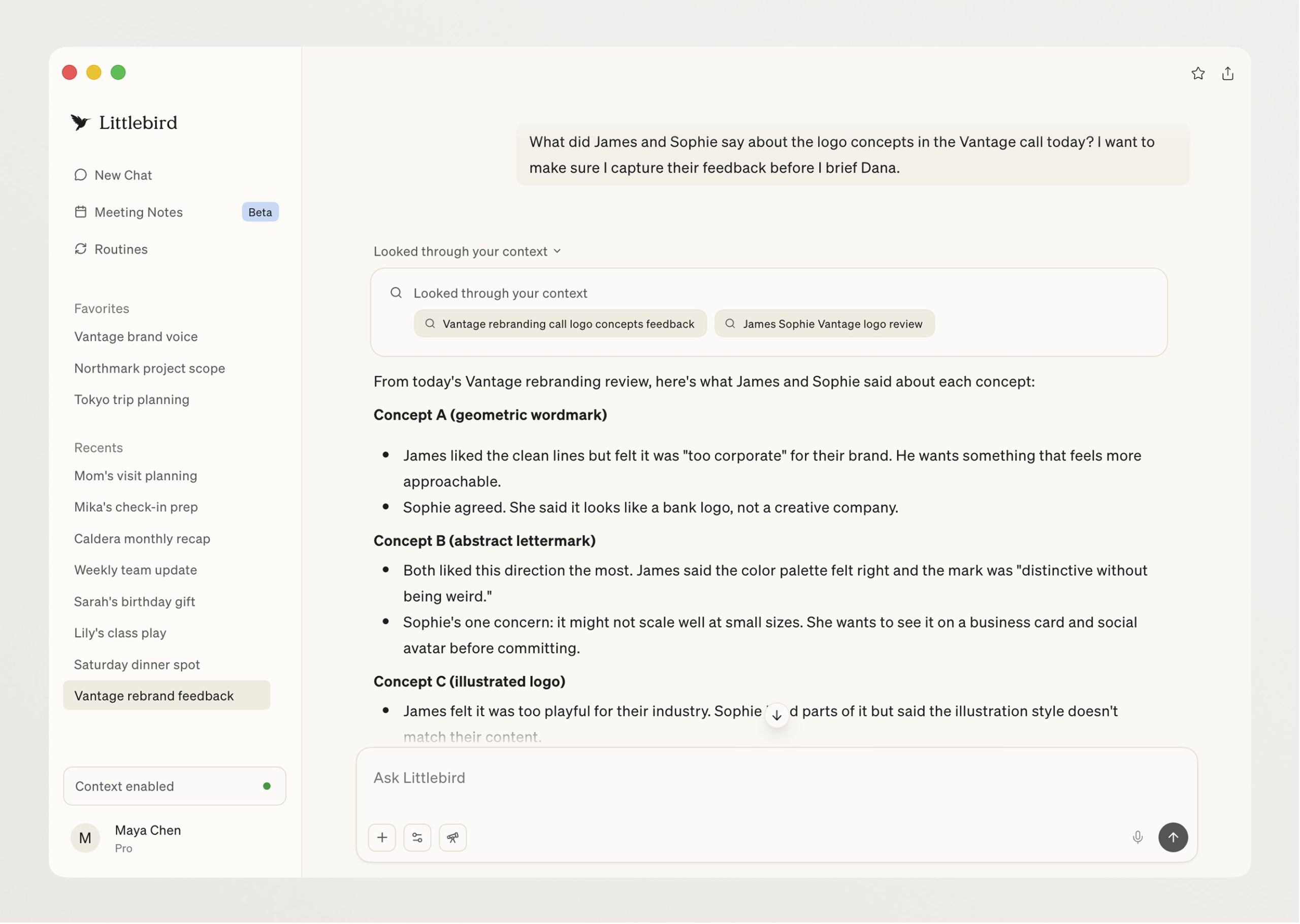

Discussions about building context for AI systems have been prevalent. In consumer software, startups have emerged focusing on search, documents, and meetings. These tools aim to capture context from digital activities, offer connections to other tools, and allow users to query the collected data. Some have taken this further, like Rewind and Microsoft Recall, which aim to record everything occurring on your screen to aid memory.
A new startup, Littlebird, follows a similar path but with a unique approach. Unlike apps like Rewind, which store screenshots, Littlebird “reads” the screen, saving the context as text.
The product’s core idea is that by continuously reading your screen, there’s no need for extra context for productivity. The startup asserts that while many AI tools can distract, Littlebird works quietly in the background, appearing only when needed.
After setting up Littlebird, users can specify apps to be ignored, preventing context capture. The startup automatically excludes password managers and sensitive web form fields like passwords and credit card info. Users can link apps like Gmail, Google Calendar, Apple Calendar, and Reminders to it.
The app allows users to ask questions about their data, providing pre-generated prompts like “What have I been doing today?” or “What kind of emails are important to me?” Over time, these prompts became more tailored.
Littlebird includes a Granola-like notetaker that captures meeting transcriptions using system audio, generating notes and action items. In a meeting’s detailed view, the “Prep for meeting” option considers past meetings, emails, and company history to give more details. It also gathers information from platforms like Reddit about users’ opinions on a product or company.
A feature called Routines offers detailed prompts for Littlebird to execute at scheduled intervals like daily, weekly, or monthly. The company provides routines like daily briefing, weekly activity summary, and yesterday’s work summary. Users can also create custom routines.
Littlebird was founded in 2024 by Alap Shah, Naman Shah, and Alexander Green. Alap and Naman previously founded Sentieo and a healthy food company, Thistle, while Green has built companies in hardware, software, and AI.
“When Alap recognized that AI’s future involves users’ data, limiting its utility, we explored potential UI and OS disruptions with AI. This led to Littlebird’s inception,” Green shared with TechCrunch.
Green noted that while Rewind was similar, it relied on screenshots without a great search experience. The startup is just beginning, aiming to solve more problems, including helping large language models (LLMs) understand varied user contexts.
With Littlebird, users can delete their data anytime, which is cloud-stored and encrypted. Green explained that storing data in the cloud facilitates powerful model running for AI workflows, which isn’t feasible locally.
“We don’t store visual information. We only store text, significantly reducing data size. This was a challenge for Recall and Rewind, which stored heavier data through screenshots. It’s also less invasive,” he added.
Littlebird is free, but users can purchase plans from $20/month to access more features and higher usage limits, including image generation.
The startup has raised $11 million, led by Lotus Studio, with contributors like Lenny Rachitsky, Scott Belsky, Gokul Rajaram, Justin Rosenstein, Shawn Wang, and Russ Heddleston.
Several investors frequently use the product. Rajaram expressed that Littlebird eliminates the friction of memory and work retrieval. Heddleston shared that he revamped his company’s marketing site using Littlebird’s context from various sources.
Rachitsky, who manages a newsletter and podcast, remarked that AI’s effectiveness hinges on context, which often misses key daily details. He uses the tool to enhance productivity and happiness, noting the need for a compelling use case for long-term success.
“I think it’s crucial to identify that essential use case. It’s critical for the product’s success. Many have already discovered it, and the team focuses on these experiences as they see them emerge,” he noted.
“I’ve interviewed many AI product builders on my podcast, and a common theme is that you can’t predict how users will utilize your product until it’s available. The strategy is to launch early, observe user interactions, and focus on those use cases rather than wait for a fully-formed solution.”