
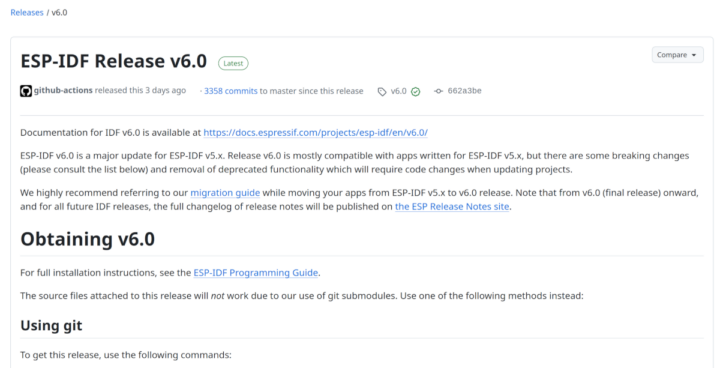

Espressif Systems recently launched the ESP-IDF v6.0 framework, featuring stable support for ESP32-C5 and ESP32-C61 SoCs, along with preview support for ESP32-H21 and ESP32-H4 low-power wireless microcontrollers.
The framework introduces the ESP-IDF Installation Manager for easier setup, utilizes the low-footprint Picolibc C library, includes security and tooling updates, Wi-Fi enhancements, and allows bootloader updates over the air.
Here are highlights of ESP-IDF v6.0:
– **ESP-IDF Installation Manager**: A cross-platform tool for simplifying ESP-IDF and compatible IDEs installation, available as a GUI or CLI. More details are available in the installation instructions.
– **Picolibc replaces Newlib**: Offers a smaller memory footprint and improved performance on resource-constrained devices. More details can be found in the Newlib vs Picolibc comparison.
– **Security updates**:
– Upgrades MbedTLS to version 4.x, moving cryptographic operations to the PSA Crypto API.
– Applications using legacy mbedtls_* cryptographic primitives will need to migrate to PSA Crypto APIs.
– **Build System and Tooling Improvements**:
– New CMake build system (Preview)
– Custom idf.py extensions for added commands and tools in the ESP-IDF CLI
– Default Kconfig values marked with a # default: annotation
– Build configuration presets storable in the CMakePresets.json file, allowing for simplified command usage.
– Built-in MCP server for AI assistants, detailed in the documentation.
– **Wi-Fi enhancements**: Introduces experimental support for Wi-Fi Aware Unsynchronized Service Discovery and a “WPA3 Compatible” mode for simultaneous WPA2 and WPA3 client support.
– **Safe Bootloader OTA updates**: Supported on ESP32-C5 and ESP32-C61, featuring fallback to a recovery partition if the primary bootloader fails.
For more details, check the full changelog on the release notes database or access the ESP-IDF v6.0 release on GitHub.
Support CNX Software by donating via cryptocurrencies, becoming a Patron on Patreon, or purchasing goods on Amazon or Aliexpress. Affiliate links are used in articles to earn commissions on purchases made through those links.