

During a conversation with Blake Resnick, he described walking through his drone startup’s latest office in Seattle, a vast 50,000-square-foot space expected to be fully operational potentially by November. This large, mostly vacant building symbolizes a burgeoning company eager to dominate its field.
The industry in focus is public safety, and the startup, Brinc, provides drones to police and public agencies across the U.S. Resnick has expressed his ambition for Brinc to become the western counterpart to Chinese drone manufacturer DJI, indicating that he wants Brinc to achieve a similar level of industry recognition.
Former Thiel Fellow, a program that supports young entrepreneurs bypassing or deferring college, Resnick established Brinc in 2017 and soon caught the attention of Sam Altman, then-founder of OpenAI, who became one of Brinc’s early investors. Brinc has since undergone multiple funding rounds and, according to Resnick, recently achieved a nearly half-billion-dollar valuation.
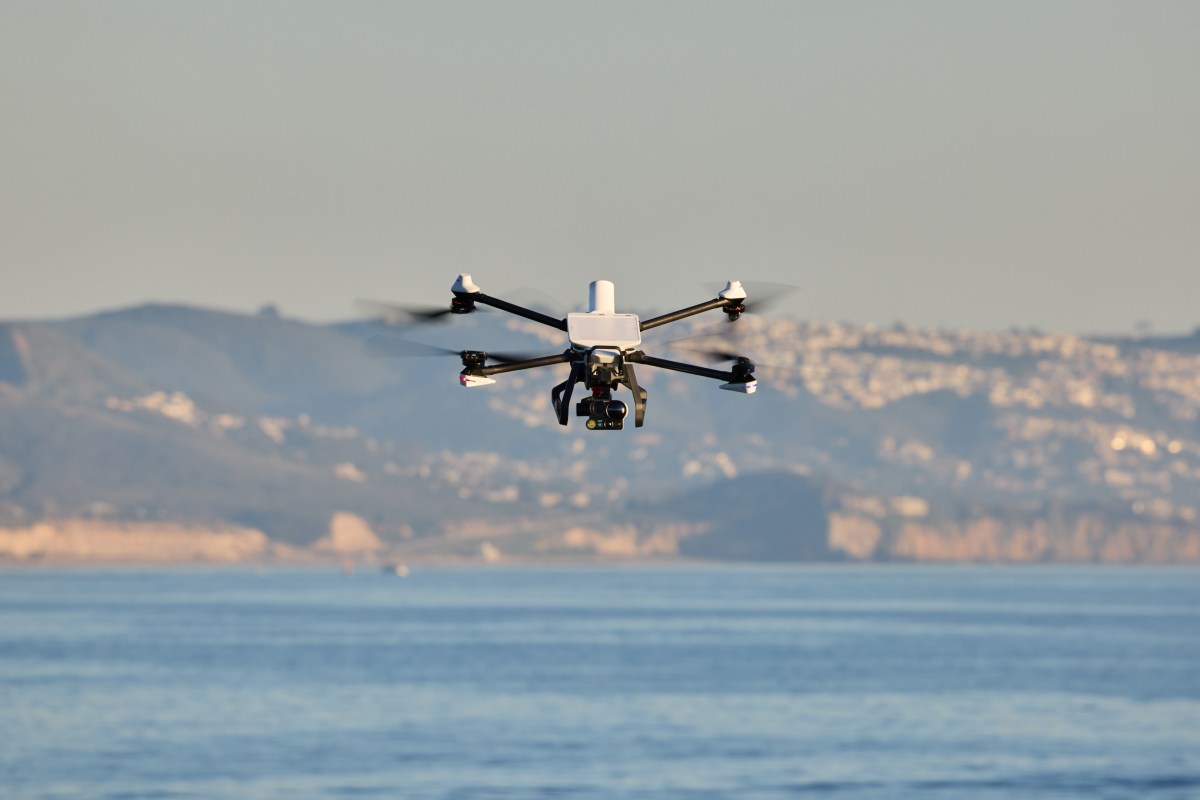
On Tuesday, Brinc unveiled its latest product, the Guardian, which Resnick described as the closest alternative to a police helicopter within the drone industry. The company claims it’s the most capable 9-11 response drone globally.
Guardian features impressive specifications and capabilities, reportedly reaching speeds of 60 mph with a 62-minute flight time. It includes thermal imaging cameras and two 4K cameras with zoom capabilities, allowing for detailed observation from high altitudes. It is also equipped with a spotlight and a loudspeaker louder than a police siren.
The drone’s landing station, or “charging nest,” allows for automatic battery swapping and can hold crucial safety gear such as defibrillators, flotation devices, and Narcan, all autonomously.
An embedded Starlink panel provides Guardian with global connectivity capabilities, making it the first public safety drone with this feature. Starlink, SpaceX’s satellite internet service, enables the drone to operate with unlimited range anywhere worldwide.
Resnick views public safety as a significant venture. He noted, “There are about 20,000 police departments in America, 30,000 fire departments, 80,000 police and fire stations — and we think the top half of that market in the future will have a 911 response drone in a recharging nest on the roof,” estimating a $6 billion to $8 billion market opportunity domestically and internationally.
Brinc recently collaborated with the National League of Cities to expand “drone as first responder” programs nationwide, an initiative to build connections with potential customer communities.
Recent geopolitical changes have also benefited Brinc. DJI previously held a significant share of the global drone market, including in the U.S., where safety agencies heavily relied on its products. However, a ban on foreign-made drones by the Trump administration has opened up a significant market opportunity.
“There is this huge need for a DJI of the West, or a leading drone manufacturer for the free world, and ultimately, that’s what we want to be,” Resnick said.