
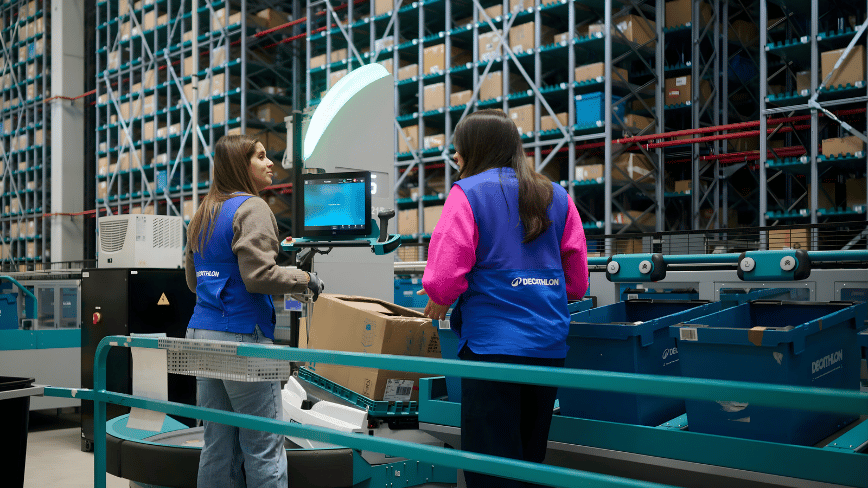

The world’s largest sporting goods retailer has entrusted seven of its European warehouses to robots, and initial results indicate the machines are proving valuable. Decathlon announced that its collaboration with Exotec, a French warehouse robotics firm, has yielded significant productivity increases across facilities in France, the UK, Portugal, Italy, and Germany.
Numbers presented substantiate the improvement. For instance, at its Setúbal, Portugal warehouse, Decathlon now prepares 114,000 orders daily, double the previous 57,000 before automation. A French warehouse almost doubled the stores it replenishes, from 37 to 73. At the Northampton site in England, workers who used to walk over 10 km daily now cover less than one. Workplace incidents linked to order picking there have dropped by half, from one in 5,000 to one in 10,000.
These are not the humanoid robots often seen in headlines. Exotec’s Skypod, its flagship product, consists of wheeled machines resembling large Roombas. They carry storage bins and climb proprietary shelving up to 14 meters, handling vast numbers of items daily. A typical Decathlon setup involves 150 to 200 Skypods, along with automatic depalletisers, carton-openers, RFID tunnels, and palletisers, all coordinated by Exotec’s Deepsky software.
Romain Moulin, Exotec’s co-founder and CEO, states that the main advantage is density, not just speed. Traditional warehouses stack shelves to about two meters for human pickers, necessitating larger spaces as orders grow. The average warehouse covers about 18,000 square meters, but with Skypods’ vertical ability, Exotec claims a reduction to 6,000 square meters without losing capacity since the same volume requires less floor space.
This means retailers can operate in smaller, cheaper locations or use the extra space elsewhere. For Decathlon, with over 1,800 stores worldwide and 101,000 employees, the benefits are clear: a standardized warehouse model quickly expandable to various markets. Moulin asserts Exotec can open a new automated warehouse every four months.
A critical issue with warehouse automation is its impact on employment. Exotec’s data partially answers this: at one site, picker positions dropped from 50 to 12 after installing Skypods, with remaining employees shifted to returns processing and repairs.
Moulin views this as an improvement in work conditions, not just workforce reduction. Workers now walk less each shift, injury rates have decreased, and facility throughput has improved, necessitating that reassigned workers manage larger goods volumes.
This narrative addresses a structural issue. Labor shortages in warehouse logistics are severe and worsening in Europe, Japan, and the US. According to Moulin, every customer struggles to recruit pickers, and the warehouse robotics market, projected at $8.75 billion in 2026, is expanding over 18% annually due to this deficit.
Exotec’s strategy does not involve humanoid robots. While firms like BMW and Amazon explore humanoid robots for warehouses, Moulin dismisses this for his needs, suggesting that using a humanoid robot to push a cart daily merely repeats the problem automation should resolve. Instead, Exotec employs specialized machines optimized for single tasks, enhanced by AI for routing, scheduling, and inventory management.
This approach, focusing on pragmatism and specialization without spectacle, exemplifies European industrial robotics. Founded in 2015, Exotec achieved unicorn status in 2022, raising $335 million at a $2 billion valuation, supported by Goldman Sachs. Its annual revenue now approximates €300 million, with Skypod systems operating at over 200 sites globally, including Uniqlo, Carrefour, Gap, and Geodis.
The Decathlon deployment, branded as the Skyfleet program, is Exotec’s largest multi-site rollout to date. Future success as a model for European retail supply chain management depends on whether the productivity gains are sustainable. For the 38 former pickers reassigned at one location, the outcome may already be apparent.