

RuView is an open-source “WiFi DensePose” implementation, using multiple ESP32 nodes to convert WiFi signals into real-time human pose estimation, vital sign monitoring, and presence detection without depending on video cameras.
WiFi DensePose is a sensing technique, initially explored in academic research, that uses WiFi signals to reconstruct human pose. RuView implements this technique in Rust or Python, utilizing your WiFi router and several ESP32 nodes to track body pose, detect breathing rate, and measure heart rate, even through walls. This project is controversial, as some have labeled it fake.
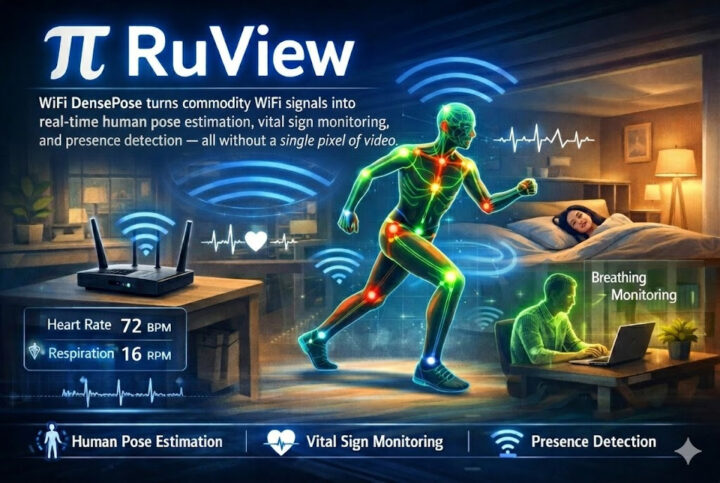
The solution uses Channel State Information (CSI) disturbances caused by human movement to reconstruct body position, breathing rate, heart rate, and presence in real time through “physics-based signal processing and machinelearning”.
CSI-capable hardware is necessary, and not all consumer WiFi nodes support this. The project description lists different hardware options:
- ESP32 Mesh (recommended) – 3-6x ESP32-S3 + WiFi router; Approximately $54 (ESP32 nodes only) for pose, breathing, heartbeat, motion, presence
- Research NIC – Intel 5300 / Atheros AR9580 (~$50-100) with full CSI and 3×3 MIMO
- Other WiFi client – Windows, macOS, or Linux laptop (no additional cost); RSSI-only for coarse presence and motion detection
If no WiFi hardware is available, the solution can be run in simulated mode with synthetic CSI data. However, with ESP32-S3 mesh, the following performance metrics may be achievable:
- Pose estimation – 54K fps (Rust)
- Breathing detection – 6-30 BPM
- Heart rate – 40-120 BPM
- Presence sensing – 1ms latency
- Through-wall – Up to 5m depth
Installation on the host machine requires Docker and works on Windows 10/11, macOS 10.15, Ubuntu 18.04 or higher, and firmware installation on each ESP32-S3 node. Presence detection, motion level, breathing rate, and signal quality should work without neural networks. However, pose estimation with a 17-keypoint skeleton is not plug-and-play, requiring the user to train a model for their environment. Instructions are available in the user guide on the project’s GitHub repo. The web dashboard is accessible at http://localhost:3000. For a quick look at the web interface using simulated data, the live demo website may be checked.
