
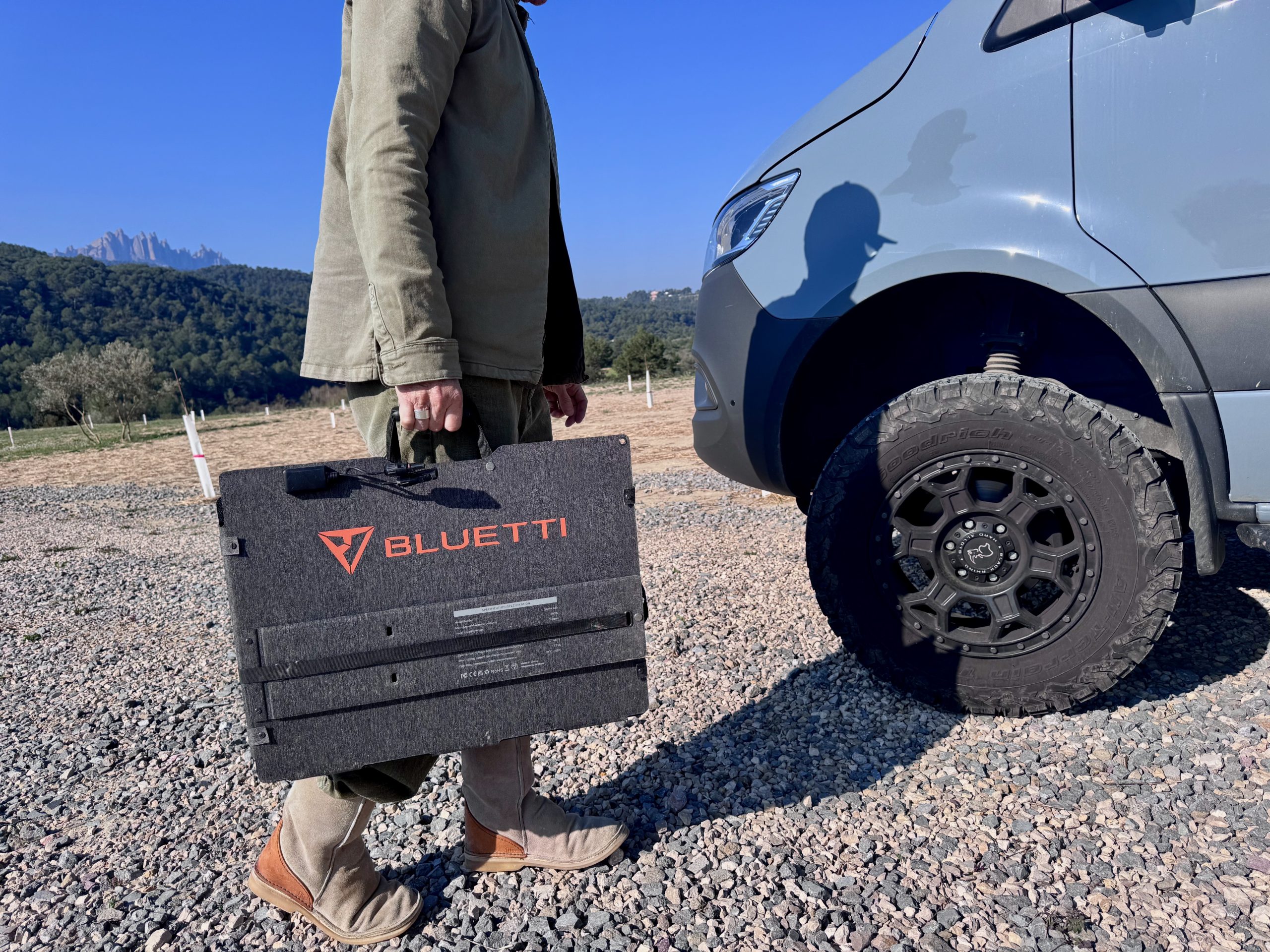

It’s unfortunate that the 500W N-Type panel is not bifacial and isn’t available in the US yet.
At The Verge, we rarely review solar panels, but the technology in Bluetti’s incredibly portable Sora 500 panel deserves a closer look. The advanced N-Type panels from Bluetti and others offer better value, making them a crucial choice for vanlifers who rely on such portable solar panels to extend their stay off-grid.
In my testing, Bluetti’s 500W panel delivered an impressive 509W to my van’s power station, adding significant power when used with the three 140W monocrystalline panels installed on my van. Typically, I consume around 1.6kWh daily, so this setup enables me to recharge a full day’s worth in just two hours. However, I wish Bluetti made the Sora 500 bifacial like Jackery and Zoupw, which designed their lighter, high-wattage portable panels to maximize output in suboptimal conditions.
The Sora 500 is priced at €849 in Europe and is not available in the US yet. According to Bluetti’s spokesperson Ellen Lee, there are plans to introduce it to the US market, navigating through some regional policies and trade dynamics, obstacles that Zoupw and Jackery have already addressed.
Bluetti’s Sora 500 uses TOPCon (Tunnel Oxide Passivated Contact) cells, an N-Type technology that outperforms older PERC (Passivated Emitter and Rear Cell) technology. Compared to PERC, the TOPCon panels have better low-light performance, handle high temperatures more efficiently, and degrade slower. Consequently, these panels offer greater efficiency (often between 23-25%) compared to typical PERC panels (20-23%), depending on their implementation.
These enhancements mean you’ll get more value from your investment as soon as you set up all 12 panels of the Sora 500 over their extended lifetime. Additionally, the panel includes IP67 resistance to dust and water and an ETFE coating for easier cleaning.
During my mid-March tests in southern France at approximately 600 meters altitude, the Sora 500 consistently delivered above its rated output, measuring up to 509W on a cool, clear day. It also maintained good performance in partial shade.
For example, on a very sunny day when the Sora 500’s 12 panels were generating over 500W, partial shading lowered the output to 412W with one corner panel shaded and 390W when shading the right two panels. Shading four panels adjacent to the center reduced the output to 276W. However, covering the center four panels significantly decreased the output to 50W, possibly due to disconnecting the entire array along its power zones. Bluetti employs a half-cut cell design and a 3-series, 4-parallel (3S4P) circuit configuration for the Sora 500, creating multiple independent power zones to prevent a shaded area from becoming a bottleneck like with lower-quality panels.
Bluetti, however, chose to cover the back of the panels with fabric and a complex system of kickstands and straps. In contrast, the Zoupw 480W and Jackery SolarSage 500 X N-Type panels are bifacial, meaning they can gather ambient light from the panel’s back when placed on reflective surfaces such as snow, sand, concrete, and grass.
I haven’t tested these panels myself but have seen user reports of exceeding 525W output with the Zoupw. Notably, both panels weigh 22lb (10kg), lighter than the 28.4lb (12.9kg) Bluetti Sora 500.
While weight is crucial for portability, it’s important to remember these panels can become airborne on windy days. Thankfully, the Bluetti panel I’ve tested includes tie-down points for added security in gusty weather. All three panels are lighter than the reliable 400W PERC panel from EcoFlow that I’ve used for four years, weighing 35.3lbs (16kg) and priced at $599.
Vanlifers will find the Bluetti Sora 500 exceptionally convenient when storing the panel in an RV, van, or closet. Both Zoupw and Jackery use standard 4-section or 6-section slab-fold designs, while Bluetti utilizes a 12-section grid fold, creating a compact package similar to a briefcase. The folded 3.3-inch thick Bluetti is thinner than the Zoupw panel at 3.35-inch thick and Jackery at 3.82-inch thick.
However, setting up the Sora 500 is cumbersome due to the numerous hinges and straps needed to stabilize so many segments. Despite this, it’s a puzzle I mastered after three attempts, though adjusting the panel for optimal sun exposure can be tedious.
Without official US pricing for the Sora 500 panel, it’s challenging