
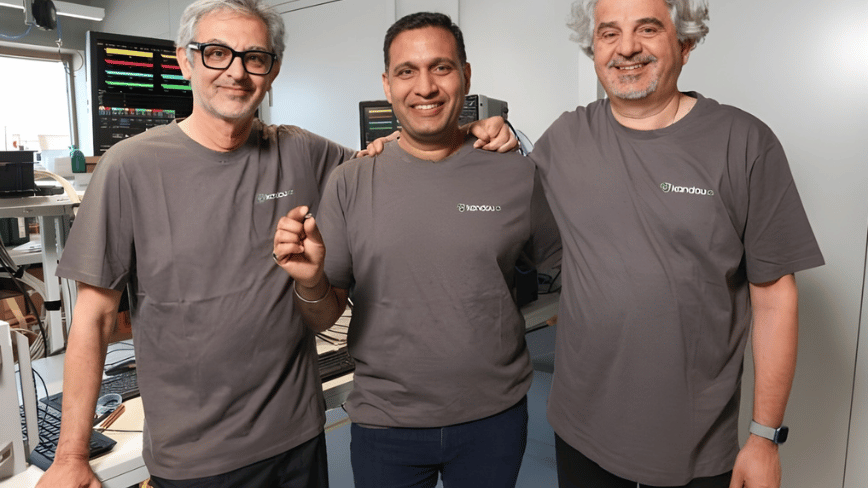

Kandou AI, a Swiss semiconductor firm specializing in chip-to-chip interconnect technology, has secured $225 million in what it’s calling a Series A round. The funding was led by Maverick Silicon, with strategic contributions from SoftBank, Synopsys, Cadence Design Systems, and Alchip Technologies. This round places the company’s value at $400 million. This “Series A” tag marks a rebrand and leadership change rather than a new start since Kandou, founded in 2011 as Kandou Bus, had previously raised over $163 million across Series B and C rounds.
Srujan Linga, formerly a Goldman Sachs managing director, became CEO in 2025, succeeding founder Amin Shokrollahi, an EPFL professor who invented the core technology. Shokrollahi’s Chord signalling method, sending correlated signals across multiple wires for better bandwidth and reduced power use, remains central. Linga’s rebranding to Kandou AI and focus on AI infrastructure has proven successful, with this funding the largest in the company’s history and bringing SoftBank, a major AI infrastructure investor, into the fold.
Distinctively, Kandou AI emphasizes copper over the industry’s shift to optics to address AI interconnect challenges. As models grow and training clusters expand, the speed of data flow between processors and memory is a limiting factor. With copper interconnects at signaling speeds of 224 gigabits per second consuming significant power and having signal degradation issues, optics has been the favored solution. Ayar Labs raised $500 million for optical interconnects, and Marvell acquired Celestial AI for $3.25 billion for its photonic technology.
Kandou AI argues that copper, enhanced with its Chord technology, isn’t obsolete. They assert it reaches near Shannon-capacity efficiency, dramatically reducing costs and extending capabilities to 448 gigabits per second and beyond. If true, it suggests the premature nature of the costly optical shift, offering a longer lifecycle for copper infrastructure.
The syndicate of strategic investors is noteworthy. Synopsys and Cadence, leaders in electronic design automation, signal potential integration of Kandou AI’s technology into standard design processes. Alchip provides manufacturing pathways, while SoftBank offers substantial capital and networking.
Kandou’s model emphasizes licensing its technology, similar to Arm’s approach, rather than producing chips, which is more cost-effective. Achieving market dominance with a $400 million valuation amid heavily valued optical competitors is the core challenge.
Valued at $400 million, Kandou AI is positioned significantly lower than Ayar Labs and Celestial AI. This could reflect doubts about copper’s future in AI, or recognition of its potential with existing setups. Kandou’s technology could enable another generation of AI workloads more effectively than shifting to optical solutions.
Nonetheless, as AI models and training clusters quickly evolve, the adequacy of copper speeds is uncertain. The optical interconnects promise higher speeds despite their complexity and cost.
With $225 million secured, Kandou AI aims to demonstrate the continued viability of copper. Its 15-year history and Chord signalling’s commercial usage lend credibility. Yet in a market favoring bold over incremental advancements, proving copper’s relevance while the sector leans toward replacing existing materials will be a tougher story to sell. The investors are betting on practical engineering, but market acceptance relies on the optical shift’s progression and Kandou’s ability to keep pace with an unyielding industry.