
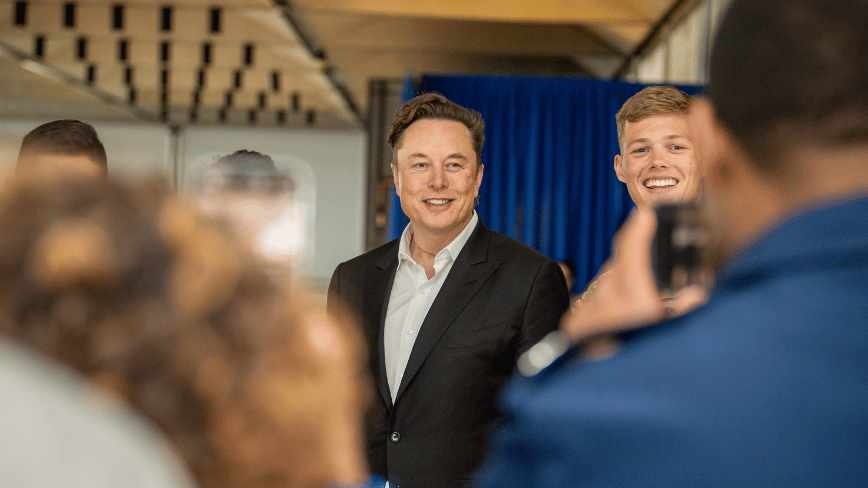

All co-founders recruited by Elon Musk to build xAI have reportedly left the company. Manuel Kroiss, who led the pretraining team, announced his departure this month. Ross Nordeen, described by Business Insider as Musk’s “right-hand operator,” left on Friday. These departures mark the exit of the last two of eleven co-founders from a company valued at $250 billion when SpaceX acquired it in February. Musk himself mentioned recently that it was “not built right the first time around.”
The exits are significant, as the researchers Musk brought together in 2023 were among the top in artificial intelligence. Jimmy Ba co-authored the highly cited 2014 Adam optimization paper. Igor Babuschkin, the chief engineer, was from Google DeepMind. Christian Szegedy came from Google. Tony Wu led the reasoning team. Greg Yang, Toby Pohlen, Zihang Dai, Guodong Zhang, and Kyle Kosic had backgrounds from DeepMind, Google, Microsoft, and OpenAI. This entire team has now left, and the company is being “rebuilt from the foundations up,” as per Musk.
A timeline of unravelling
The departures became evident in early 2026. Christian Szegedy left in February 2025, signaling early trouble. The situation escalated when Tony Wu announced his exit on February 10, 2026, and Jimmy Ba resigned shortly after. By mid-March, only Kroiss and Nordeen were left. Their recent departures concluded the exodus.
This timing correlates with xAI’s corporate restructuring. On February 2, SpaceX acquired xAI in a transaction that valued SpaceX at $1 trillion and xAI at $250 billion, combining to form a $1.25 trillion entity. SpaceX is preparing for a potential IPO in mid-2026 targeting a $1.75 trillion valuation.
In January, Tesla invested $2 billion in xAI’s Series E round, valuing the company at $230 billion. Tesla shareholders are suing Musk for breach of fiduciary duty, accusing him of directing shareholder capital into his private venture. This was intensified when Musk acknowledged on March 13 that xAI’s products were not competitive with Anthropic’s Claude Code or OpenAI’s Codex. Tesla invested $2 billion in a company needing a complete rebuild, as admitted by its founder.
What “not built right” means at $250 billion
Musk’s March 13 admission was untypically candid for a CEO of a recently acquired $250 billion company. He stated xAI’s AI coding tools were ineffective and needed a full system rebuild. This likely justified the co-founders’ departures: if the leadership confirmed product failure, the researchers had little motivation to stay for a rebuild, particularly given better compensation offers elsewhere.
The AI talent market in 2026 is extremely competitive. Meta has offered packages worth up to $300 million over four years for top AI researchers. OpenAI, Google DeepMind, and Anthropic are all aggressively expanding their research teams. The departure of eleven researchers from xAI represents talent highly desirable to these companies. Their future moves will reveal industry directions as much as their xAI departure reflects its past.
xAI has assets. The Colossus supercomputer, with over 200,000 NVIDIA H100 GPUs, is a major AI training cluster. Grok, the company’s chatbot, has a distribution channel via X’s user base. The SpaceX merger provides access to substantial capital, infrastructure, and engineering talent. However, the key question is whether these are sufficient without the research leadership critical to competitiveness.
The pattern
The xAI co-founder exodus mirrors a pattern seen across Musk’s companies. Twitter saw significant leadership loss after his 2022 acquisition. Tesla’s senior ranks have diminished as Musk’s focus spread across six companies. This management style, successful in hardware engineering, seems less effective in research fields where talent has better alternatives and intolerance for instability.
Artificial intelligence research in 2026 is a highly competitive field. xAI’s co-founders joined due to Musk’s resources and project ambition. Their collective exit, even during a $250 billion valuation period and SpaceX resource access, suggests xAI’s problems are organizational, not financial or infrastructural. Capital