

Welcome back to TechCrunch Mobility — your go-to source for news and insights about the evolution of transportation. Subscribe for free to get this delivered to your inbox by clicking [here](https://techcrunch.com/newsletters/)!
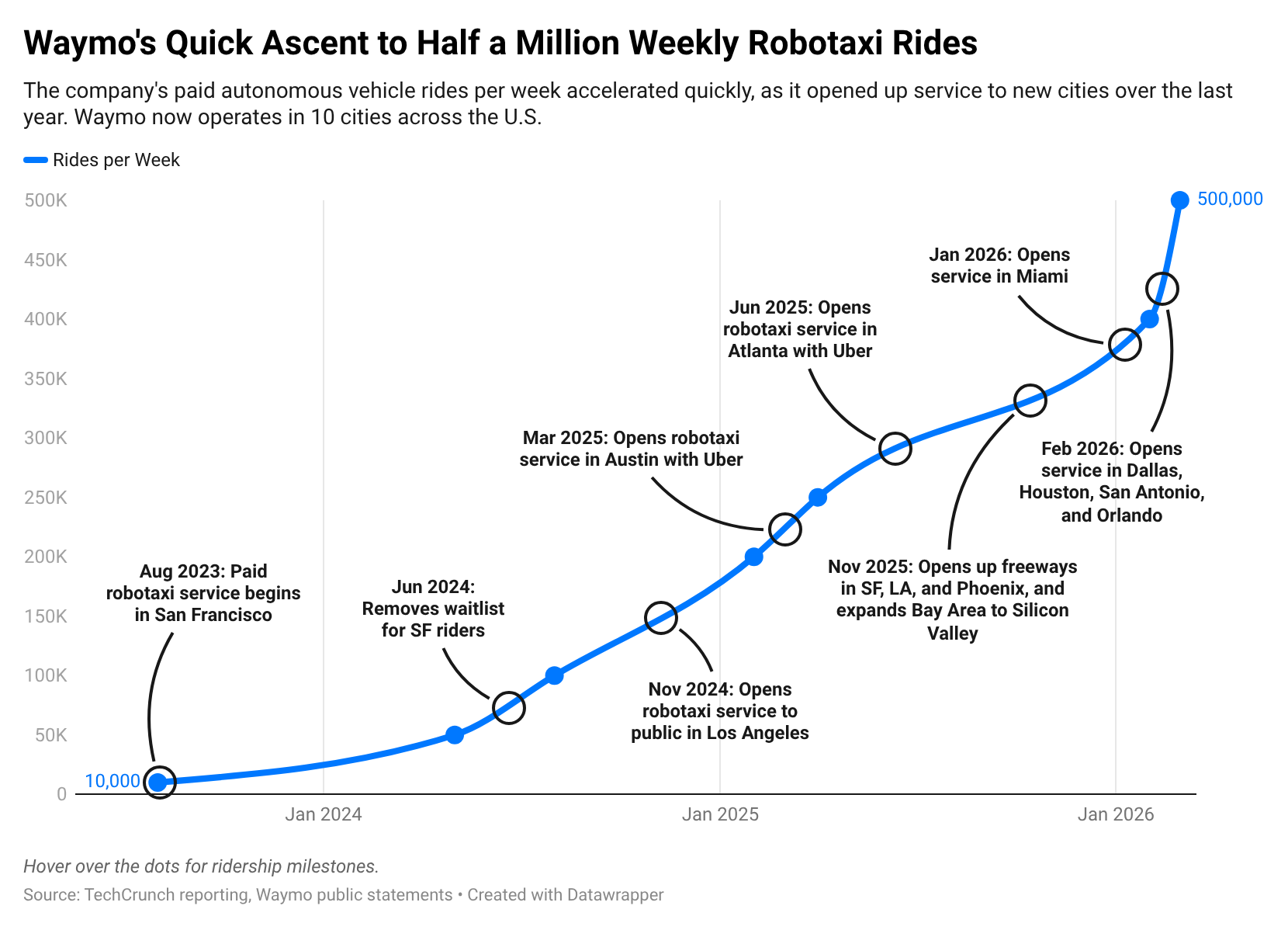
**Waymo** announced offering 500,000 paid robotaxi rides each week. Although smaller in scale compared to **Lyft** and **Uber**, what intrigued me most was the growth rate and new market expansions relative to fleet size. We created a [chart](https://techcrunch.com/2026/03/27/waymo-skyrocketing-ridership-in-one-chart/) visualizing this rapid expansion.
However, this growth introduces challenges, such as robotaxis being immobilized, as many were during December’s California blackout. It raised questions about what occurs when a robotaxi is stuck — and who resolves it.
Senior reporter **Sean O’Kane** explored [Waymo’s system](https://techcrunch.com/2026/03/25/waymo-robotaxi-roadside-assistance-emergency-first-responders/), including its roadside assistance team, and multiple incidents where first responders had to move stranded robotaxis. For instance, during an emergency in Austin, a police officer had to move a Waymo robotaxi.
At its essence, Sean discovered that Waymo relies on public services funded by taxpayers to relocate its vehicles.
Opinions on this vary, with some viewing it as unacceptable, others as trivial, or somewhere in between. In a recent hearing, San Francisco District 4 supervisor **Alan Wong** noted that using first responders as a roadside service is contentious among his peers.
For those unconcerned, it’s worth considering future implications.
This isn’t exclusive to Waymo. Companies like **Motional** and **Zoox** aim to roll out paid robotaxis in the U.S. this year, with **Tesla**, operating in Austin, harboring ambitious plans. Each company’s system varies in reliance on first responders.
*Image Credits: TechCrunch / DataWrapper*
*A little bird*
*Image Credits: Bryce Durbin*
A source close to **Uber** mentioned that **Waymo**, which the ride-hailing giant partners with in various cities, can take up to 30% longer than human drivers. This is due to the cautious nature of the robotaxi and its avoidance of complex situations like unprotected left turns. (Note: Waymo cars can handle left turns but may avoid them due to difficulty.)
*Got a tip for us? Email Kirsten Korosec at* [[email protected]](mailto:[email protected]) *or Sean O’Kane at* [[email protected]](mailto:[email protected]).
*Deals!*
*Image Credits: Bryce Durbin*
**Zipline**, involved in autonomous drones, has expanded in home delivery and globally, securing more funding. The company [raised $200 million](https://techcrunch.com/2026/03/23/zipline-snaps-up-another-200m-to-fuel-its-drone-delivery-expansion/), adding to an earlier round announced in January. The Series H round now totals $800 million, valuing Zipline [at $7.6 billion](https://techcrunch.com/2026/01/21/zipline-charts-drone-delivery-expansion-with-600m-in-new-funding/).
The reason for substantial investor interest: exceeding home delivery volume forecasts in January and February, with expectations of continued growth.
**Other deals of note:**
– **NoTraffic** raised $90 million in Series C funding, led by PSG Equity, as reported by [Axios](https://www.axios.com/pro/enterprise-software-deals/2026/03/24/notraffic-90m-psg-series-c).
– **Rivian** acquired [another $1 billion](https://techcrunch.com/2026/03/27/rivian-gets-another-1b-from-volkswagen/) from **Volkswagen Group** after achieving a joint venture milestone.
– **Shield AI** raised $1.5 billion in Series G funding at a $12.7 billion valuation, led by Advent and a JPMorganChase group.
– **Swish**, a food delivery firm in Bengaluru, [secured $38 million](https://techcrunch.com/2026/03/23/bengaluru-food-startup-swish-raises-38m-in-its-third-round-in-18-months/) in Series B led by Hara Global and Bain Capital Ventures.
– **Uber** plans to invest in **Verne**, Rimac Group’s robotaxi company. This is part of a [broader deal](https://tech