

Bluesky has introduced an AI assistant named Attie that enables users to create personalized social media algorithms and custom feeds within its AT Protocol ecosystem. The reaction has been highly contentious.
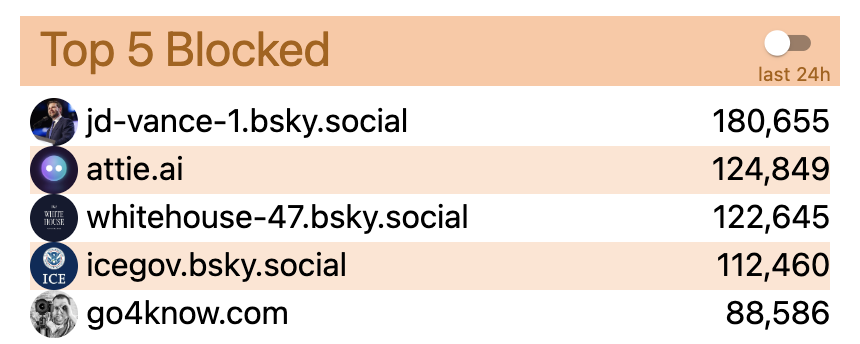
Attie was unveiled this weekend at the ATmosphere conference, sponsored by Bluesky. However, the userbase did not welcome the new product. Approximately 125,000 users have blocked Attie’s Bluesky account, making it the second most blocked account on the network, according to open source data. Attie has only 1,500 followers, indicating about 83 times more users have blocked than followed the account.
The account with more blocks than Bluesky’s AI agent is Vice President J. D. Vance, with around 180,000 blocks — Attie even surpassed the White House account (122,000 blocks) and the ICE account (112,460 blocks). This places Attie among a group of highly criticized entities on a platform with a predominantly left-leaning audience.
Bluesky did not respond to requests for comment before publication.
Bluesky has a userbase of 43 million accounts, many of whom joined as an alternative to Elon Musk’s X, which is reported to be plagued by neo-Nazism and AI-generated CSAM. For many users, Bluesky provides a haven from the mainstream social media landscape dominated by AI technologies, making the introduction of Attie feel like a betrayal.
Critics have also pointed out Bluesky’s lack of response to user demands for basic features, such as image sharing through direct messages.
From Bluesky’s perspective, this product launch isn’t as problematic as it might appear.
Jay Graber, the former Bluesky CEO now serving as CIO, stated in a blog post that the company believes “AI should serve people, not platforms.”
“Currently, AI is simultaneously undermining and enhancing human agency,” Graber wrote. “The abundance of low-quality AI-generated content is making public social networks increasingly noisy and less reliable when we most need accurate information. The vital information is becoming harder to discern just when it is most crucial.”
Graber argues that, though AI has its malevolent uses, the technology has a broad range of potential applications, some of which may benefit humanity. Social media is notoriously poor at facilitating nuanced discussions on emotionally charged issues. Still, critics of AI have valid concerns about the technology, including its environmental impact and cultural implications.
Compared to other more harmful uses of AI, the risk posed by Attie is relatively minor. However, for Bluesky users, the discontent is less about Attie itself and more about what it represents: a concession to the notion that AI’s pervasive influence is unavoidable.
This story has been amended to clarify Bluesky’s association with the ATmosphere conference.