
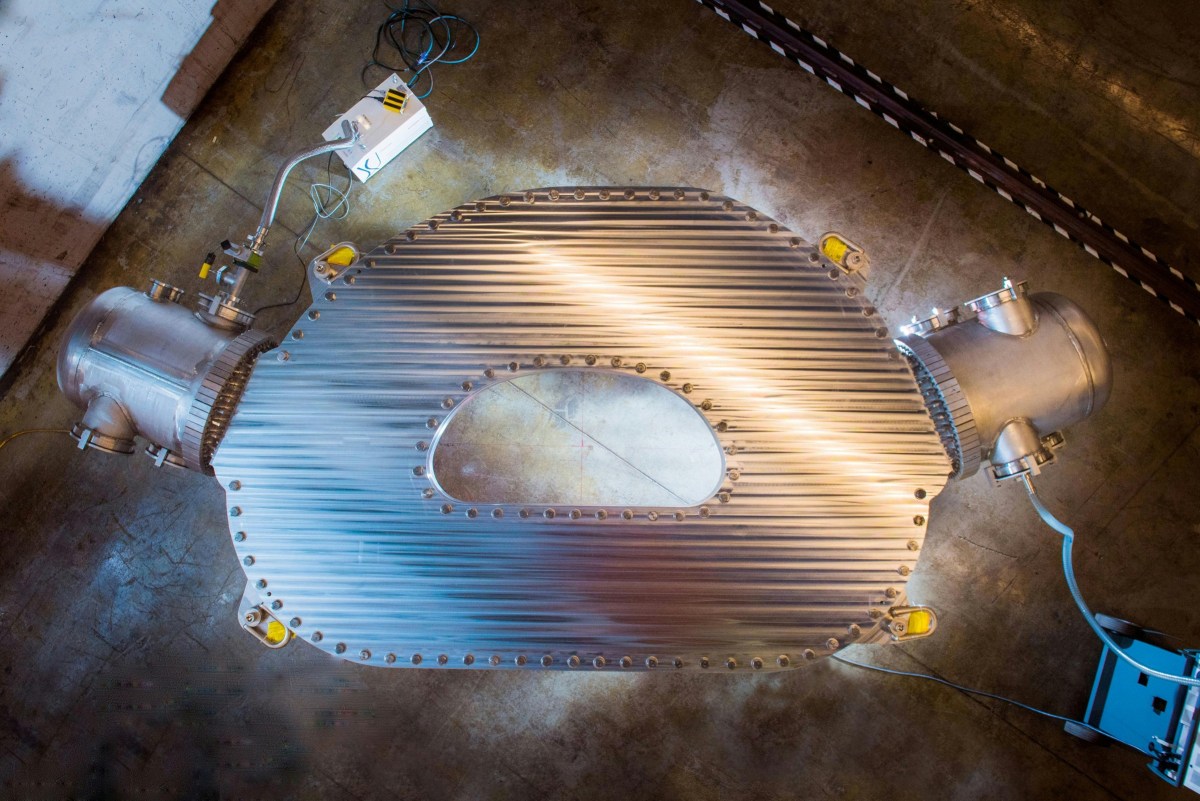

Commonwealth Fusion Systems announced on Thursday its agreement to supply high-temperature superconducting magnets to Realta Fusion, marking the second such deal indicating the company’s emphasis on leveraging its magnet technology for revenue in the future.
“It’s the largest deal of this kind to date for CFS,” said COO Rick Needham during a press call.
CFS had earlier provided magnets to the University of Wisconsin’s WHAM experiment, a project closely associated with fusion startup Realta. The magnetic mirror reactor technology that Realta uses is based on the physics behind WHAM.
In a magnetic mirror, the plasma is confined in a shape like two soda bottles joined at the base. Magnets at each end push the plasma towards the center, while weaker magnets encircle the midsection.
Realta, backed by Khosla, can scale its reactor by expanding the central section, using less powerful and therefore cheaper magnets, potentially reducing the per kilowatt-hour costs as the reactors grow.
CFS is developing tokamaks for magnetic confinement fusion. In a tokamak, powerful D-shaped magnets maintain the plasma in a doughnut-shaped path. The company has been refining these magnets, aiming for its Arc commercial-scale reactor planned for Virginia to join the electric grid.
The existence of both CFS and Realta is based on these magnets. CFS was founded in 2018 following MIT scientists’ discovery that new high-temperature superconductors could support a viable tokamak design. Realta emerged when University of Wisconsin physicists saw this new technology as a game-changer for magnetic mirror reactors, according to co-founder and CEO Kieran Furlong.
Besides deals with Realta and WHAM, CFS has also licensed its magnet technology to Type One Fusion, focusing on stellarator reactor designs. Although this deal doesn’t currently include CFS manufacturing magnets for them, it remains a possibility, as noted by CFS’s head of external communications, Christine Dunn.
These agreements help CFS recoup its investment in magnet production. The company spent seven years and hundreds of millions building a factory for fusion-spec superconducting tape manufacturing. This material has been used for Sparc, the demonstration reactor, expected to activate later this year. The deals sustain factory operations until full work begins on the commercial plant Arc.
“With Spark now 70% complete, the timing was perfect to begin supporting Realta with our magnet manufacturing,” Needham stated.
CFS doesn’t currently see Realta and Type One as direct competitors due to their different reactor designs. Realta’s initial focus on industrial applications for high-heat needs also sets it apart from CFS in the market.
So far, CFS has raised nearly $3 billion, a significant portion of venture capital directed at fusion startups. This strategic position allows it to build essential facilities like its magnet factory ahead of others. While the company promotes these deals as beneficial to the fusion sector by providing access to costly technologies, it also attracts further venture investment indirectly.