
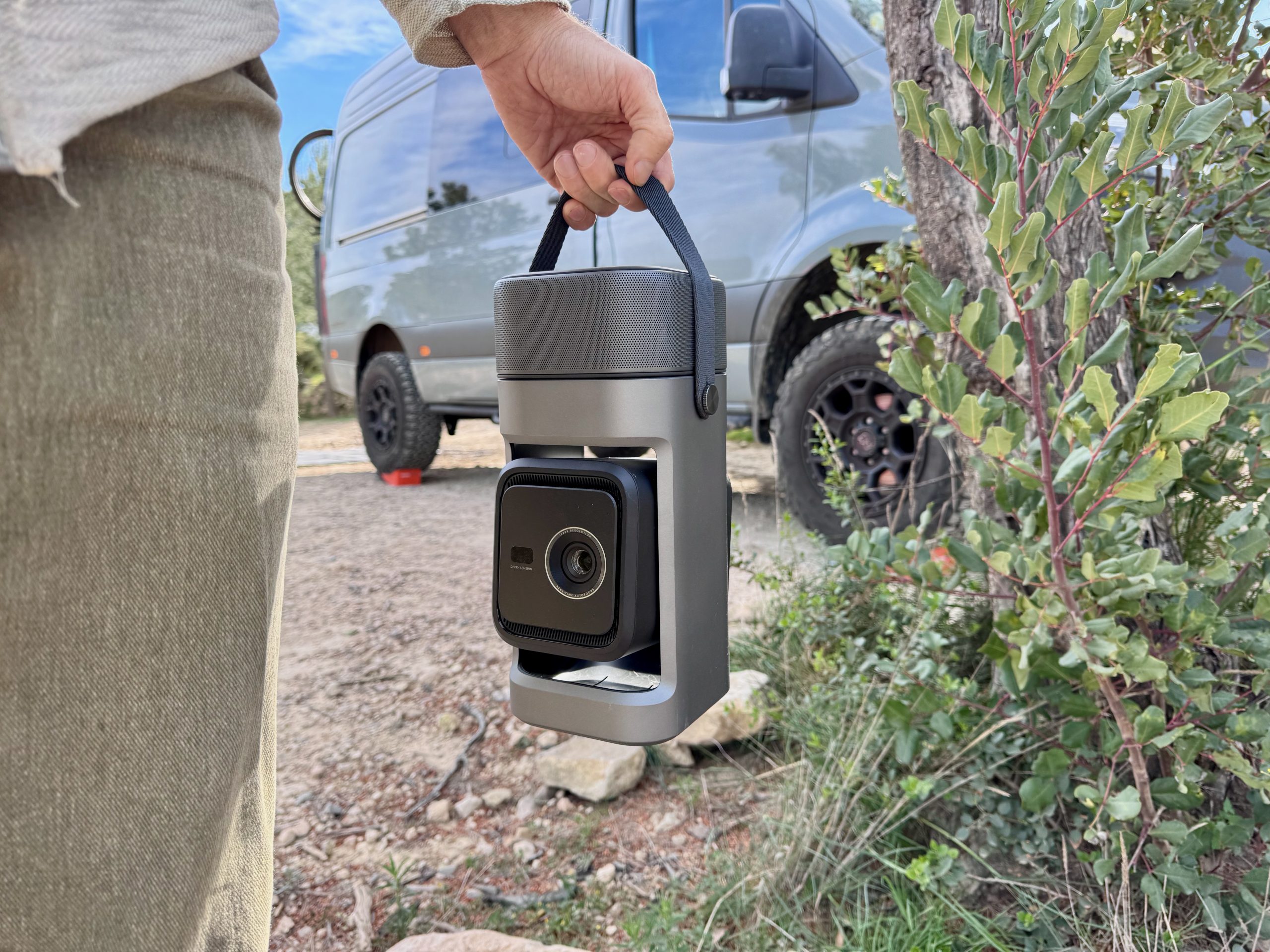

Too bad they forgot the battery.
The Soundcore Nebula P1 from Anker isn’t the most portable Google TV projector I’ve reviewed, nor is it the brightest. It doesn’t have a built-in battery. Instead, it focuses on sound.
The standout feature is its detachable speakers offering true left- and right-channel separation, sounding better than typical all-in-ones like TCL PlayCube, Xgimi MoGo, or Anker’s Capsule projectors.
Testing the $799 (on sale for $639) Nebula P1 while traveling the European countryside, it’s not my favorite portable projector, but I’ve grown fond of the P1— sometimes the best projector is the one with you.
Anker’s impressive portable projectors started with the $3,000 Nebula X1, then the massive X1 Pro. The Nebula P1 trims excess, weighing 5.3 pounds and fitting vanlife or impromptu movie nights—provided there’s a power outlet or large USB-C battery.
In dark rooms, it delivers a satisfying 1080p image. Its 650 ANSI Lumens LED light struggles with too much ambient light, but in close quarters, it still impresses.
The detachable 10W speakers provide a wide and pleasant soundscape. They magnetically attach to my van for a clean outdoor movie setup, enhancing the immersive experience by positioning audio where the action happens.
The sound, while decent and soda can-sized, benefits from being used as a Bluetooth speaker. The volume fills a room effectively.
Madeleine Peyroux’s “La Vie En Rose” sounded fantastic. However, bass-heavy tracks like Kendrick Lamar’s “Not like Us” felt thin due to the lack of a subwoofer like in Anker’s larger projectors.
The Nebula P1 operates quietly at 26dB from a meter away. Its IP54 resistance protects against dust and light rain splashes, while the projector itself is rated IP33 for light rain protection.
Anker claims the P1’s speakers last 20 hours before needing a recharge. They magnetically dock on top of the projector to charge while plugged into a wall or a 100W USB-C battery. They also charge directly over USB-C while in use, helpful during low-battery warnings.
Booting into Google TV takes about 50 seconds or 5 seconds from sleep, consuming 6W. Streaming Netflix at maximum brightness for an hour uses 51Wh, meaning a typical 99Wh power bank won’t last a full movie like “Pulp Fiction” without recharging.
The Nebula P1 features Intelligent Environment Adaptation 4.0, claiming automatic adjustments, but struggles with obstacle and screen detection. Anker’s “VisionFit” tech requires snapping a photo with an app for screen detection, which is cumbersome.
Fortunately, autofocus and keystone correction work well, with manual overrides and presets for frequent locations. The swivel mount offers flexibility without extra props.
Lacking a built-in battery means dealing with cables or extra batteries—an inconvenience with the Nebula P1.
While enjoyable, TCL’s PlayCube is preferable for true portability, costing the same, being brighter, tilting, and having a three-hour battery, although not matching the Nebula P1’s sound quality.
Specs: Anker Nebula P1
– Display Technology: DLP 0.23” DMD
– Resolution: 1920 × 1080
– Light Source: LED
– Brightness: 650 ANSI Lumens
– Color Gamut: 124% Rec. 709
– Native Contrast Ratio: 400:1
– Light Source Lifespan: 25,000 Hours
– Aspect Ratio: 16:9
– Throw Ratio: 1.2:1
– Offset: 100%
– 3D Content Compatibility: No
– Focus Adjustment: Auto / Manual
– Projection Mode: Front / Rear / Front Ceiling / Rear Ceiling
– Keystone Correction: Auto (Vertical ±40°), Auto (Horizontal ±30°)
– Interface: HDMI 2.1 (eARC), AUX-OUT, USB-A, USB-C
– OS: Google TV (With Official Netflix)
– Modes: Projector Mode / Bluetooth Speaker Mode
– Screen Mirroring: Google Cast Built-In
– CPU: Quad Core ARM Cortex-A55
– GPU: ARM Mali-G52MC1
– RAM / ROM: 2 GB / 32 GB
– Speakers: 10W ×2 (Dolby Audio Supported)
Photography by Thomas Ricker / The Verge