

Table of Contents
The 2026 version of my favorite robot vacuum from the previous year has arrived: As of March 23, the $1,599.99 Roborock Saros 20 is available in the U.S.
This is not simply a matter of whether the Saros 20 is better than the Saros 10R—it literally is. As the new version of the Saros 10R, the Saros 20 comes with several upgraded specs. So in my at-home testing, I’m seeing if the Saros 20 excites me in 2026 as much as the Saros 10R did in 2025.
What’s special (or not) about the Roborock Saros 20?
The premium robot vacuum market is more crowded than last year, so the Saros 20 needs to work harder to stand out. The Dreame X60 Max Ultra Complete is extremely similar in capabilities, slim design, and price. The Roborock Qrevo Curv 2 Flow has weaker suction and a different mopping style but remains a great vacuum from the same brand at a much lower price. Both have been available for at least a month, diminishing the Saros 20’s debut impact.
And then there’s the Roborock Saros 20 Sonic, scheduled for release later this spring. “Sonic” refers to a vibrating D-shaped mopping pad similar to what the Saros 10 had, but this one isn’t restricted to the vacuum’s circular body. It shares most of its other features with the Saros 20. Still, I can’t evaluate the Saros 20 in isolation knowing another version is coming soon.
The Saros 20 boasts several key improvements over the 10R. Not only does its 36,000 Pa suction power surpass the Saros 10R’s 22,000 Pa, but it’s now the strongest on the market, just above the Dreame X60 Max Ultra Complete’s 35,000 Pa. The Saros 20 also features the AdaptiLift Chassis 3.0: a tri-wheel system capable of lifting the vacuum over thick thresholds up to 3.46 inches. The Saros 20’s obstacle avoidance is far advanced compared to the Saros 10R.
The Saros 20 launches at $1,599.99—the same price as last year’s Saros 10 and 10R models. You’re getting an extra 14,000 Pa of suction and better navigation for the same price someone paid last year. If you already own a Roborock, you can save up to $1,050 on the Saros 20 by trading in an older model.
The Saros 20’s small obstacle avoidance is phenomenal
The Saros 20 uses the same StarSight 2.0 navigational system that the Saros 10 did. This alternative to traditional LiDAR was hyped last year, yet in my testing, it wasn’t better at avoiding small obstacles than other robots. I expected the Saros 20 to be similarly fine, but I was impressed by its accuracy. It clearly understands the different items that could appear on the floor.
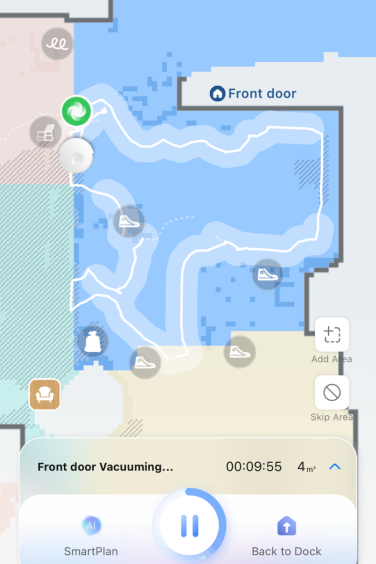
The Saros 20 consistently avoided obstacles for several days. It recognizes shoes, bags, and cords, sweeping or scrubbing up close without capturing them, while keeping a safe distance from cords. Its peripheral vision even identifies desk chairs that are easy to get stuck in, navigating back to the dock accordingly.
Is the Roborock Saros 20 good on carpet?
The Saros 20 has had reliable rug performance but hasn’t been flawless for a 36,000 Pa machine.
Its standout tests involved quinoa on a textured kitchen rug and dryer lint on a tufted living room rug, tackling both with few stragglers. The lint roller test in the living room picked up only a few stray hairs and rug fuzzies.
The Saros 20 excelled in picking up pancake mix from the flat rug, yet struggled with finer debris like protein mix and oats on a fluffier rug where the Dreame X60 Max Ultra Complete succeeded.
Bathrooms present a challenge, but the AdaptiLift Chassis handles bath mats effectively, avoiding dragging them beneath the vacuum.