
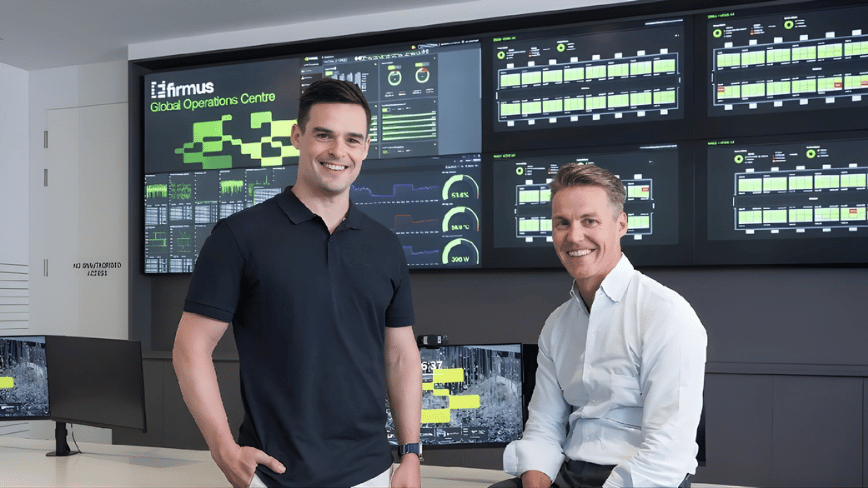

Australian AI data centre company Firmus has secured $505 million at a valuation of $5.5 billion, marking its final round before an anticipated $2 billion IPO on the ASX in mid-2026. Supported by a $10 billion Blackstone-backed debt facility, Firmus aims to deploy 1.6 gigawatts of liquid-cooled AI compute across Australia by 2028.
Firmus Technologies, an Nvidia-supported Australian firm building AI Factories powered by renewable energy, has raised $505 million in equity at a $5.5 billion valuation ahead of a planned IPO on the Australian Securities Exchange. Announced on April 6, 2026, and led by Coatue Management with Nvidia’s continued support, this is Firmus’s third equity round in half a year, pushing their total equity raised within this period to about $1.35 billion. The IPO aims to generate an additional $2 billion, potentially ranking among the largest tech listings in Australia’s history. Preparations involve Bank of America, JPMorgan, Morgans Financial, and Morgan Stanley consulting potential investors.
Firmus’s premier project, Project Southgate, is a $4.5 billion venture centered on a dedicated campus in Launceston, Tasmania, featuring modular, liquid-cooled AI Factories housing 36,000 Nvidia GB300 Grace Blackwell chips. With Tasmania’s hydroelectric-powered grid underpinning its low-carbon footprint, the first project stage will deliver 90 megawatts of AI infrastructure by 2026. Saving up to 60% energy compared to air-cooled facilities, their cooling technology could substantially boost the economics of large AI training runs. Expanding beyond Tasmania, the plan includes sites in Melbourne, Sydney, Canberra, and Perth, aiming at a total capacity of 1.6 gigawatts nationwide by 2028, with a projected cost of $73.3 billion.
In February 2026, Firmus secured a $10 billion debt facility led by Blackstone to support its expansion. This deal, one of Australia’s largest private credit transactions, provides long-dated infrastructure debt, reflecting AI data centre assets’ bankability. The funds support Project Southgate’s national rollout. Paired with $1.35 billion raised in equity, Firmus is positioned robustly, ready to simultaneously launch multiple sites pre-IPO. A surge in private credit for AI infrastructure characterizes today’s investment landscape, driven by the increasing compute demand that equity alone cannot cover. Strategic lender support comes from expected revenue streams contracted from hyperscalers and AI labs.
Nvidia, key to Firmus’s operations, stands as both a strategic investor and primary chip supplier. Initially contributing to Firmus’s $330 million raise in 2025 at a valuation of $1.9 billion, Nvidia’s stake rose with the latest $505 million raise valuing the company near $5.5 billion. Nvidia’s strategic investment and supply relationship reflect aligned incentives, further bolstering Firmus’s rapid Nvidia GB300 system deployments.
Firmus founders Oliver Curtis, Tim Rosenfield, and Jonathan Levee incorporate an intriguing backstory. Curtis’s prior insider trading conviction and subsequent business resurrection add depth to Firmus’s IPO narrative. Initially focused on cooling technology for bitcoin mining, the company’s shift to AI data centers mirrors a broader market trend—refocusing from cryptocurrencies to AI.
Australia emerges as a prominent AI infrastructure hub, with Firmus’s progress indicating substantial investment potential. Factors include abundant renewable energy, political stability, an English-speaking workforce, and Asia-Pacific proximity. Like Firmus, NEXTDC, an Australian data centre operator, secured significant funding and is developing a Sydney-based hyperscale AI campus. Australia’s AI infrastructure prospects underscore investment trends driven by energy access, regulation, and commercial needs, making it a key beneficiary alongside regions like Northern Europe and parts of Southeast Asia.
Australia’s growing AI infrastructure presence includes major deals such as Meta’s partnership with Nebius for a $27 billion infrastructure arrangement. For Firmus, the forthcoming IPO will determine if public investors align with private expectations surrounding AI infrastructure. If achieved, Firmus would join Australia’s most valued tech companies post-IPO. How Australian regulators and investors approach governance for capital-intensive AI infrastructure remains pivotal as groundwork for major sites unfolds, especially in Tasmania, leveraging the state’s hydroelectric grid for intensive AI training demands.