

In 2022, California announced its goal to install 6 million heat pumps by 2030. To date, about 2.3 million have been installed. To meet this target, roughly 2,000 installations per day are required over the next five years. This is challenging as a typical mini split takes about a day to install and costs between $4,000 to $6,000 per zone, according to EnergySage.
“We’ve got to do something different,” says Mary-Ann Rau, co-founder and CEO of Merino Energy. Merino Energy aims to simplify the heat pump installation process. The startup introduced the Merino Mono to TechCrunch, a new product priced at $3,800 with a one-hour installation time.
Rau’s background includes work at Apple, where she introduced new AirPods, and at Quilt, another heat pump startup. When she electrified her San Francisco home, she faced high costs with heat pump installation. This realization made her acknowledge the inaccessibility for many Californians and Americans.
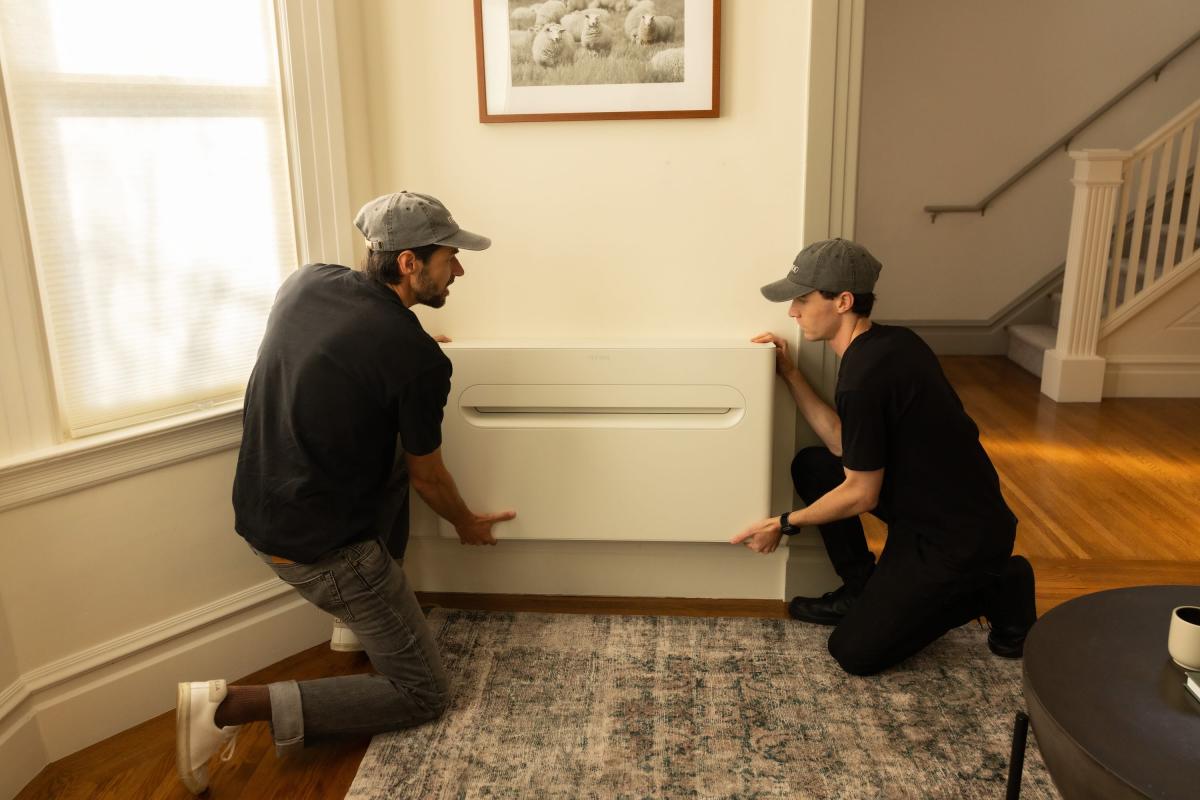
Traditional heat pumps have an indoor heat exchanger and an outdoor condenser. Merino’s design combines these into one unit similar in size to a radiator under a window, which connects to a standard 120-volt outlet, reducing the need for electrical upgrades. Rau states, “If you can plug in a microwave and it works on that outlet, then the Merino Mono is gonna work on that outlet.”
The Mono includes all modern heat pump features: Wi-Fi connectivity, room occupancy sensing, and coordinated unit operation for efficiency. An Oura Rings integration is in progress to adjust room temperature based on the wearer’s REM sleep.
To install the Mono, two wall holes are needed—one for air intake and another for exhaust. The air moves over coils for the condenser, sending refrigerant to the heat exchanger, which heats or cools room air. Externally visible are only the intake and exhaust ports and a condensate pipe.
Rau notes that Merino’s design simplifies installation by moving all components indoors, avoiding outdoor unit connections that require copper line brazing and refrigerant charging. “They’re very expensive from a labor perspective,” she explained.
Merino’s strategy trades some efficiency for the Mono’s compact size. It has a SEER2 rating of 15.2 compared to a Quilt system’s 25. Larger outdoor units perform better. However, the streamlined design suits apartments, condo buildings, and dense urban areas. Rau asserts that the Mono offers a cost-effective solution tailored to specific needs.
The company installs 48 heat pumps at Richmond, California’s Civic Center Apartments, a low-income project. Initially, it focuses on California with plans to expand to Hawaii, Oregon, and Washington. Six installers have joined in the Bay Area and Los Angeles, with pre-orders open for later this year delivery.
Rau believes this simplified product can help heat pumps become more widespread. “If we can reduce the amount of time and complexity of installing a heat pump, then we can scale adoption,” she said.