

For years, purchasing editorial coverage was more akin to rummaging through old email archives than to modern marketing. Brands would hire agencies, which then constructed media lists. This led to numerous outreach emails to publishers—sometimes hundreds. Threads expanded, negotiations stretched out, and only when everything aligned would a sponsored article or press release finally be published.
Both brands and publishers were familiar with this ritual and tired of the endless email threads bearing subject lines like “Re:Re:Re:Re: Partnership opportunity.”
Alexander Storozhuk, founder of Medialister, expressed this common frustration: “Everyone in this industry has had that moment,” he said. “You open your inbox to find fifty emails in the same thread and realize: there must be a better system.”
For Storozhuk, this frustration evolved into a product that could potentially shift the way editorial advertising operates.
**The old workflow nobody loved**
The structure of editorial advertising has remained largely unchanged for over a decade. A brand seeks credibility or visibility in a media outlet, prompting an agency or PR team to identify potential publications and begin outreach. This often involves negotiating with each publisher via email, agreeing on terms, preparing content, and eventually publishing.
In simplified form, the process is: brand → agency → email outreach → publisher.
Despite the expansion of digital marketing, the ecosystem around editorial placements remains surprisingly manual and fragmented, especially on a global scale. This sharply contrasts with other areas of advertising: display ads run through automated exchanges, social advertising is managed on centralized platforms, and influencer marketing is increasingly conducted through dedicated marketplaces. However, editorial placements still rely on spreadsheets, personal contacts, and lengthy email threads.
**Replacing email with a marketplace**
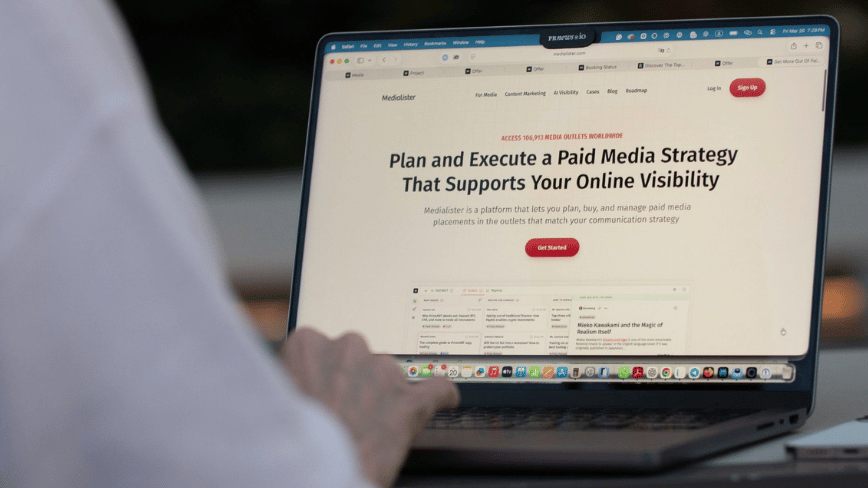
Storozhuk founded Medialister to change this. His idea is straightforward: create a marketplace where brands and agencies can discover publishers, compare placement options, and manage campaigns in one location instead of through scattered email dialogs. The platform aggregates editorial opportunities from multiple publishers, including sponsored articles, press releases, and guest posts, to secure guaranteed media placements.
Medialister didn’t appear out of nowhere; it’s a product of PRNEWS, a company established in Estonia under the government’s e‑Residency digital identity program. PRNEWS employs 72 people, and Storozhuk, with his 20 years of experience in news technologies, brings a unique blend of expertise in media, technology, and B2B communications. This background allowed him to envision how technical infrastructure, editorial teams, and growing brand demand could converge in a single system.
Simultaneously, demand for editorial advertising has shifted. Brands increasingly use sponsored content, native formats, and thought leadership to stand out in an oversaturated digital environment and overcome “banner blindness.” The B2B sector is particularly fast-growing: technology, financial, and health‑tech firms are investing more in expert content and long‑term media programs to nurture complex deals and influence multiple decision‑makers.
As AI began to reshape professional interaction with software, Storozhuk saw another transformation on the horizon. “If AI is becoming the interface for work,” he thought, “then marketplaces need to be accessible to AI too.”
**Turning AI assistants into media planners**
This week, Medialister launched a Model Context Protocol (MCP) server, allowing AI assistants like ChatGPT, Claude, and Gemini to directly interact with its editorial media marketplace. Practically speaking, marketers can now ask their AI assistant to perform tasks that previously required hours of research.
For instance: “Find technology publishers in the U.S. with domain authority above 50 and placements under $500.”
The AI can search the marketplace, find relevant outlets, and compile a shortlist of potential placements. This means the traditional workflow may evolve into a new one: brand → AI agent → marketplace → publisher.
Storozhuk describes this shift as part of a wider transformation in how professionals work with software: “AI assistants are becoming the operating system for knowledge work,” he says. “If that’s true, then marketing platforms need to become accessible to AI agents.”
**A massive, and messy, market**
The opportunity is vast. The global content marketing market is projected to reach hundreds of billions by the decade’s end, with sponsored and native formats among the fastest‑growing segments of digital advertising.
Brands increasingly rely on media placements not just for reach but also for credibility, search visibility, and thought leadership. Meanwhile, the infrastructure connecting advertisers and publishers is under pressure from various directions. Publishers face declining open‑web ad revenues, intensifying competition from large platform “walled gardens,” and a surge in the number of content sources vying for limited user attention.
Some outlets are shifting to subscription and paywall models, others are creating in‑house content studios for brands, but nearly all seek more predictable and transparent ways to monetize editorial formats.
Medialister is betting that editorial media will eventually function more like other digital advertising markets: structured, searchable, automated where it makes sense, and