
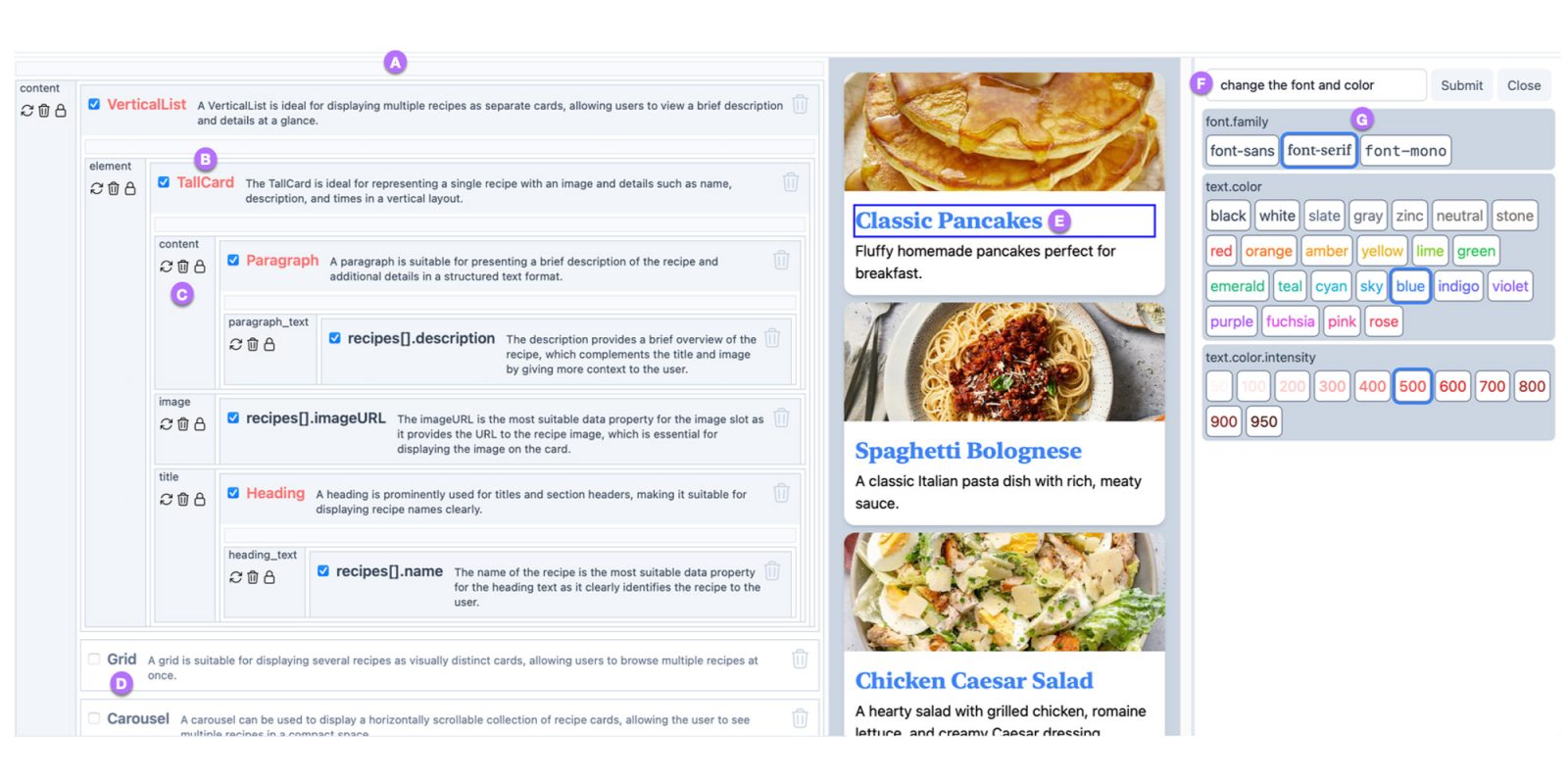

Apple scientists have unveiled SQUIRE, a groundbreaking AI-driven instrument aimed at improving the interface prototyping workflow. This tool empowers developers to investigate and enhance UI designs with much more accuracy than conventional AI coding instruments.
### A Fascinating Method for AI-Driven Interface Prototyping
In their research paper titled “SQUIRE: Interactive UI Authoring via Slot QUery Intermediate REpresentations,” Apple engineers introduce a distinctive approach for creating AI-assisted interfaces. They recognize that although natural language provides enhanced flexibility in development, it also brings about issues like ambiguity and erratic responses from the model.
SQUIRE tackles these challenges by offering a visual interface that allows developers to build and enhance UI prototypes progressively, providing clearer control over the outcomes. Users kick off a project by entering a prompt that outlines their UI objectives and sample data for reference. They then construct the UI as a tree of components, prompting SQUIRE to fill in the gaps with anticipated functionality. SQUIRE produces a list of options for each gap, refreshing both a live preview and the underlying code instantaneously. This focused approach guarantees that developers can adjust particular UI elements without disrupting the entire interface.
An investigation with 11 frontend developers indicated that SQUIRE enabled participants to confidently explore different UI designs, boosting usability and overall satisfaction. The design of the tool encouraged boldness in design modifications, as developers felt reassured that they could effortlessly revert any changes.
### SQUIRE’s Internal Mechanism
SQUIRE functions by generating an intermediate representation of the interface, referred to as SquireIR, which represents the UI as a tree of components with designated slots. This format accommodates placeholders for unspecified elements and presents various UI options. For instance, it can depict content as either a list or a grid.
When developers request modifications, only the targeted section of the UI is adjusted, avoiding unintentional changes in other areas. This precise update mechanism helps eliminate the trial-and-error cycles prevalent in many AI coding tools, where models may implement broader modifications than intended.
Although the study doesn’t explore the specifics of model training or architecture, it mentions that SQUIRE runs on OpenAI’s GPT-4o. The emphasis is on the system’s design and interaction model rather than on technical specifications.
At present, SQUIRE is not accessible to the public and was used solely by the developers who participated in the study. However, there is a possibility of its integration into future iterations of Xcode or other Apple development platforms.
For further details regarding SQUIRE, you can follow [this link](https://machinelearning.apple.com/research/squire).