
The experiment will determine how soon future astronauts can conduct a moonwalk. NASA will put the Artemis II astronauts through an obstacle course immediately after their Orion spacecraft splashdown. Commander Reid Wiseman, Christina Koch, Victor Glover, and Jeremy Hansen will undergo multiple studies before acclimating to Earth’s gravity. This includes testing their “right stuff” at NASA’s Johnson Space Center using a giant robotic crane and a heavy test suit to answer how soon humans can safely begin work in another world after a 10-day weightless mission. The experiment stems from ongoing studies with astronauts returning from six-month International Space Station missions, who typically struggle with pallor and wobbliness upon their return. Scientists are particularly concerned about astronauts’ weakened states affecting their ability to perform moonwalks or Marswalks. “We don’t want to put astronauts in a position where they’re stranded in a suit doing tasks beyond their physical capacity,” said Jason Norcross, the leading scientist on this effort. The experiment will employ the Active Response Gravity Offload System (ARGOS) to simulate different gravity environments. For Artemis II, ARGOS will be adjusted to reflect lunar gravity and tasks will mimic work needed on the moon. Within hours of landing, astronauts will complete a capsule escape drill. Using a mock spacecraft, they will need to sit up, deploy a ladder, climb over it, shoulder a pack, and walk. This seeks to assess their ability to open a hatch after a rough landing. Marie Mortreux, a space physiologist, highlights concerns about astronauts’ ability to exit the spacecraft safely, as experienced by returning astronauts seen struggling to walk upon landing. Mortreux’s research suggests that lower-body, weight-bearing muscles are most affected in space, with arm muscles faring better. Understanding these effects is crucial, even if astronauts are expected to complete these tasks despite fatigue. The following day, astronauts will engage in a simulated lunar EVA using liquid cooling garments and heavy-duty spacesuits. They will navigate a challenging course, including climbing ladders on a mock lander platform, drilling, and traversing unstable terrain with a treadmill hike. The experiment evaluates their response to tasks requiring head movements that can cause vertigo. Throughout the obstacle course, astronauts will conduct exercises like making electrical and fluid connections, crucial for a real mission, and carry several 30-pound bags over sandy terrain. They will conclude with a treadmill walk, simulating a steep uphill hike. Finally, each astronaut will participate in a 1.5-hour obstacle course while researchers track task durations, energy use, and heart rate responses. Norcross anticipates astronauts will appear and feel close to normal within four days of landing. The tests will help NASA set safe parameters for lunar excursions in future missions. Though the Artemis II crew doesn’t set foot on the moon, they gain a feel for a lunar EVA. “For this Artemis II crew, it’ll be, ‘Congratulations, you’ve done your lunar EVA,'” remarked Norcross.
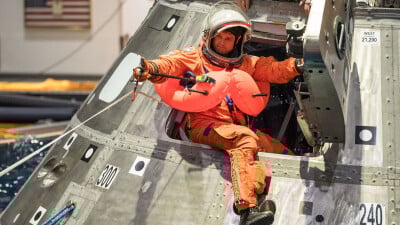
Artemis II Crew Faces Grueling Obstacle Course Post-Splashdown

3 Min Read