
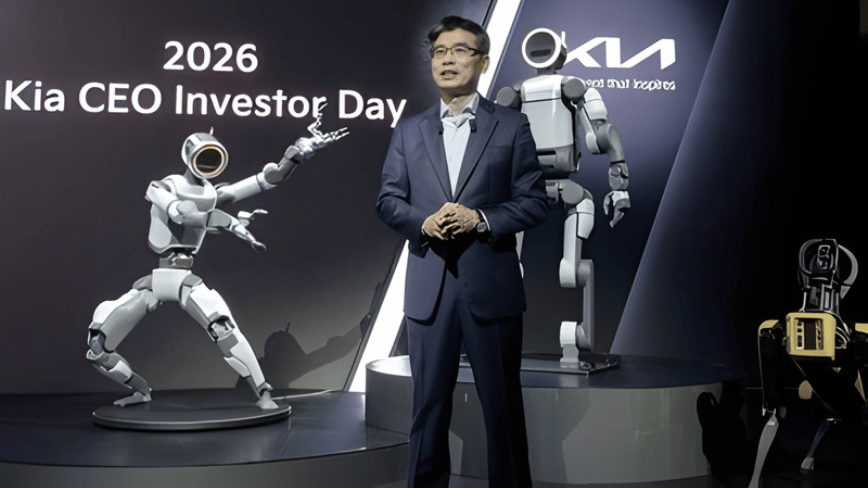

On the day US tariffs on South Korean imports took effect, Kia held its 2026 CEO Investor Day in Seoul, unveiling plans for a reduced 2030 EV sales target, expanded hybrid range, a North American electric pickup, and deploying Boston Dynamics’ Atlas robots in Georgian factories by 2028. The five-year investment plan totals KRW 49 trillion, aiming for KRW 170 trillion in revenue by 2030.
Kia President and CEO Ho-sung Song outlined a direction focusing on EVs, HEVs, autonomous driving, and robotics as growth drivers. Kia seeks revenue through diverse technology strategies, reflecting a broader approach than solely focusing on battery-electric vehicles.
Kia revised its 2030 EV sales target to 1 million units annually across 14 models, down from previous targets due to factors like US EV subsidy removal and import tariffs costing KRW 3.3 trillion in 2025. The company plans to boost its hybrid offerings, targeting annual HEV sales of 1.1 million units by 2030, alongside plans to sell 2.1 million electrified vehicles per year. The PBV range adds a 232,000 unit target by 2030. Regionally, Kia aims for sales of 1.02 million units in the US, 746,000 in Europe, and 1.48 million in emerging markets.
For 2026, Kia projects KRW 122.3 trillion in sales and KRW 10.2 trillion in operating profit, reflecting recovery from prior tariff impacts. The current 15% tariff rate under the Korea-US agreement may change with ongoing trade policy discussions.
Kia confirmed a mid-size electric pickup targeting North America, seeking a 7% market share with about 90,000 annual sales. The vehicle’s production is strategically positioned at US facilities to avoid import tariffs, highlighting a shift in product strategy.
Kia advances its timeline to use Boston Dynamics’ Atlas robots in manufacturing, with initial deployment at Hyundai Motor Group’s site by 2028, and expanding to Kia’s factory in 2029. This staged integration reflects the evolving role of humanoid robots in complex assembly tasks.
Kia commits to developing software-defined vehicles with highway-level autonomous capability by 2027, aiming for urban autonomy rollout in 2029. Amid rapid changes in autonomous technology, Kia focuses on integrating meaningful driver assistance into high-volume production vehicles.
The financial plan allocates KRW 49 trillion for investment from 2026-2030, with KRW 21 trillion for robotics, SDVs, and autonomous driving. By 2030, Kia targets KRW 170 trillion in revenue and a 10% operating profit margin. This strategy reflects an effort to capture value from automation and software transitions, underlining the challenge traditional automakers face in competing with tech companies in mobility.