
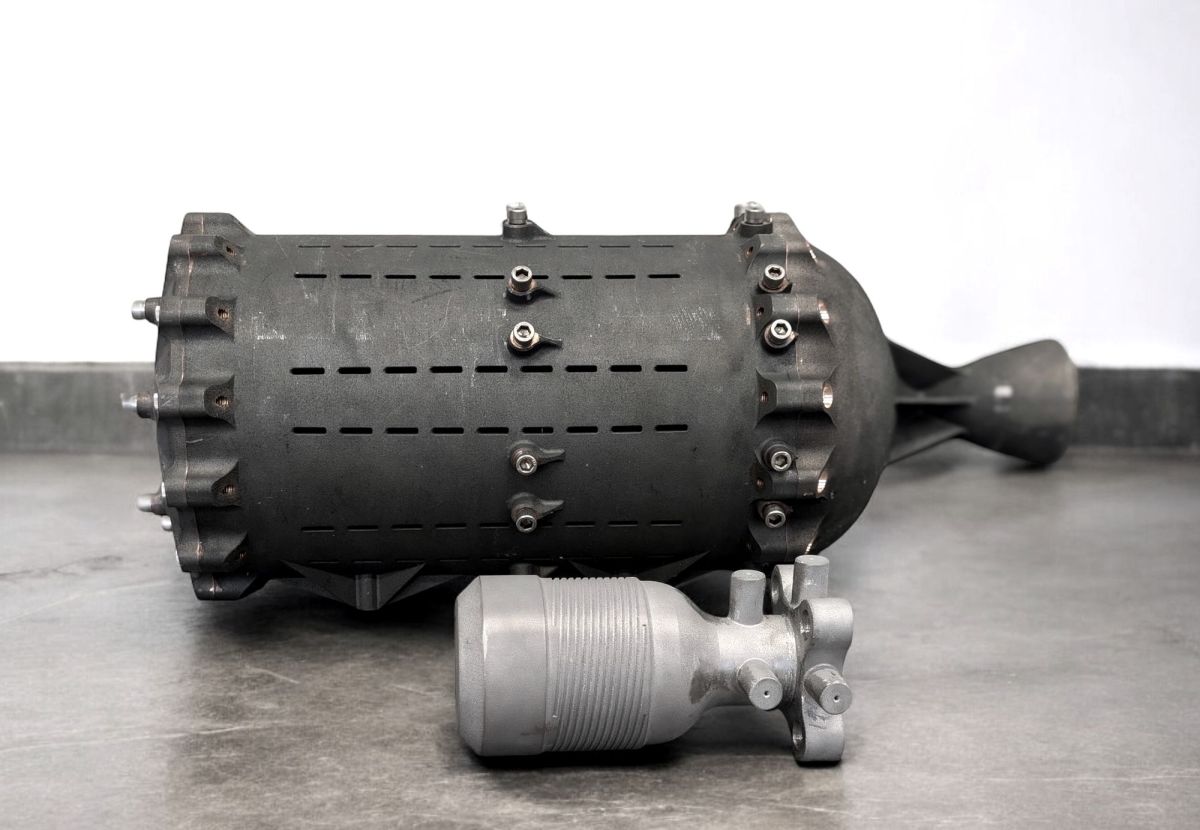

Jeff Thornburg, who transformed a government research project into SpaceX’s powerful rocket engine, is now attempting to replicate that success with his startup, Portal Space Systems. The company is taking a concept once dismissed by NASA and converting it into advanced propulsion for next-gen spacecraft.
Founded in 2021, Portal revealed a $50 million Series A funding round on Thursday, valuing the company at $250 million. Geodesic Capital and Mach33 led the round, with participation from Booz Allen Ventures, ARK Invest, AlleyCorp, and FUSE.
Portal is working on a technology called solar thermal propulsion. Unlike current satellite engines that either burn chemical fuel or use the sun’s energy to generate electricity for low-powered thrusters, Portal’s engines harness solar heat to warm propellant, propelling spacecraft at high speed.
This technology has been explored in government labs since the 1960s, recently as a concept for an interstellar probe, but has yet to reach orbit. Thornburg, together with co-founders Ian Vorbach and Prashaanth Ravindran, aims to change that within two years.
Thornburg’s career began in the U.S. Air Force, developing efficient rocket engines known as full-flow staged combustion. Later, Elon Musk recruited him to SpaceX to develop the Raptor engine for the Starship.
After working with Stratolaunch and Amazon’s Project Kuiper, Thornburg returned to propulsion innovation.
Solar thermal power represents, in Thornburg’s view, the next rocket technology step. Although NASA’s 2003 report noted its potential, further development stalled due to low demand for in-space mobility at that time. Today, however, the demand has shifted due to the increasing number of satellites and military needs for agile spacecraft.
“It’s no longer acceptable to move slowly on orbit,” Thornburg told TechCrunch, indicating the rising competition with nations like China.
Portal has secured $45 million in strategic funding from the U.S. military, in addition to $67.5 million in private capital, with its technology poised for orbital warfare applications, as stated by Booz Allen Ventures’ managing director, Travis Bales.
As space sees a surge in satellite numbers providing essential services, operators will require cost-efficient propulsion options, says Aaron Burnett, CEO of the aerospace-focused venture fund Mach33. He envisions Portal as a leader in “space mobility,” delivering propulsion across various clients.
To achieve its goals, Portal must demonstrate its technology in orbit. Last week, its flight electronics embarked on a test mission, with another prototype slated for launch in October. The company’s first working engine prototype, SuperNova—a spacecraft likened to a “fighter jet for orbit”—is anticipated to launch in 2027.
Portal leverages recent advancements in additive manufacturing and materials science, particularly in developing its Hex thruster—a combined solar concentrator and nozzle.
While nuclear-powered rockets are considered the future of solar system travel, the regulatory hurdles involved make them challenging for startups. Yet, Portal’s engine paves the way for a nuclear thermal propulsion system, using a reactor to replace solar heat. Once the U.S. government decides to pursue it, Thornburg’s team will have already tested many components in orbit.
“I’ll be able to help mature this technology faster on orbit than we ever will by trying to build a $2 billion ground test facility that’s nuclear safe,” Thornburg said.