
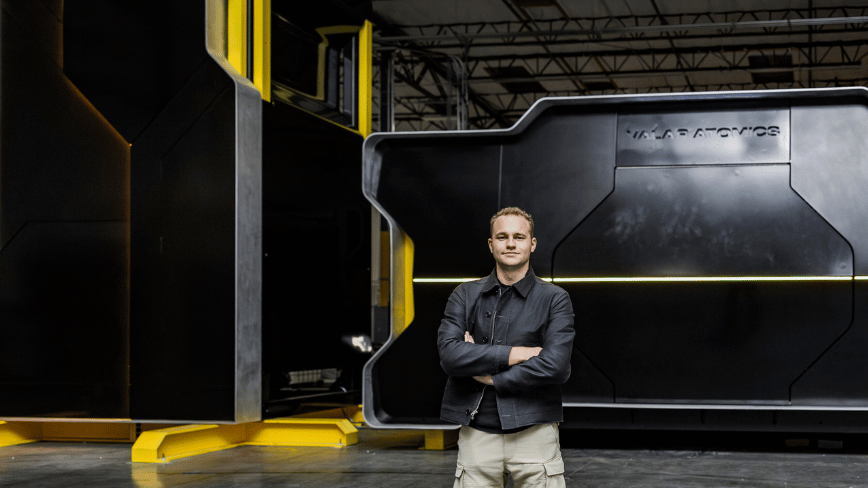

Isaiah Taylor was just sixteen when he identified a major issue in the nuclear industry: the reactors’ size. While their danger and expense were obvious, their excessive size was a critical flaw. The traditional multi-gigawatt structures scattered across America were built to deliver electricity one-way—from remote plants to far-away cities. They were never designed to support the modern infrastructure demands of AI data centers with rapidly growing consumption needs.
Now aged 27, Taylor founded Valar Atomics in 2023 for a different approach. The startup, based in El Segundo, California, announced a $450 million funding on Tuesday at a $2 billion valuation per Bloomberg’s report. This round included $340 million in equity and $110 million in debt, following a $130 million Series A tied to a much lower company valuation.
Prominent figures from the U.S. defense-tech realm, known for making large investments recently, back Valar. Notable investors include Palmer Luckey, founder of Anduril Industries, and Shyam Sankar, CTO of Palantir Technologies. The Series A had participants like Snowpoint Ventures (co-founded by Doug Philippone of Palantir), alongside Day One Ventures and Dream Ventures. John Donovan, a Lockheed Martin board member and former AT&T top executive, also invested.
Valar’s proposal revolves around “gigasites”—vast industrial areas with numerous small, high-temperature gas-cooled reactors working in unison. These reactors use helium and TRISO fuel in graphite, promoting higher operational temperatures than standard designs. The company claims these sites can consistently supply dense, carbon-free power to meet the specific needs of AI centers, manufacturers, and grid-pressured regions.
This innovative idea addresses a pressing concern: the future of electricity sourcing. The International Energy Agency foresees data-center power needs doubling by 2026. Goldman Sachs projects a requirement for 85 to 90 gigawatts of new nuclear capacity. Despite agreements by Microsoft, Amazon, and Google with nuclear suppliers, no reactors of the required scale exist yet.
Valar touts its progress. In late 2025, it announced that its NOVA Core reached zero-power criticality at Los Alamos National Laboratory, a first under the US Department of Energy’s Pilot Programme per the Breakthrough Institute. While not a fully operational power plant, zero-power criticality is a crucial milestone that Valar’s competitors haven’t demonstrated publicly.
Now, the company is readying its Ward250 reactor, a 100-kilowatt thermal high-temperature gas-cooled model, for operation at Utah’s San Rafael Energy Research Centre. Earlier in February 2026, this reactor was transported from California to Utah via three C-17 Globemaster military aircraft, a collaborative effort between the Departments of Defense and Energy that served as a prototype for rapid reactor deployment. Valar targets operational status by 4 July 2026, the DOE’s set deadline for achieving criticality in its pilot program.
Taylor’s path is unusual in deep-tech circles. A self-taught programmer who began his first business as a teenager, Taylor comes from a nuclear lineage: his great-grandfather, Ward Schaap, played a part in the Manhattan Project, lending his name to the Ward250 reactor. The company is managed by a team including Mark Mitchell from Ultra Safe Nuclear Corporation and Muhammad Shahzad from Relativity Space.
The industry remains competitive and well-funded. TerraPower, supported by Bill Gates, started work on a sodium-cooled reactor in Wyoming. Kairos Power is building a molten-salt demonstration facility in Tennessee, while X-energy partners with Dow Chemical on an HTGR project. Oklo, which went public through a SPAC, is working on a fast-neutron microreactor. None have yet delivered commercial power from advanced models.
Valar adopts a bold stance on regulations. In April 2025, it sued the Nuclear Regulatory Commission, claiming that the agency’s license framework unfairly limits small reactor innovation by treating them the same as large plants. This lawsuit, supported by Texas, Utah, Louisiana, Florida, Arizona, and startups Last Energy and Deep Fission, seeks to transfer regulatory power for small reactors to individual states. The case is currently on hold due to a broader overhaul directive from the Trump administration.
With a $2 billion valuation, Valar stands as one of the top-valued nuclear startups in the U.S., a status seemingly improbable five years prior. Whether this valuation truly reflects confidence in Valar’s technology or simply attracts AI-related investment remains to be seen. The next 18 months will be telling; if Ward250 achieves operational status, Valar would be the first advanced-reactor startup to progress from inception to operational grid electricity in just three years. Should it fail, this valuation may just underline a costly desert physics experiment.