
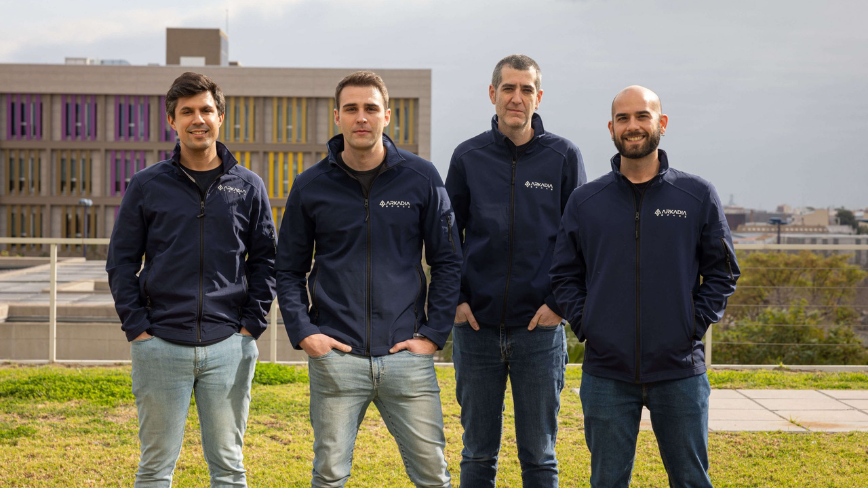

The Spanish propulsion startup at Castellón Airport is the first Spanish space company chosen for the European Innovation Council Accelerator. Its DARK system became the first hydrogen peroxide propulsion system flown in orbit in Europe on a SpaceX mission in March 2025.
Most satellites operating in orbit use hydrazine for propulsion, a fuel that has been standard since the 1960s. Hydrazine is effective, but it is toxic, carcinogenic, flammable, and under strict regulation in Europe. Using hydrazine adds complexity, time, and cost to launch preparations due to the need for specialized facilities and handling.
Arkadia Space, based in eastern Spain, has worked to develop a credible alternative over the past five years. This effort was recognized with €14.5 million in institutional backing from the European Innovation Council Accelerator. The package includes a €2.5 million grant, €6 million in equity from the EIC Fund, and €6 million in private investment, making Arkadia the first Spanish space company to access this funding instrument.
Selected as one of 61 startups from 923 applications, Arkadia’s work is seen as strategically important by Europe. Their system uses a hypergolic bipropellant technique with hydrogen peroxide and a proprietary green fuel. The propellants ignite on contact, eliminating the need for ignition hardware and improving reliability for precise operations.
Arkadia claims their system can cut operational and refuelling costs by over 60% compared to conventional methods due to simpler handling requirements. The technology reached a milestone in March 2025, when the DARK propulsion system flew aboard a D-Orbit ION Satellite Carrier on SpaceX’s Transporter-13 mission, becoming the first of its kind in Europe. By June 2025, the company confirmed successful testing in orbit, matching ground test data. Hydrogen peroxide allows for safer fueling at launch sites, reducing costs and complexity.
Besides DARK, Arkadia developed ARIEL, a 250-newton monopropellant thruster for reaction control systems, through an ESA contract. ARIEL reached technology readiness level six within two years, and Arkadia secured contracts for MaiaSpace’s reusable launch vehicle program.
The EIC funding will aid commercialization, further R&D, infrastructure expansion at Castellón Airport, and scaling operations. CEO Francho García stated the support comes at the right time as they aim for commercial deployment next year and described the technology as a viable alternative to toxic fuels. Arkadia positions itself as a supplier to European space programs aiming to reduce hydrazine reliance.