
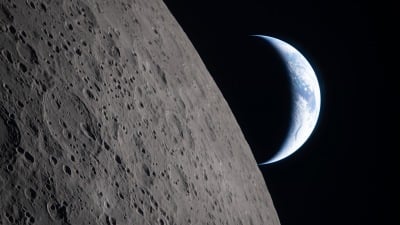

A 21st-century Earthrise image offers a new perspective.
Artemis II astronauts spent Monday circling the moon’s edge with digital cameras, capturing images of craters, an eclipse, and Earth as a blue marble rising and setting in space. Inside NASA’s Orion spacecraft, Commander Reid Wiseman, pilot Victor Glover, and mission specialists Christina Koch and Jeremy Hansen took turns at the windows, observing as if on a first flight.
They spent about seven hours taking shifts on the sixth day of the mission, exchanging lenses, noting surface features, and photographing the far side of the moon. At their closest, they flew within 4,000 miles of the lunar surface, seeing every ridge, crater, and shadow sharply. The astronauts noted that the surface appeared brown rather than gray, with patches of green and white.
The latest Artemis II images surpass the Apollo era. While iconic Earth and moon shots were taken by Apollo crews, Artemis II offers longer views, sharper details, and a closer experience. Their extended look at a total solar eclipse was a contrast to earlier NASA missions’ brief glimpses, illustrating advances in space travel over the decades.
“At one point towards the end of the images of my time in Window 3, I just had an overwhelming sense of being moved by looking at the moon,” Koch remarked.
The moon didn’t remain motionless for its portrait. Sunlight cast long shadows along the terminator, transforming familiar lunar terrain. During Glover’s observation, he was captivated by the boundary’s dramatic appearance.
“There’s just so much magic in the terminator,” he stated, “the islands of light, the valleys that would look like black holes you’d fall straight to the center of the moon if you stepped in.”
The massive Mare Orientale basin, rich with ancient eruptions, unfurled below. The crew humorously suggested naming fresh craters after Wiseman’s late wife and the spacecraft.
The moon obscured Earth briefly as Orion slipped behind it, cutting off signals for about 50 minutes. During this time, the sky turned dark. The astronauts witnessed the moon blotting out the sun in a solar eclipse, with stars, the sun’s corona, and even Venus visible. However, the moon’s backlit presence dominated the view.
After the eclipse, they observed a breathtaking Earthrise, the planet appearing as a pale blue crescent from behind the moon.
NASA reports that these images will help scientists understand how asteroid impacts shape celestial bodies and the moon’s history of crater formation. They also emphasize our planet’s significance.
“The truth is the moon really is its own body in the universe. It’s not just a poster in the sky that goes by,” Koch noted. “When we have that perspective, and we compare it to our home of the Earth, it just reminds us how much we have in common, everything we need, the Earth provides, and that, in and of itself, is somewhat of a miracle.”
Updated April 7, 2026, 2:04 p.m. EDT to include a quote from Victor Glover.