
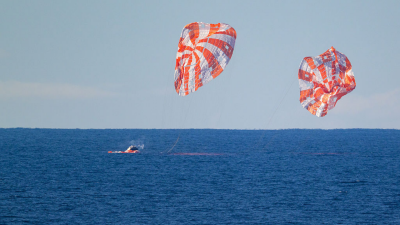

The Artemis II mission successfully concluded with the safe return of its four courageous astronauts.
On April 11, 2026, these astronauts, who participated in NASA’s ten-day mission around the moon—venturing farther into space than any humans before—safely splashed down near their target in the Pacific Ocean, according to NASA.
Reentry was a critical phase, described as the riskiest part of the mission by CNN. NASA’s Abby Graf and Joseph Zakrzewski highlighted the challenges of reentry in a blog post, noting concerns about the ship’s structural integrity.
Traveling at over 24,000 miles per hour (40,000 km/h), the spacecraft formed a plasma fireball with temperatures reaching 2,700 Celsius (4,892 Fahrenheit). Inside, astronauts experienced forces nearly four times their body weight on Earth, according to former astronaut Chris Hadfield.
The NASA livestream of Artemis II’s return, viewed by over 20 million globally, peaked in tension during a six-minute communication blackout caused by the intense reentry heat. This silence was broken by Commander Reid Wiseman’s transmission: “Houston, Integrity here. We hear you loud and clear,” as reported by BBC.
Following reentry, the spacecraft landed 2,000 miles southwest of San Diego’s coast in the Pacific Ocean. The Orion landing capsule used parachutes deployed in a precise sequence to ensure a safe splashdown, described in a NASA brochure.
At splashdown, the parachutes had significantly slowed the capsule, allowing for a gentle ocean landing, captured by CNN. Happening shortly after 5 p.m. PT, NASA commentator Rob Navias described it as a “perfect bull’s-eye splashdown.”
A naval rescue team extracted the astronauts from the floating capsule, transporting them to the USS John P Murtha for medical evaluation, according to NASA’s Jennifer M. Dooren.
To watch the Artemis II mission, including crew interviews, visit NASA’s YouTube page. Alternatively, view the taped livestream or check out Mashable’s photo summary of the splashdown.
Post-mission, NASA and other agencies are focusing on the future, although the crew, called “ambassadors for humanity” by NASA administrator Jared Isaacman, will take time to recover. They will also undergo tests to study adaptation to prolonged weightlessness, detailed by Mashable’s Elisha Sauers.
Looking ahead, Artemis II is seen as the first step in a long-term project to establish a foothold in space, with plans to land humans on the moon, build a lunar base, and eventually send a crewed mission to Mars, as noted by NASA writer Lauren E. Low.
For now, the world celebrates the crew’s safe return, content with the positive outcome.
Reporting by Mashable’s Elisha Sauers and Chris Taylor contributed to this article.