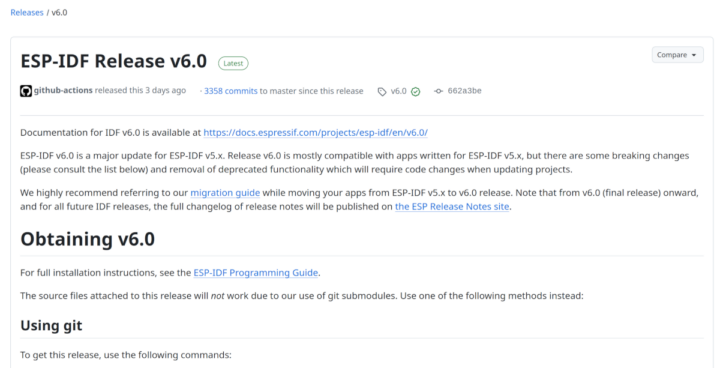
ESP-IDF v6.0 Framework Now Supports ESP32-C5 & C61, Previews ESP32-H21 & H4

ESP-IDF Release v6.0

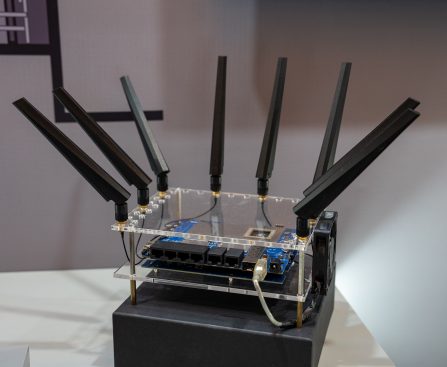
Espressif Systems released the ESP-IDF v6.0 framework a few days ago with stable support for ESP32-C5 and ESP32-C61 SoCs, as well as preview support for ESP32-H21 and ESP32-H4 low-power wireless microcontrollers. The framework also implements a new ESP-IDF Installation Manager (EIM) to make the ESP-IDF installation easier, relies on the low-footprint Picolibc C library, adds security and tooling updates, as well as a few Wi-Fi enhancements, and the ability to update the bootloader over the air. Here are some of the ESP-IDF v6.0 highlights: ESP-IDF Installation Manager – Unified cross-platform tool to simplify the setup process for ESP-IDF and compatible IDEs. It’s available as a graphical interface or a CLI for automation and CI/CD pipelines. You can check the installation instructions for your OS. Picolibc replaces Newlib for a smaller memory footprint and better performance on resource-constrained devices. Check the Newlib vs Picolibc comparison for details. Contrary to some of […]

The post ESP-IDF v6.0 framework adds support for ESP32-C5 and ESP32-C61, preview for ESP32-H21 and ESP32-H4 appeared first on CNX Software – Embedded Systems News.

Enhance AirPods Battery Longevity with an Easy Charging Routine

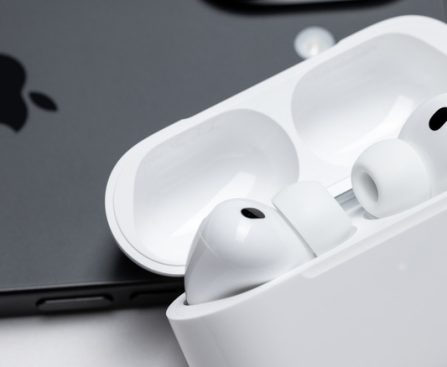
AirPods Pro 3 provides up to eight hours of audio playback on a single charge, with a total of 24 hours available using the charging case. Battery longevity was certainly one of the major aspects we highlighted in our AirPods Pro 3 evaluation, and even when looking back a generation or two, Apple AirPods have a reputation for excellent battery longevity.

Nonetheless, the lithium-ion (Li-ion) batteries found in these AirPods are consumable items, which means they will gradually decrease in charging efficacy over time. Fortunately, there are straightforward methods to extend the battery life of those AirPods, such as ensuring they are charged to the ideal level, but not exceeding it. Apple has even integrated a software feature that can accomplish this for you. Thus, until scientists discover a way to double the lifespan of Li-ion batteries, it’s beneficial to learn how to maximize that battery life through a simple charging routine.

How to preserve battery efficiency in AirPods

EU Broadcasters Push for Regulation of Apple TV and Siri as Gatekeepers Under the Digital Markets Act

A coalition representing commercial broadcasters in Europe has called on the European Commission to broaden its strict Digital Markets Act (DMA) regulations to include smart TVs and virtual assistants. The Association of Commercial Television and Video on Demand Services in Europe (ACT) has pointed out the growing market dominance of firms like Google, Amazon, Apple, and Samsung, advocating that these platforms should be identified as gatekeepers under the DMA.

ACT, which encompasses key broadcasters such as Canal+, RTL, Mediaset, ITV, Paramount+, NBCUniversal, Walt Disney, Warner Bros. Discovery, Sky, and TF1 Groupe, contends that a small number of operators are acquiring the power to shape outcomes for millions of users and businesses by managing access to audiences and content distribution. They stress the importance of the Commission labeling major TV operating systems as gatekeepers to maintain fairness and competitive balance in the market.

The coalition has raised alarms that companies like Apple might have motivations to keep users within their ecosystems, possibly hindering access to content and services. This issue parallels ongoing debates concerning the App Store, which is currently regulated under the DMA. The dynamics between Apple and the EU have been fraught, especially regarding App Store policies, with recent proposals under evaluation for almost a year.

Besides smart TVs, ACT has voiced concerns about virtual assistants, such as Amazon’s Alexa and Apple’s Siri, which have yet to be designated as gatekeepers under the DMA. This absence of classification has created a regulatory void, enabling these influential AI assistants to operate as unofficial gatekeepers for media content across multiple platforms without being bound by DMA requirements.

ACT’s appeal represents a broader initiative for regulatory oversight in the swiftly changing digital environment, striving to ensure that major tech companies do not monopolize access to content and services.

US Government Bans Consumer Routers Manufactured Outside the US

In December, the Federal Communications Commission banned all future drones made in foreign countries from being imported into the United States, unless or until their maker gets an exemption. Now, the FCC has done the exact same for consumer networking gear, citing “an unacceptable risk to the national security of the United States and to […]