NASA’s Experiment to Generate Oxygen from Moon Soil

grow fruit in space with significant labor, but when you’re on the Moon, oxygen isn’t readily available — since there are no trees on the Moon. However, you can utilize the Moon’s soil to produce oxygen through some scientific methods.

In February, NASA revealed that the Carbothermal Reduction Demonstration (CaRD) initiative effectively tested a prototype that harnessed “concentrated solar energy” (also known as sunlight) to extract oxygen from the Moon’s soil, referred to as lunar regolith. The environment was mimicked, but proof of concepts play a crucial role in the scientific process.

The transformation depended on a “carbothermal oxygen production reactor” that heated and melted lunar regolith while combining carbon with the silicate minerals present, resulting in carbon monoxide. The gas was collected and transformed into oxygen using a “downstream system.” While NASA has identified at least 20 theoretical methods to extract oxygen from lunar soil, all of which have been tested in labs, CaRD was the first to showcase its potential in a relatively precise simulated lunar environment.


What Carbothermal Reduction Indicates for the Future of Space Exploration

As per NASA, the Carbothermal oxygen production reactor technique can enhance the organization’s understanding of carbothermal reactions. Researchers think that, when scaled, the technology could “generate multiple times its own weight in oxygen annually.” This will clearly facilitate the long-term sustainability of a lunar colony, but NASA’s perspective encompasses more than just breathable oxygen; scientists propose that oxygen sourced from lunar regolith could be utilized as

Sony Phasing Out Specific PlayStation Network Services

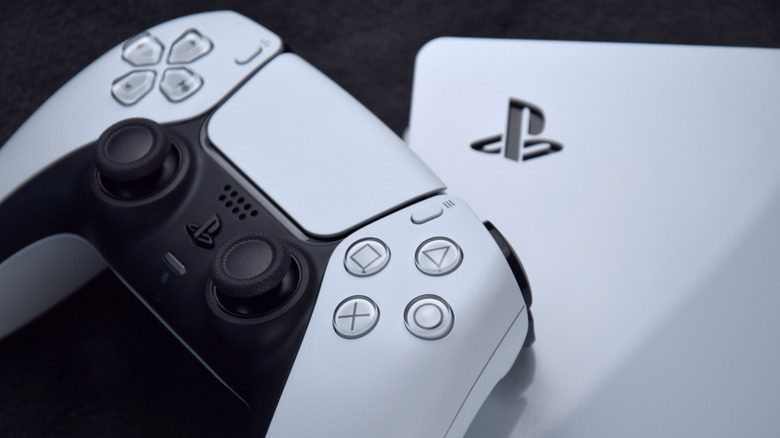
Insider Gaming has reported that Sony developers received an email indicating the company intends to retire the PlayStation Network label as early as this year. While not officially announced, this choice appears to be a marketing strategy rather than a comprehensive overhaul, since Sony asserts that there will be minimal alterations from a technical viewpoint. Nevertheless, this development has sparked speculation that the rebranding is part of Sony’s strategy to transition away from a focus solely on console gaming. Additionally, rumors about the new branding are surfacing.

This information arrives amidst concerns regarding the PlayStation’s future, attributed to component shortages that are increasing prices of devices. While it seems users will still have access to the service for various gaming functions, it will be intriguing to observe how this prospective rebranding resonates with the audience. Given that the service connects millions of players (with Sony having sold over 50 million PS5 units by December 2023), we will keep you informed as more details emerge.

Sony set to introduce new branding for the PlayStation Network

As per reports from an email distributed to Sony developers, the company intends to “phase out” the terms PlayStation Network and PSN from its services to “accurately reflect the range of our advancing digital offerings.” This modification is said to be solely cosmetic, with no immediate plans for technical alterations.

Apple Music Unveils Functionality to Monitor Concerts of Beloved Artists

Apple Music has collaborated with Ticketmaster and Bandsintown to improve the concert discovery journey for its users. This partnership enables Apple Music to highlight forthcoming concerts aligned with users’ listening preferences, offering quick links for ticket purchases.

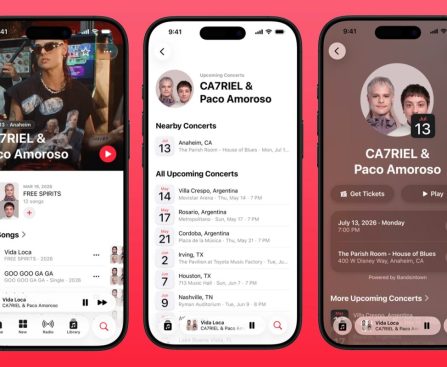
Following the recent iOS 26.4 update, Apple Music has rolled out features that allow users to find shows nearby from artists they follow. Concert dates will now automatically populate on artist profiles and in a new Concerts tab within the Search feature, simplifying the process for fans seeking live music events.

Bandsintown has indicated that artists can leverage the Bandsintown for Artists platform to display concert details in two primary sections on Apple Music: an “Upcoming Concerts” area on artist pages for those touring, and a Concerts Tab where fans can explore events by location, genre, and date. Moreover, venues, festivals, and promoters enrolled in Bandsintown Pro will see their events highlighted on Apple Music.

This integration also permits Apple Music to dispatch push notifications about local events customized to users’ listening habits. The collaboration with Ticketmaster further enriches this experience by building on their existing partnership, which already featured event listings across multiple Apple services. Users can now conveniently purchase tickets directly through a new “Get Tickets” button when viewing concert listings on Apple Music.

To utilize these features, users must have an active Apple Music subscription, priced at $10.99 per month, which includes a one-month free trial.

Three Surprising Ways You Unwittingly Aided AI Training

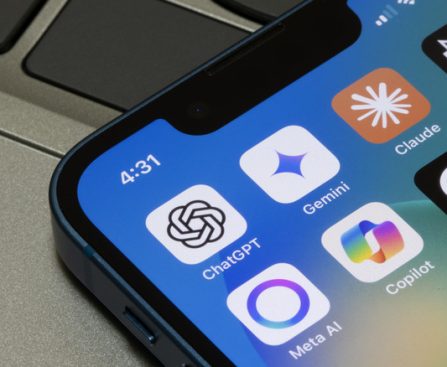
shortage of RAM chips that could lead to an increase in the price of your next smartphone. These firms also require quality data to assist in training their models, and whether you realize it or not, you’re supplying it to them at no cost. Some of the methods by which you are contributing may even astound you.

You likely recognize the evident ways your device usage and online behaviors aid in training AI. When you engage with public content on social media, you’re nourishing the algorithm that decides what to present to you next. By correcting Siri, Alexa, and Google Assistant, you have assisted their creators in enhancing the AI’s speech recognition behaviors. Even while using autocorrect and predictive text in Google Docs or Microsoft Word, you’re instructing the AI on patterns that result in improved grammar and spelling recommendations. However, you might be unaware that tackling an online puzzle, engaging in an augmented reality (AR) game, and even flagging spam could also be utilized to train AI.

Solving a CAPTCHA aids in training self-driving vehicles

Samsung Galaxy Buds 4: Remarkable Attributes Diminished by One Minor Flaw

Fit is always essential, yet it’s even more vital for open-air earbuds that lack ear tips.

Wireless earbuds are available in numerous shapes and styles, but they can be generally categorized into two main form factors — those with ear tips and those without. From a functional perspective, earbuds with ear tips provide a more stable fit, enhanced active noise-canceling effectiveness, and better passive sound isolation. They’re frequently promoted as the superior choice, while some midrange and budget earbuds favor a unibody plastic construction instead.

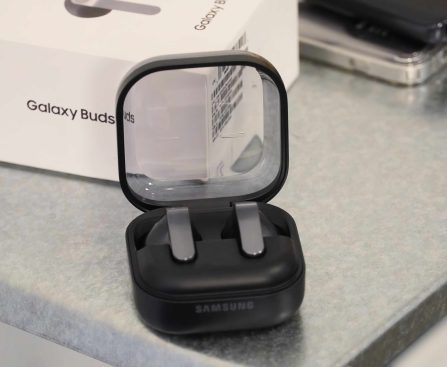
This distinction holds true for Samsung’s latest Galaxy Buds 4 series. The entry-level Galaxy Buds 4, priced at $180, do not come with ear tips. Upgrading to the Galaxy Buds 4 Pro at $250 grants you silicone ear tips and a more thoughtful design that promises improved fit. However, there is slightly more to this narrative — some individuals appreciate the lightweight, unobtrusive, and liberating sensation of earbuds without replaceable tips. Yet, based on my experience with the Galaxy Buds 4, I find myself questioning why anyone would opt for a pair of earbuds lacking silicone or foam ear tips.

To be fair, this could be a concern regarding the form factor itself rather than specifically with the Galaxy Buds 4. The previous Galaxy Buds 3 and the current AirPods 4 feature the same design style, and I would have the same reservations about either variant. Regardless of the cause, the impact seems apparent. This type of earbud probably won’t fit or sound as well, so why choose it?

The Galaxy Buds 4 and Buds 4 Pro are certainly not equivalent

Samsung revamped both the Galaxy Buds 4 and Galaxy Buds 4 Pro this year, yet there’s still a significant factor distinguishing the two models. Beyond audiophile features like driver dimensions or ANC performance, only one model fits entirely in your ear. That’s the Galaxy Buds 4 Pro, which come with silicone ear tips that create a physical seal in your ear canal. Conversely, the standard Galaxy Buds 4 rest just outside your canal.

This parallels the Apple earbuds range, where the AirPods Pro 3 have hybrid silicone/foam ear tips, while the AirPods 4 lack tips altogether. Nevertheless, not every brand organizes its offerings this way. Both of Google’s earbuds, the Pixel Buds Pro 2 and Pixel Buds 2a, incorporate silicone ear tips. Every set of Beats earbuds also features the in-ear design, complete with silicone ear tips. When exploring Google or Beats offerings, you can select products across various price ranges while ensuring a consistent experience throughout.

This, however, does not apply to the Galaxy Buds 4 lineup. Here, you’ll need to assess whether you require buds with ear tips that fully seal off your ear canal. It’s arguably a greater concern, even surpassing price and general feature set.

Galaxy Buds 4 introduce a new design, yet an old issue persists

Let’s delve into the specifics of the Galaxy Buds 4 design, starting with the positives. I appreciated the Galaxy Buds 3 Pro, so I was indeed doubtful about Samsung discarding that design for something entirely fresh here. As it turns out, Samsung made a smart decision. The flat case design and altered earbud aesthetics look fantastic. The square Galaxy Buds 4 wireless charging case feels more portable and compact, making it easy to place the earbuds in when they require charging.

The square Galaxy Buds 4 charging case measures 51x51x28.3mm and weighs just over 45 grams, ensuring it is easily pocketable. While I will miss the blade lights from the Galaxy Buds 3 Pro, the design is now more uniform across the Galaxy Buds 4 and Galaxy Buds 4 Pro. In other words, the visual redesign scores high in my opinion.

Unfortunately, the redesign does not significantly enhance the functionality of the Galaxy Buds, and that’s disappointing. I consider the Galaxy Buds 3 Pro and Galaxy Buds 4 Pro to be among the most comfortable earbuds available, yet the Galaxy Buds 3 and Galaxy Buds 4 tell a completely different story. The earbuds’ rounded shells and absence of silicone ear tips do little to ensure a secure fit within your ear. In my experience, the Galaxy Buds 4 never felt securely positioned.