
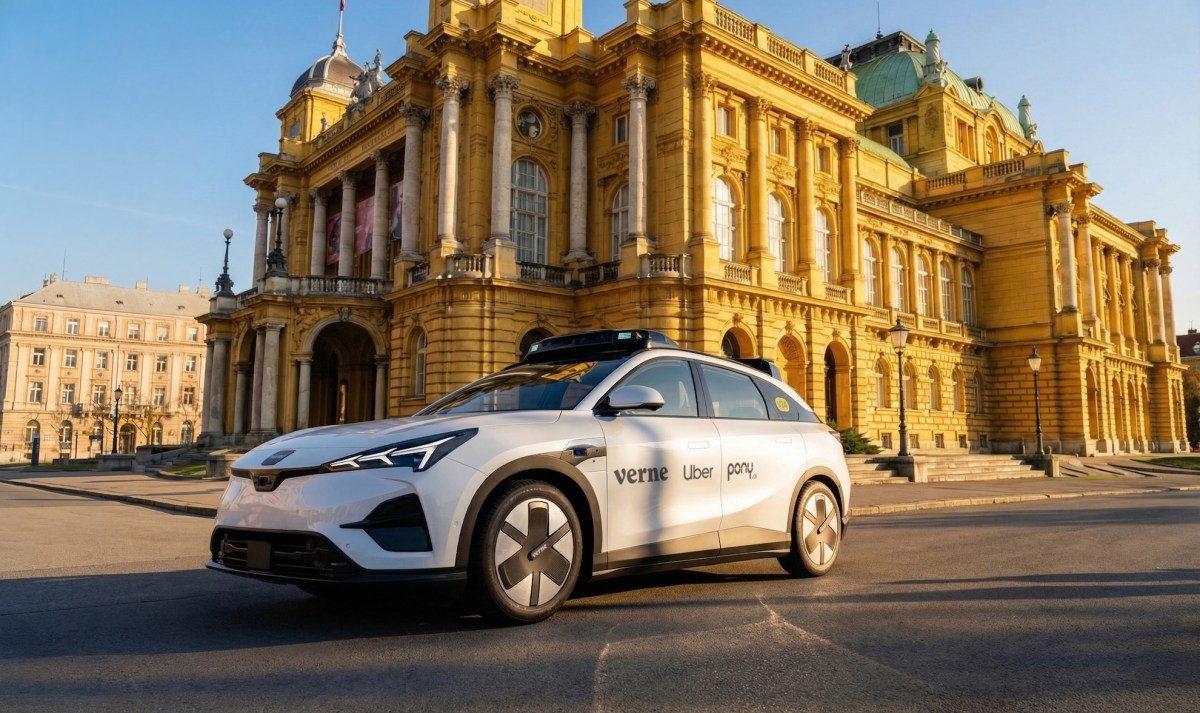

Mate Rimac, founder of Croatian electric vehicle maker Rimac Group, embarked on developing electric robotaxis seven years ago. Now, his vision is partly being realized through a strategic partnership between Uber, Chinese autonomous vehicle company Pony.ai, and his robotaxi startup Verne.
The trio announced plans Thursday to launch a commercial robotaxi service in Europe, beginning in Zagreb, Croatia. Pony.ai will provide the autonomous driving system and a robotaxi called the Arcfox Alpha T5, developed with Chinese automaker BAIC. Verne will own and operate the fleet, while Uber will offer its extensive ride-hailing network.
Uber also plans to invest an undisclosed amount in Verne and support future expansion as a strategic partner.
The companies did not specify a launch date for the service, but road testing in Zagreb—where Rimac Group is headquartered—is already underway.
Verne may not be as well-known as Waymo or Tesla, at least in the U.S., but it shares similarly ambitious goals.
Established in 2019 as Project 3 Mobility (or P3) within Rimac Group, Verne is part of a growing ecosystem that includes hypercar maker Rimac Bugatti, Rimac Energy, and Rimac Technology. Mate Rimac owns a 23% stake in the group.
Updates on the project were sporadic until July 2024, when Verne went public with 100 million euros in funding, revealing more detailed plans.
Rimac’s vision for Verne has always been an urban robotaxi service with purpose-built two-seater electric vehicles. While this may seem a peculiar mission from the creator of the $2.2 million electric hypercar Nevera, Rimac’s interest lies in advancing autonomous vehicle technology, deeming high-volume human-driven EVs obsolete.
“It will take a while, but it’s coming; I’m sure about that,” he previously told me.
Verne is not developing its own self-driving system but focuses on the urban electric vehicle, ride-hailing app, and the back-end infrastructure to manage the fleet, including cleaning and maintenance.
Verne plans to manufacture its robotaxi EVs at a new facility in Lučko, Croatia, set to start operations later this year.
The two-seater vehicles have not yet been launched, and there was no update in the announcement with Uber and Pony.ai. However, in November, the company reported producing and testing 60 verification prototypes.
For now, Verne’s robotaxi service will utilize the Pony.ai-BAIC vehicle, the Arcfox Alpha T5, which users can hail via Uber and Verne’s own app.
Though starting small, Verne aims to scale to a fleet of thousands of robotaxis in the coming years, as revealed in Thursday’s announcement. The company’s ambitions extend beyond Zagreb, Croatia’s capital and home to Rimac Group.
“Europe needs autonomous mobility that can move from testing to a real service,” said Verne CEO Marko Pejkovic in a statement. “At Verne, we are bringing together the technology, platform, and operational capabilities required to make this a reality, starting in Zagreb before expanding to new markets.”