
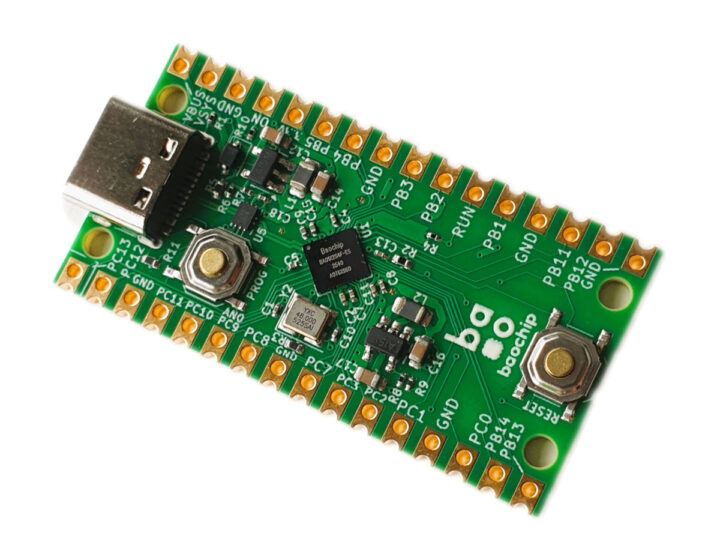

An open-source hardware board typically includes a closed-source microcontroller or processor, but the Dabao evaluation board stands out with the open-source Boachip-1x MCU, complete with accessible RTL files. It is built to be inspectable using the Infra-Red, In Situ (IRIS) technique, enabling users to verify the silicon and ensure the correct chip is used non-destructively.
The Boachip-1x is a general-purpose microcontroller featuring a 350 MHz Vexriscv RV32-IMAC CPU core, a BIO accelerator for I/Os with four 700MHz PicoRV RV32-EMC CPU cores, 4MB of ReRAM, 2MB SRAM, a USB interface, various other I/Os, and hardware security elements such as cryptography accelerators and true random number generation. The Dabao board itself is simple with a microcontroller, two 16-pin headers for I/Os, a USB-C port for power and programming, and buttons for Reset and Prog.
The Dabao board has:
– SoC – Baochip-1x with mostly open RTL
– CPU – 350 MHz Vexriscv RV32-IMAC CPU core with MMU
– Co-processor – 4x 700MHz PicoRV RV32-EMC CPU cores with BIO register extensions
– Memory
– 2MiB on-chip SRAM + 256k I/O SRAM
– 4MiB fast on-chip ReRAM
– Hardware security
– Signed boot
– On-chip ring oscillator-based TRNG
– Key store
– One-way counters
– HW accels: RSA, ECC, ECDSA, X25519, SHA256/512, SHA3, Blake2/3, AES
– Secure mesh, glitch sensors, ECC-protected RAM
– USB – 1x USB high-speed Type-C port
– Expansion – 2x 16-pin headers for 20x I/Os (GPIO, PWM, SPI, UART, I2C, etc.)
– Misc – IRIS inspectable
– Power Supply – 5V via USB-C port
– Dimensions – 41 x 21 mm
Almost everything is open-source. The SystemVerilog and Verilog code for the chip is available on GitHub, as well as the KiCAD files for the Dabao board in another repository. The source code for the bootloader and Rust-based Xous OS with virtual memory for process isolation can be found on betrusted.io.
Since the chip is open-source and can be easily inspected at home with a slightly modified CMOS microscope camera and LED illuminator, the Baochip-1x is suitable for security-focused applications such as password managers and authenticators. Most popular boards like Raspberry Pi Pico 2, ESP32-DevKitC, Teensy 4.1, BBC Micro:bit v2, and Arduino Nano 33 IoT do not offer an open-source RTL chip and are not IRIS inspectable. Few, like the Raspberry Pi Pico 2, come with an open bootloader.
Baochip has launched the Dabao board on Crowd Supply, setting a symbolic $1 funding target. Rewards start at $9.50 for the Dabao Evaluation Board, but supporters can purchase a full reel of 100 boards for $899. Shipping is an additional $10 within the US and $18 internationally, except for the reel reward, which has free US shipping. Deliveries are expected to start by the end of June 2026.